
Gravity Battery: Generate Power by Dropping Weights; A Revolutionary New Energy Invention introduces a novel, eco-friendly energy storage method where power is stored by lifting heavy masses and released by lowering them to generate electricity.
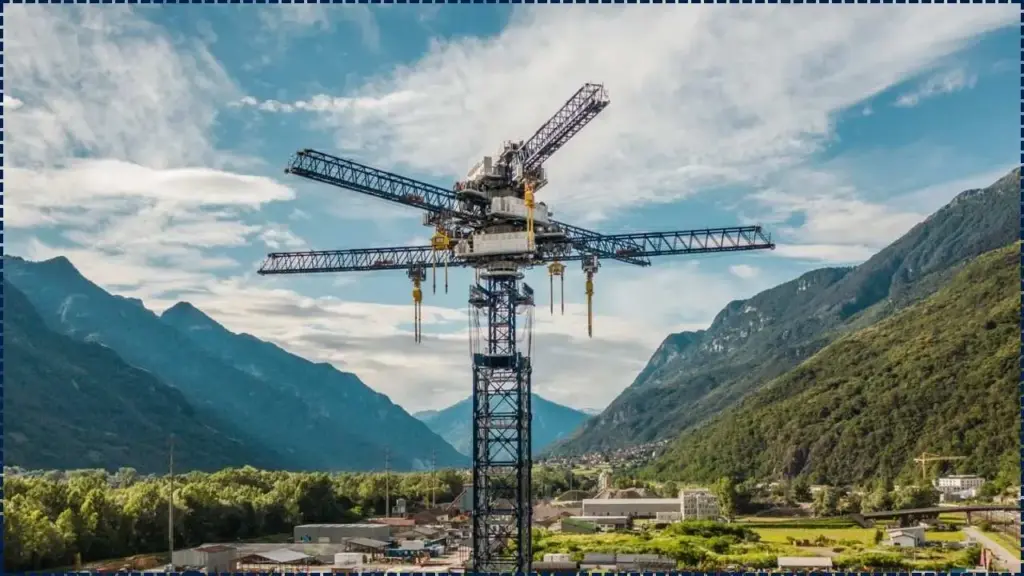
This mechanical solution provides an alternative to traditional chemical batteries, promising a sustainable and durable way to address energy storage challenges.
What Is a Gravity Battery?
A gravity battery is a form of mechanical energy storage where electricity is stored in the form of gravitational potential energy. This method leverages the force of gravity to store and release energy, offering a unique solution for balancing the intermittent supply of renewable energy sources such as solar and wind.
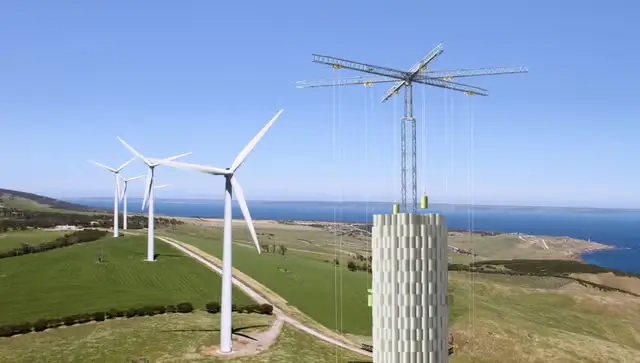
In essence, a gravity battery consists of a system that lifts a mass to a higher elevation when excess electricity is available. This stored energy is then released when needed by lowering the mass, which drives a generator that converts the motion back into electricity.
Gravity batteries contrast sharply with chemical batteries (such as lithium-ion), which rely on chemical reactions to store and release electricity. Instead, gravity-based storage depends solely on mechanical principles of energy conversion.
The fundamental principle behind gravity batteries is expressed by the formula:
E = m × g × h
Where:
- E is the energy stored,
- m is the mass,
- g is the gravitational acceleration,
- h is the height the mass is raised.
This highlights how increasing the mass or the height (or both) directly increases the amount of energy stored.
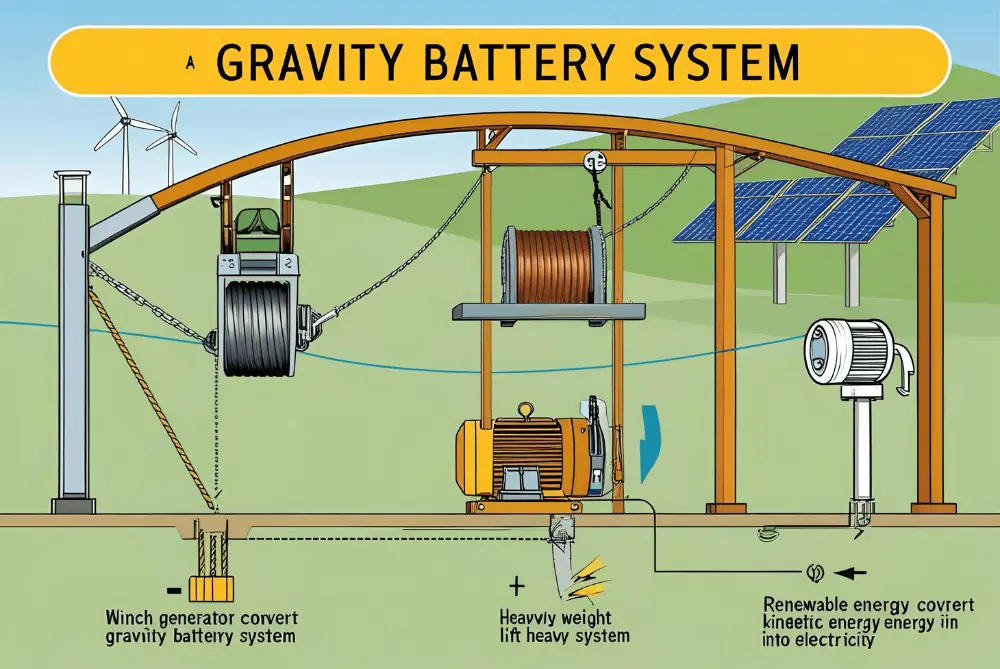
How Do Gravity Batteries Work?
Storing Energy
The energy storage cycle begins when surplus electricity is available (for example, when solar or wind power generation exceeds demand). The system uses this electricity to lift a heavy object (such as a concrete block, large weight, or liquid mass) to a higher point.
The higher the object is raised, the more energy is stored due to the increased gravitational potential energy. The key advantage here is that this process does not depend on chemical reactions, making it environmentally friendly and less resource-intensive.
Releasing Energy
When there is a demand for electricity, the stored energy is released by lowering the mass. As the mass descends, it drives a generator that converts the kinetic energy back into electricity, which is then fed into the grid or used for specific applications.
This cycle can be repeated numerous times, providing a highly efficient way to store and release energy without significant degradation, unlike conventional battery storage.
The speed and efficiency of this process depend on the technology used to lift and lower the mass, as well as the control systems that manage the energy flow.
Advantages of Gravity Batteries
1. Long Lifespan and Durability
Unlike chemical batteries, which degrade over time and lose capacity with repeated charge and discharge cycles, gravity batteries have a much longer operational life. The physical system of lifting and lowering weights experiences minimal wear and tear, allowing the system to operate for decades with minimal degradation.
Energy experts note that this long lifespan reduces the need for costly replacements, providing a more cost-effective solution in the long run.
Mystery Solved! Physicists reveal why Perovskite cells harvest energy with such "insane" efficiency
2. Eco-Friendly Design
Gravity batteries rely on abundant materials like concrete, steel, or other heavy materials, making them significantly less harmful to the environment compared to chemical batteries. They do not require rare minerals like lithium or cobalt, which are both finite and environmentally damaging to mine.
The environmental impact of manufacturing, operating, and disposing of gravity batteries is minimal, making them an attractive option for long-term, sustainable energy storage solutions. (energyvault.com)
3. Scalability
Gravity storage systems are highly scalable. They can range from small, modular systems designed for homes or businesses to large-scale systems that store energy for entire cities or regions. This flexibility allows for customized solutions that can be tailored to meet different energy needs.
In fact, early prototypes have been developed in various regions, showing great promise for large-scale deployment.
4. Cost Efficiency
While the initial installation cost of a gravity battery can be high due to the infrastructure required, such as heavy-duty lifting mechanisms and containment systems, operational costs are typically much lower compared to chemical batteries.
The materials involved are less expensive, and the low maintenance costs over the system’s lifespan make it a financially viable solution for many applications.
Global Deployment and Research
Energy Vault and Gravitricity
Two leading companies, Energy Vault and Gravitricity, are at the forefront of gravity battery technology. Energy Vault has created a modular, crane-based system that uses composite bricks to store energy, while Gravitricity is developing a vertical weight-lifting system that operates in deep mine shafts.
Both companies are testing large-scale systems capable of generating and storing several megawatt-hours (MWh) of electricity. Early results from pilot projects have been promising, with systems demonstrating efficient storage and fast release of energy.
These projects showcase the growing interest and potential of gravity batteries in solving modern energy challenges.
Research Advancements
Universities and energy think tanks are also contributing to gravity battery research. Some studies focus on optimizing materials for better energy density and lowering the cost of construction. Universities in Europe and North America are testing different weight types, including water, steel, and concrete, to identify the most efficient combinations for large-scale use.
Limitations and Challenges
1. Energy Density and Space Requirements
One of the main challenges with gravity batteries is their relatively low energy density compared to chemical batteries. This means that the volume or mass of the system required to store large amounts of energy can be quite large.
To store significant energy, systems must be designed with substantial physical space, and the mass needs to be lifted over considerable heights. This requirement can make gravity batteries less viable in densely populated areas where land is scarce.
2. Initial Infrastructure Cost
While operational costs are low, the initial cost to build the infrastructure for gravity batteries — such as the lifting towers, mass, and mechanical systems — can be substantial. This investment can be a barrier to large-scale deployment unless systems are efficiently designed and the technology matures.
3. Technology Maturity
Gravity battery technology is still in its early stages. While several successful prototypes and pilot projects have been demonstrated, the technology is not yet deployed at large commercial scales. More research and development are needed to optimize designs for better efficiency and cost-effectiveness.
Comparing Gravity Batteries With Other Storage Technologies
Gravity vs Lithium-Ion Batteries
- Lifespan: Gravity systems can last decades with minimal capacity loss; lithium‑ion batteries degrade with use.
- Environmental Impact: Gravity storage avoids rare minerals and toxic chemicals inherent in batteries.
- Energy Density: Batteries store more energy per unit volume, making them better for compact storage needs.
Gravity vs Pumped Hydro
- Geography: Pumped hydro requires suitable elevation and water resources; gravity systems can be built on non‑hydro sites.
- Scale: Pumped hydro dominates large‑scale storage, while gravity designs are still emerging in grid applications. (en.wikipedia.org)
Experts increasingly view gravity storage as complementary to other technologies rather than a universal replacement. It is likely to occupy niches where rapid response and long life are priorities, while batteries and hydro continue to serve other energy storage purposes.
Real‑World and Future Applications
Grid Stabilisation
Gravity batteries could play a significant role stabilising grids with high renewable penetration, absorbing excess power and delivering it when demand spikes. This function is critical in countries rapidly adding wind and solar capacity.
Long‑Duration Storage
For longer duration storage — multiple hours or days — gravity systems may need to be larger or integrated with other storage modes. Research continues on hybrid solutions combining gravity storage with batteries or pumped hydro.
Renewable Integration
Gravity energy storage can aid integration of intermittent renewable sources by buffering output and smoothing supply variations, making grid operations more reliable.
Related Links
Solar Tiles: Replace Panels with ‘Solar Tiles’; Beautiful Roofs That Generate Free Power.
Tidal Power: India’s First Tidal Station in Gulf of Kutch; Clean Energy from Waves.
Gravity batteries represent an exciting and environmentally friendly energy storage solution that could help address the growing need for sustainable energy storage. By using gravitational potential energy, gravity batteries offer low operational costs, long lifespans, and minimal environmental impact compared to chemical battery systems.
However, their lower energy density and high initial costs remain challenges that need to be addressed before they can become a mainstream solution. Ongoing research and technological advancements will be key to scaling gravity batteries and making them an essential component of the global energy transition.
As the world increasingly turns to renewable energy, gravity batteries could play a significant role in ensuring grid stability, renewable integration, and energy security.