

Global renewable energy markets rallied sharply after the announcement of a new U.S.–India solar pact, lifting investor confidence across the The US-India Solar Pact sector.

The agreement, which eases certain trade barriers on solar modules and components, has fuelled optimism about export growth, stronger supply chains, and improved margins for manufacturers in India, the United States, and beyond.
Understanding the The US-India Solar Pact Momentum
The newly announced U.S.–India solar pact represents a strategic adjustment in trade relations between two of the world’s largest democracies. According to official statements from the Office of the United States Trade Representative (USTR) and India’s Ministry of Commerce and Industry, the understanding includes tariff rationalisation on select solar cells, modules, and related clean energy equipment.
Although detailed tariff schedules are yet to be fully disclosed, both governments described the measure as part of broader economic cooperation. Officials highlighted its potential to strengthen renewable energy supply chains and promote clean technology exchange.
For financial markets, the implications are immediate. The United States is one of the world’s largest solar installation markets. Any reduction in trade friction directly affects export competitiveness and revenue visibility for Indian manufacturers.
The The US-India Solar Pact rally reflects expectations that lower tariffs will improve pricing power and order volumes in the near term.
Stock Market Reaction Across Regions
Indian solar and renewable energy stocks recorded strong gains following the announcement. Companies engaged in module manufacturing, EPC services, and solar infrastructure development saw heightened trading activity.
In the United States, clean energy equities also moved higher, with investors interpreting the pact as a stabilising factor in global supply chains. European and Asian renewable indices followed suit.
According to market analysts, the rally stems from improved earnings visibility. “Trade certainty reduces risk premiums in export-oriented sectors,” said a senior equity analyst at a Mumbai brokerage. “Investors are responding to the prospect of improved order flows and margin expansion.”
The gains were broad-based rather than isolated to a single company, signalling sector-wide optimism.
Why Solar Stocks React Strongly to Trade Deals
Export-Driven Growth
India’s solar manufacturing capacity has expanded significantly under government incentive schemes. However, domestic demand alone does not absorb total output.
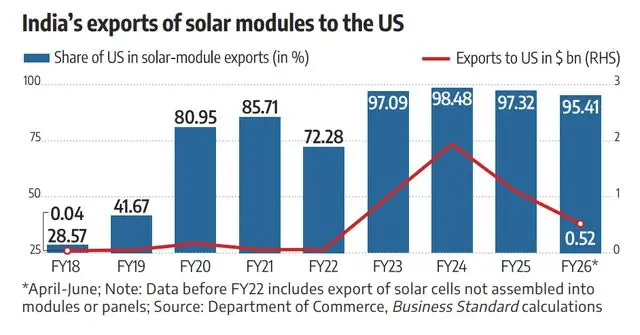
According to data from the Ministry of New and Renewable Energy (MNRE), exports have become critical in sustaining production levels. The United States is among India’s largest solar export markets. Lower trade barriers under the U.S.–India solar pact could strengthen this export pipeline.
Thin Margins and Price Sensitivity
Solar module manufacturing operates on relatively narrow margins. Even modest tariff changes can materially influence competitiveness. Analysts explain that predictable trade conditions enable companies to secure long-term contracts and manage production more efficiently.
Investor Confidence and Policy Signals
Financial markets interpret bilateral trade agreements as signals of political and economic alignment. In capital-intensive sectors like renewable energy, policy stability can boost valuation multiples.
The The US-India Solar Pact optimism is therefore linked not only to tariffs but also to perceived strategic cooperation.
Broader Policy Context in India
India has committed to expanding renewable energy capacity to meet climate targets and reduce fossil fuel dependence. The government introduced Production-Linked Incentive (PLI) schemes to encourage high-efficiency solar module manufacturing.
These initiatives aim to reduce reliance on imports and build domestic value chains. Industry experts suggest the U.S.–India solar pact complements this strategy by opening external markets.
A senior official at the Solar Energy Corporation of India (SECI) recently stated that stable export demand “supports scale economies and technology upgrades.”

However, analysts caution that overdependence on exports could expose manufacturers to geopolitical shifts.
U.S. Industrial Policy and Competitive Dynamics
The United States has simultaneously pursued domestic solar manufacturing under federal incentive programmes such as the Inflation Reduction Act (IRA). These incentives aim to expand local production and create jobs.
The coexistence of domestic support and international cooperation may create both synergy and competition. American policymakers continue to emphasise supply chain resilience and local employment.
Energy economist Dr. Ananya Rao said, “Trade openness can coexist with domestic industrial policy. The outcome depends on how integrated supply chains become over time.”
China remains the dominant global solar supplier, controlling large segments of polysilicon and wafer production. Any shift in U.S.–India trade flows could subtly reshape global competitive patterns.
Impact on Supply Chains and Manufacturing
The solar value chain includes raw materials such as polysilicon, wafers, cells, and finished modules. Stability in trade policy reduces disruptions across these interconnected stages.
Industry bodies have previously warned that abrupt tariff changes complicate procurement planning. The U.S.–India solar pact may reduce such uncertainty.
However, challenges remain. Raw material price fluctuations, logistics constraints, and certification requirements continue to affect competitiveness.
Experts emphasise that while the The US-India Solar Pact rally reflects optimism, long-term sustainability depends on supply chain resilience.
Renewable Energy Transition and Climate Goals
From a policy standpoint, expanded cooperation aligns with climate objectives in both countries. India has pledged to expand renewable capacity significantly in the coming decade. The United States has set decarbonisation targets through federal legislation.
Lower trade barriers can reduce installation costs, accelerate deployment, and support emissions reduction efforts.
Environmental advocates have welcomed measures that strengthen clean energy collaboration but emphasise the importance of responsible manufacturing and recycling frameworks.
Employment and Investment Implications
Improved export visibility may encourage companies to expand manufacturing capacity. This could generate employment in engineering, logistics, and quality control.

State governments in India have actively courted renewable manufacturing investments. Expanded trade access may influence decisions regarding factory expansion and new project development.
Financial institutions may also respond positively, given improved demand projections.
Risks and Market Caution
Despite the surge, uncertainties remain. Full implementation details of the U.S.–India solar pact will determine actual commercial benefits.
Currency volatility, global oversupply, and evolving subsidy regimes could affect profitability. Analysts note that rapid capacity expansion without balanced demand may pressure prices.
The The US-India Solar Pact rally therefore represents renewed optimism rather than guaranteed structural change.

Strategic Significance for Global Energy Markets
The U.S.–India solar pact signals deeper economic cooperation between two major energy markets. By reducing trade friction, both sides aim to strengthen clean energy supply chains.
For investors, the immediate takeaway is improved visibility in export markets and greater policy clarity. For policymakers, the agreement represents a step toward coordinated energy transition efforts.
If successfully implemented, the pact could support sustained growth in renewable deployment and manufacturing.
Related Links
E-Waste to Energy: Turning Old Laptop Batteries into Power Banks; A Massive Business Idea.
The U.S.–India solar pact has sparked a broad rally in global solar stocks by easing trade barriers and boosting export expectations. The The US-India Solar Pact surge reflects investor confidence in stronger margins, improved order pipelines, and enhanced supply chain cooperation.
However, sustained performance will depend on policy clarity, competitive positioning, and global demand growth.
As implementation details emerge, markets will assess whether optimism translates into durable earnings expansion.