Shares of Waaree Energies and Premier Energies fell up to 14% after the United States imposed a preliminary 126% countervailing duty on certain Indian solar imports.

The sharp reaction in the Waaree and Premier Energies Plunge solar stocks reflects investor concern over export exposure, earnings visibility and global trade risk at a critical stage in India’s renewable expansion.
What Triggered the 126% Duty?
The U.S. Department of Commerce announced preliminary countervailing duties of 125.87% on certain solar equipment imports from India, citing alleged unfair government subsidies. The decision follows a petition filed by U.S.-based manufacturers seeking protection from lower-priced imports.
According to official filings referenced in financial media, the investigation is part of broader trade enforcement measures aimed at safeguarding domestic solar manufacturing under U.S. industrial policy initiatives.
Countervailing duties are imposed when imported goods are deemed to benefit from state subsidies that distort pricing. The 126% rate, if upheld in final determination, would significantly increase the landed cost of Indian modules in the U.S. market.
Immediate Market Reaction in India
Both Waaree Energies and Premier Energies saw sharp declines on domestic exchanges following the announcement. Market data showed intraday losses of around 14%, with heavy trading volumes.
Broader renewable energy counters also experienced selling pressure, though to a lesser extent. Analysts noted that export-focused companies bore the brunt of the reaction.
The decline reflects uncertainty rather than confirmed earnings loss. However, investors are factoring in the risk that U.S. revenue could decline materially if the tariff remains in place.
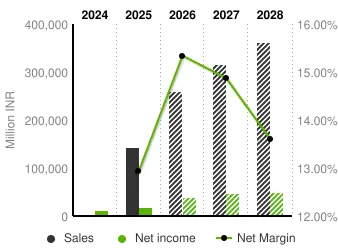
How Exposed Are Waaree and Premier Energies?
Waaree Energies
Waaree has historically maintained meaningful export exposure, including shipments to the United States. The company has also announced plans to expand overseas manufacturing capacity to mitigate trade barriers.
Industry analysts note that localisation of manufacturing in the U.S. could partially offset tariff risks, though execution timelines and capital expenditure requirements remain key variables.
Premier Energies
Premier Energies has comparatively higher domestic revenue exposure, but it also participates in export markets. The company’s diversification into modules and cells gives it operational flexibility, though export margins may face pressure.
Brokerage research prior to the tariff announcement had already highlighted competitive pricing pressures and margin sensitivity in global markets.
Why the 126% Duty Is Significant
A tariff of this magnitude can render exports economically unviable unless alternative pricing structures or manufacturing arrangements are implemented.
To understand the scale: a module priced at $100 would effectively cost over $225 after duty, making it difficult to compete in a price-sensitive market.
The U.S. remains one of the largest solar markets globally. According to the International Energy Agency (IEA), solar installations in the U.S. continue to grow under federal clean energy incentives.
Losing cost competitiveness in such a market could impact revenue forecasts and order pipelines for Indian manufacturers.
Domestic Cushion: India’s Renewable Push
India’s renewable energy ambitions remain strong. The government has reiterated its commitment to reaching 500 GW of non-fossil capacity by 2030.
The Ministry of New and Renewable Energy (MNRE) has supported domestic manufacturing through production-linked incentive (PLI) schemes. These initiatives aim to reduce import dependency and strengthen India’s supply chain.
Domestic solar installations continue to expand under schemes such as rooftop solar incentives and utility-scale projects. This internal demand could cushion export setbacks to some extent.
Trade Policy Uncertainty and Final Determination
It is important to note that the 126% duty is preliminary. Final determinations typically follow additional investigation and stakeholder submissions.
Trade cases can also be subject to appeals or diplomatic engagement. In past global solar disputes, tariff rates have sometimes been adjusted following review. Investors should distinguish between preliminary actions and final, legally binding outcomes.
Broader Implications for the Solar Sector
1. Supply Chain Diversification
Global solar supply chains are undergoing structural change. Countries are seeking to reduce overdependence on a single geography.
Indian manufacturers have benefited from diversification trends away from Chinese dominance. However, increased scrutiny also exposes them to new trade risks.
2. Manufacturing Localisation Strategy
Several Indian firms have announced overseas manufacturing facilities to benefit from local subsidies and avoid tariffs. If Waaree and others accelerate U.S.-based production, tariff impact could reduce over time. However, capital investment and regulatory approvals may delay relief.
3. Margin Compression Risk
Even if exports continue, pricing adjustments may compress margins. Companies may need to absorb part of the tariff burden to maintain market share. This could affect earnings guidance and valuation multiples.
What Should Investors Do?
Short-Term Investors
Short-term traders should expect volatility. News-driven price swings may continue until clarity emerges. Risk management and stop-loss discipline become important in such conditions.
Long-Term Investors
Long-term investors should assess:
- Export revenue proportion
- Order book visibility
- Balance sheet strength
- Diversification into domestic markets
- Capital expenditure plans
If companies successfully localise production or shift markets, earnings recovery could follow.
Portfolio Diversification
Financial advisers generally recommend diversification to manage sector-specific shocks. Investors heavily exposed to a single renewable sub-sector may consider balancing allocations.
Expert Perspectives
Market strategists caution against reactive decisions. One senior equity strategist at a Mumbai-based brokerage said during a television interview that “trade shocks often create temporary dislocations, but investors must examine structural demand trends before concluding long-term damage.”
Renewable energy remains a global growth theme driven by decarbonisation goals. However, policy risk is intrinsic to the sector.
Currency and Macro Considerations
Exchange rate movements may also influence impact. A weaker rupee can partially offset export price pressures, though not enough to neutralise a 126% tariff.
Global interest rates and funding conditions also matter, as solar manufacturing is capital-intensive. Higher borrowing costs can amplify stress during revenue disruptions.

Valuation Perspective
Before the tariff news, both stocks had witnessed strong investor interest amid renewable enthusiasm. The correction raises valuation questions. If earnings estimates are revised downward, price-to-earnings multiples may adjust accordingly.
Investors should review updated analyst reports once companies provide management commentary.
Related Links
Hydrogen Heroes: The top 3 companies that will dominate India’s Green Hydrogen Mission by 2030
Monitoring Key Developments
Investors should track:
- Final U.S. duty decision
- Company statements and earnings calls
- Any U.S.-India trade dialogue
- Manufacturing expansion updates
- Quarterly export data
Clarity on these variables will shape market direction.
The 126% preliminary duty imposed by the United States has triggered sharp declines in Waaree Energies and Premier Energies, highlighting the vulnerability of export-linked Waaree and Premier Energies Plunge stocks to global trade policy shifts.
While short-term volatility is likely, the long-term outlook depends on final tariff decisions, domestic demand strength and strategic responses from companies. Investors should focus on fundamentals, diversification and disciplined risk management rather than reacting solely to headlines.