Researchers in Germany have developed a molecular system described as a “solar battery” that captures sunlight, stores the energy chemically for days, and later converts it into hydrogen fuel on demand.
The experimental technology, created by scientists at Ulm University and Friedrich Schiller University Jena, offers a new pathway for renewable energy storage that separates sunlight capture from hydrogen production.
The innovation addresses a central challenge in the clean energy transition: how to store intermittent solar energy in a stable and transportable form.
New ‘Solar Battery’ Converts Sunlight into Hydrogen
| Key Fact | Detail |
|---|---|
| Innovation | Molecular solar battery storing sunlight chemically |
| Output | Hydrogen produced without continuous sunlight |
| Efficiency | ~72% hydrogen evolution efficiency (lab-scale) |
| Storage Duration | Energy retained for multiple days |
A Solar Battery at the Molecular Level
The New ‘Solar Battery’ refers to a chemical system that functions both as a light absorber and an energy storage medium. Unlike traditional photovoltaic panels that generate electricity instantly, this solar battery stores absorbed solar energy within molecular bonds.
Professor Sven Rau, head of the Institute of Inorganic Chemistry I at Ulm University, explained in a university statement that the system effectively “combines a solar cell and a battery in one molecular structure.”
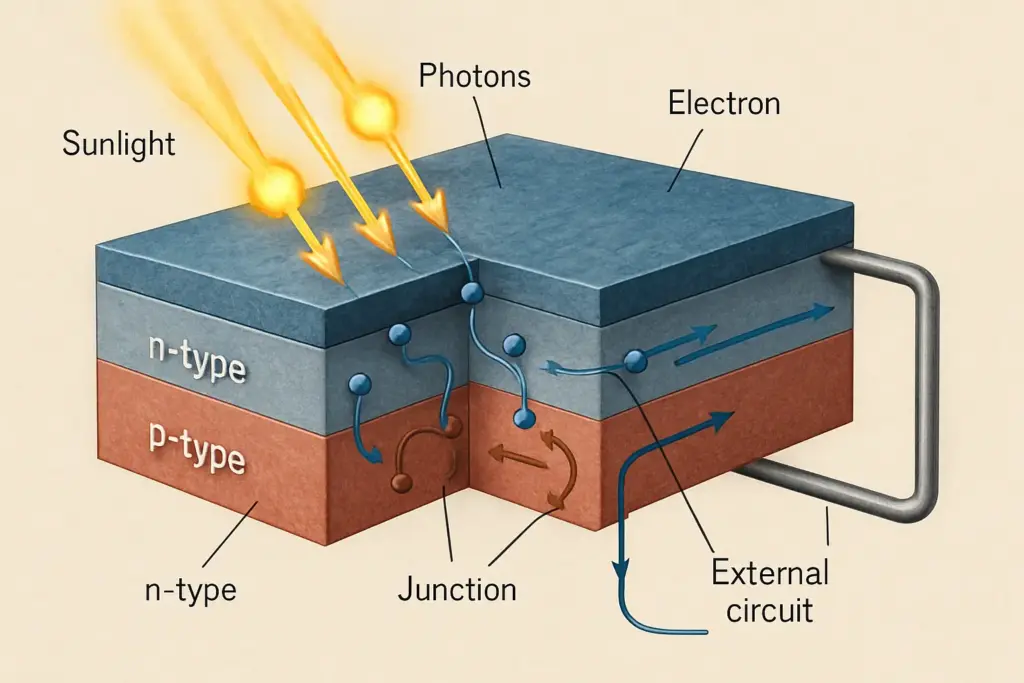
When illuminated, the polymer material undergoes a reversible redox reaction. It absorbs photons and stores electrons in a reduced chemical state. The energy remains trapped in the material until deliberately released.
This differs from standard photocatalytic hydrogen production, which requires sunlight at the moment hydrogen is generated.
How the System Converts Sunlight into Hydrogen
Light Absorption and Chemical Charging
The system uses a specially designed water-soluble, redox-active copolymer. When exposed to sunlight, the polymer absorbs energy and stores it as high-energy electrons within its molecular framework.
Laboratory experiments show that the charged state remains stable for several days without substantial energy loss. This decoupling of capture and release is considered the most significant feature of the technology.
Hydrogen Release on Demand
To generate hydrogen, researchers introduce an acid and a hydrogen evolution catalyst to the charged polymer solution. The stored electrons combine with protons to form hydrogen gas.
The reported hydrogen evolution efficiency is approximately 72 percent under controlled laboratory conditions.
Professor Ulrich S. Schubert, co-author of the study, stated that the system can be reset by adjusting pH levels, enabling repeated charging cycles without isolating the polymer.The solution visibly changes color during charging and discharging, offering a simple indicator of its energy state.
Why Hydrogen Matters in the Energy Transition
Hydrogen is increasingly viewed as a critical component of global decarbonization strategies. According to the International Energy Agency (IEA), global hydrogen demand reached approximately 95 million tonnes in 2022, with most production still derived from fossil fuels.
Green hydrogen, produced using renewable energy, emits no carbon dioxide during production or use. It is seen as essential for decarbonizing heavy industry, long-haul transport, and chemical manufacturing. However, hydrogen production depends heavily on reliable renewable energy storage.
Comparing This Solar Battery to Electrolysis
The dominant method for green hydrogen production today is water electrolysis powered by renewable electricity. According to the U.S. Department of Energy, modern electrolyzers achieve efficiencies between 60 and 80 percent.
The molecular solar battery operates at comparable laboratory efficiency but integrates solar capture and storage within a single chemical material.
Dr. Anya Sharma, an independent energy systems analyst, commented during a public research forum, “Reducing conversion steps could theoretically improve system efficiency, but industrial feasibility depends on scale, cost, and durability.”
Electrolysis systems are already commercial, while the solar battery remains experimental.

Grid-Tied, Off-Grid या Hybrid Solar System – आपके घर या ऑफिस के लिए कौन है बेस्ट ऑप्शन? जानिए फर्क
Potential Advantages
Long-Duration Storage
Unlike lithium-ion batteries, which are optimized for short-term storage, chemical storage systems may retain energy over longer periods without significant self-discharge.
Reduced Infrastructure Complexity
By storing energy chemically at the molecular level, the system could reduce dependence on separate photovoltaic arrays, battery packs, and electrolyzers.
Flexibility
Hydrogen can be stored, transported, or converted into electricity through fuel cells, offering cross-sector energy use.
Challenges and Commercialization Barriers
Scaling Laboratory Materials
The polymer system must be produced economically at industrial volumes. Synthetic complexity may affect cost competitiveness.
Durability and Cycling
Long-term stability across thousands of charge-discharge cycles remains untested. Industrial systems must maintain performance over years.
Safety and Regulation
Hydrogen production and storage require strict safety protocols. Any new production technology must meet international safety standards.
Catalyst Availability
Hydrogen evolution catalysts often use rare or precious metals. Scaling may require alternative catalyst materials.
Funding and Research Context
The project forms part of Germany’s Transregional Collaborative Research Centre “CataLight,” funded by the German Research Foundation. The initiative focuses on sustainable photocatalysis and chemical energy systems.
Public research funding plays a significant role in advancing early-stage technologies that may not yet attract private capital.
Energy economists note that early government support often precedes commercial deployment of renewable technologies.
Global Hydrogen Market Implications
The European Union, United States, Japan, and South Korea have published national hydrogen strategies. The U.S. Inflation Reduction Act includes incentives for clean hydrogen production, including tax credits tied to carbon intensity.
If scalable, chemical solar battery systems could complement electrolyzers in regions with abundant sunlight but limited grid infrastructure.

However, industrial adoption would require cost parity with existing hydrogen production methods.
Environmental Lifecycle Considerations
Hydrogen combustion produces only water vapor. However, lifecycle assessments must account for polymer production, catalyst materials, and disposal processes.
Researchers indicate that further environmental impact studies are planned. Experts stress that sustainable material sourcing and recyclability must be addressed before commercialization.

Expert Perspectives: Optimism and Caution
Energy researchers view the molecular solar battery as scientifically significant but emphasize caution.
“Decoupling sunlight absorption from hydrogen generation is conceptually powerful,” said Dr. Sharma. “But industrial hydrogen production requires systems that operate reliably at scale and at competitive cost.”
Independent analysts note that early laboratory breakthroughs often require years of engineering refinement.
Related Links
Mystery Solved! Physicists reveal why Perovskite cells harvest energy with such “insane” efficiency
Broader Energy System Impact
Long-duration storage remains one of the most pressing challenges in renewable energy systems. While grid-scale batteries dominate short-term storage markets, chemical carriers such as hydrogen may support seasonal storage or industrial demand.
The molecular solar battery contributes to expanding the technological toolkit available for renewable integration.
Researchers plan further optimization to improve energy density, catalyst efficiency, and long-term cycling stability.Industrial partnerships may be necessary to evaluate scale-up pathways.
If future testing confirms durability and economic viability, the technology could complement existing hydrogen production methods. For now, the molecular solar battery remains a laboratory innovation with potential implications for future renewable energy systems.