A new recycling start-up says it can recover up to 99% of the silver embedded in aging solar panels, transforming decades-old rooftop installations into valuable sources of precious metals.
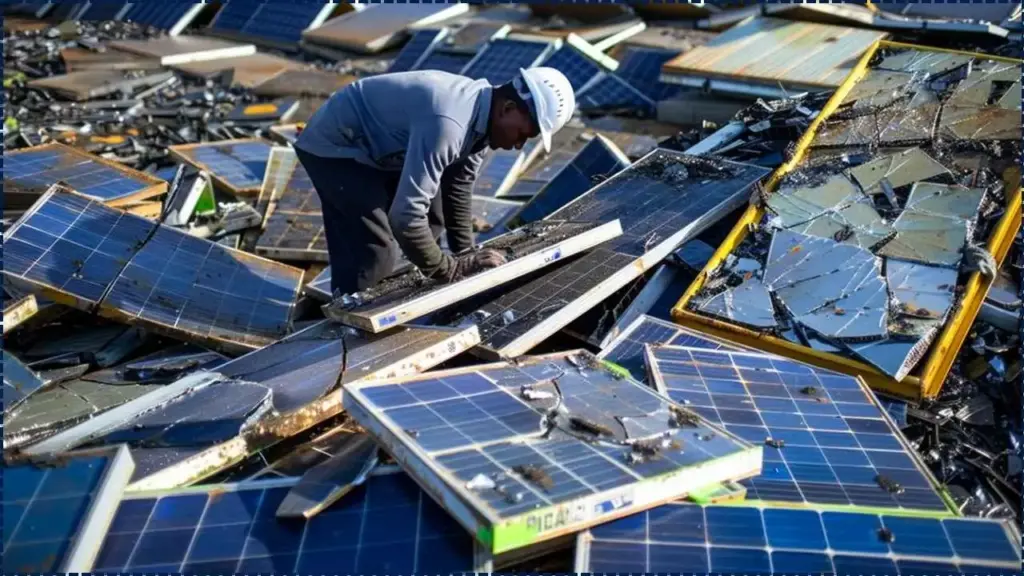
The approach, often described as Mining the Roof urban mining, arrives as millions of early solar panels approach retirement and governments confront a growing wave of solar waste.
Mining the Roof
| Key Fact | Detail / Statistic |
|---|---|
| Silver in solar panels | Each panel contains roughly 15–20 grams of silver used in electrical contacts |
| Solar waste projection | Global solar waste may reach 60–78 million metric tons by 2050 |
| Recycling breakthrough | New methods claim up to 99% silver recovery from retired photovoltaic panels |
| Circular economy potential | Recycled solar materials could generate billions in economic value |
The Rise of Mining the Roof Urban Mining
The concept known as Mining the Roof refers to extracting valuable materials from existing infrastructure instead of mining them from natural deposits. In the case of solar energy systems, that infrastructure includes rooftop arrays and large solar farms installed decades ago.
Solar power expanded rapidly beginning in the early 2000s. Many of those early installations are now approaching the end of their expected 25- to 30-year lifespan.
According to the International Renewable Energy Agency (IRENA), the world could accumulate tens of millions of tons of discarded solar panels in the coming decades.
“Solar panels were designed to last for decades, but eventually they must be replaced,” said Dr. Garvin Heath, a senior analyst at the U.S. National Renewable Energy Laboratory (NREL). “When that happens, the materials inside them represent a significant resource that should not be wasted.”
Why Solar Panels Contain Valuable Silver
Photovoltaic cells convert sunlight into electricity using semiconducting materials such as silicon. Silver plays a key role in this process.
Thin lines of silver paste are printed onto solar cells to form electrical contacts that collect and transport generated electricity. Because silver is one of the best electrical conductors known, it ensures efficient energy transfer.
Although the amount of silver per panel is relatively small, the scale of solar deployment makes it important.
The International Energy Agency (IEA) estimates that a standard crystalline silicon panel contains approximately 15 to 20 grams of silver. When multiplied by hundreds of millions of panels worldwide, the cumulative metal content becomes substantial.
“As solar capacity expands, the demand for materials like silver also increases,” the IEA noted in its renewable energy market report. Recycling old panels could help offset part of that demand.
How the New Recycling Technology Works
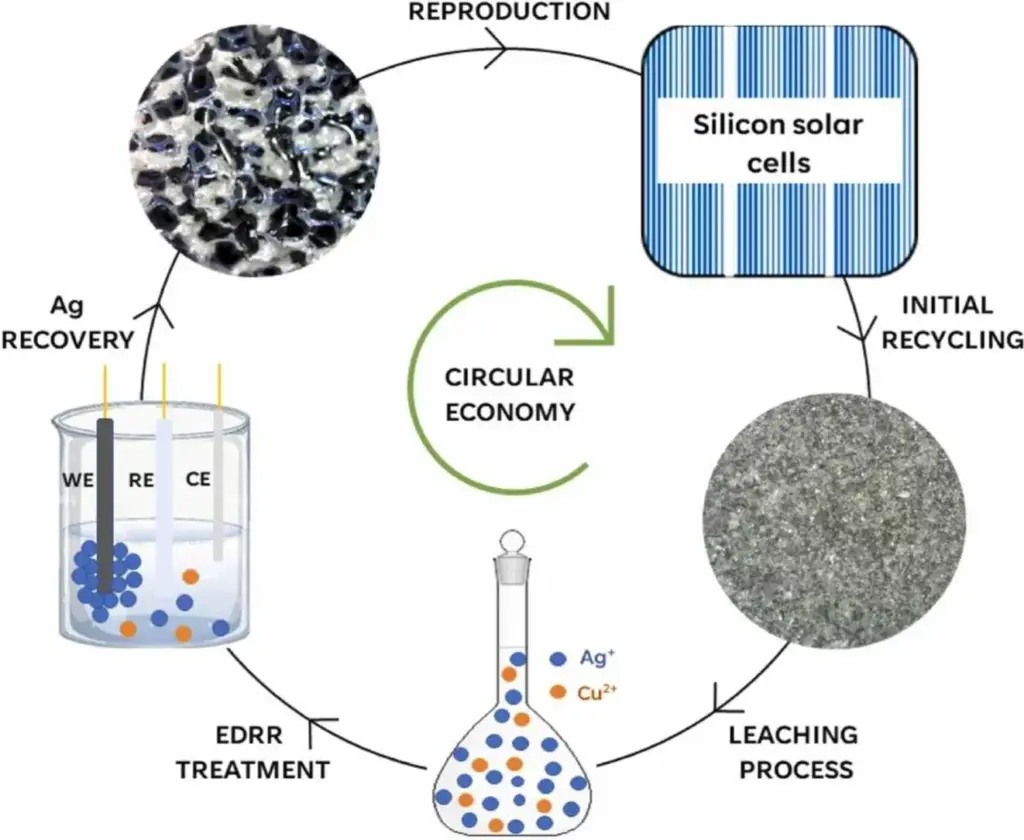
The new start-up’s process combines several industrial techniques designed to isolate and extract valuable metals from photovoltaic modules.
Traditional recycling methods often focus primarily on recovering glass and aluminum, which make up most of a solar panel’s weight. Extracting precious metals from the cells themselves has historically been more complex. The newer technology seeks to improve recovery rates.
Mechanical Dismantling
The process begins by removing aluminum frames and external components from the panels. The modules are then shredded into smaller fragments. This step separates major materials such as glass, polymers, and metal fragments.
Material Concentration
The shredded material undergoes separation techniques similar to those used in mining operations. One method, froth flotation, uses bubbles and chemical agents to concentrate metal particles.
Silver-containing materials attach to bubbles and rise to the surface, allowing them to be collected.
Chemical Extraction
The concentrated materials are treated with chemical solutions that dissolve the silver and allow it to be purified. The final product is refined silver that can be reused in industrial manufacturing.
Some research groups and recycling firms report recovery rates approaching 99 percent, significantly higher than conventional recycling methods.
“This is essentially urban mining,” said Dr. Meng Tao, a materials scientist at Arizona State University. “Instead of extracting metals from underground ore, we are recovering them from existing products.”
The Scale of the Solar Waste Challenge
Solar power is widely viewed as a key tool in reducing greenhouse gas emissions. However, the rapid growth of solar installations also creates a future waste management challenge.

सोलर पैनल की कौन-सी टेक्नोलॉजी है सबसे बेहतर? जानें Monocrystalline, Poly और Thin-Film में फर्क
According to IRENA, global solar panel waste could reach 60 million to 78 million metric tons by 2050. That figure depends on factors such as technological lifetimes, replacement cycles, and recycling capacity.
“Solar energy remains one of the cleanest sources of electricity,” said Dr. Gregory Wilson, director of the National Center for Photovoltaics in the United States. “But like any technology, it has a lifecycle. Planning for end-of-life management is essential.”
Economic Value Hidden in Rooftop Panels
The metals embedded inside solar panels represent significant economic value. Silver prices fluctuate but remain relatively high compared with most industrial metals. When multiplied by millions of panels, the potential value becomes substantial.
A study by the U.S. Department of Energy (DOE) suggests that the global solar recycling market could become a multi-billion-dollar industry by the middle of the century.
Recovered materials could include:
- Silver used in photovoltaic contacts
- Aluminum frames
- Copper wiring
- Silicon wafers
“Recovering these materials can reduce manufacturing costs and strengthen supply chains,” the DOE said in its solar recycling technology assessment.
Environmental Benefits of Solar Recycling
Recycling retired solar panels offers several environmental advantages. Mining precious metals typically requires large amounts of energy and land. It can also generate waste and chemical byproducts.
Urban mining allows industries to reuse metals that have already been extracted, reducing the environmental impact of resource production. “Every gram of metal recovered through recycling reduces the need for new mining,” said Dr. Michael Taylor, an analyst at the International Renewable Energy Agency.
In addition, recycling prevents panels from ending up in landfills where certain materials could pose environmental risks if improperly handled.
Policy and Regulation Across Regions
Governments are beginning to develop policies addressing the lifecycle of solar technology.
The European Union requires solar panels to be recycled under the Waste Electrical and Electronic Equipment (WEEE) Directive, which places responsibility on manufacturers to manage disposal and recycling.
In the United States, several states have introduced laws encouraging panel recycling programs. Industry groups say coordinated policies could accelerate the development of recycling infrastructure.
“Clear regulations help create stable markets for recycled materials,” said Jordan Roberts, a policy analyst at the Solar Energy Industries Association (SEIA).
Challenges Facing the Recycling Industry
Despite technological progress, several obstacles remain. First, the low concentration of precious metals per panel means that efficient recycling processes are essential for economic viability.
Second, logistics can be complicated. Solar panels are large and heavy, and many are installed on rooftops or remote solar farms.
Transportation costs and collection systems remain major factors. “Scaling the recycling industry will require both technological innovation and logistical planning,” said Dr. Tao.
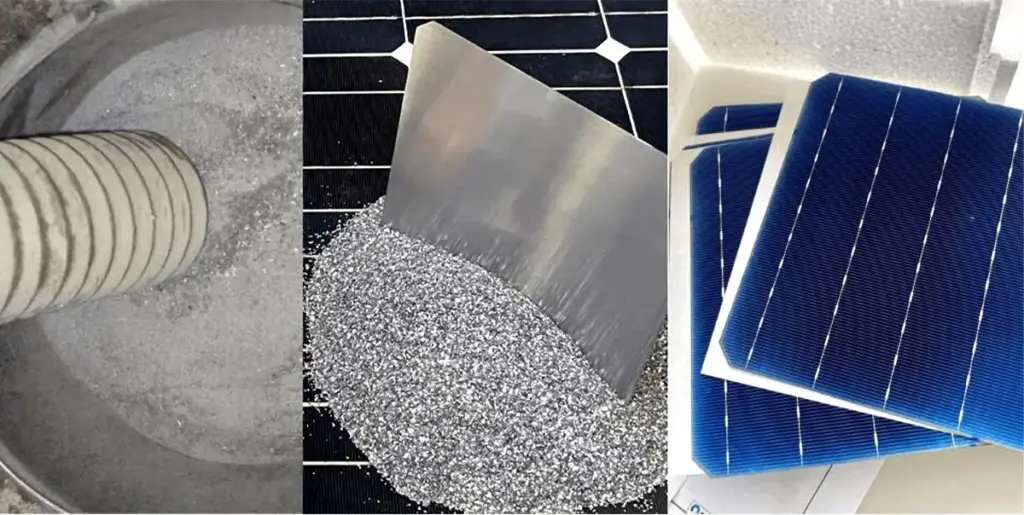
Case Study: A Recycling Facility in Operation
Some recycling plants already process thousands of panels each day. Facilities typically begin by removing aluminum frames and glass layers before extracting the photovoltaic cells. Automated equipment then sorts materials for further processing.
Glass recovered from panels can be reused in construction or manufacturing. Aluminum frames are melted and recycled into new metal products. The remaining photovoltaic material undergoes specialized processing to extract silver and other metals.
Industry analysts say scaling these facilities could transform solar waste into a major industrial resource.
Related Links
Elmya Breaks Ground on 30-MWp Solar and 40-MWh Battery Project in Scotland
Vande Solar: Inside India’s Race to Build the World’s Largest Vertical Solar Farm in Ladakh
The Future of Circular Solar Manufacturing
Researchers and manufacturers are exploring ways to design future solar panels with recycling in mind. Some companies are experimenting with alternative materials and modular panel designs that simplify disassembly and material recovery.
Others are investigating ways to reduce silver use in new photovoltaic cells. Still, experts say recycling will remain essential.
“Solar power is expected to grow dramatically over the next several decades,” said Dr. Heath of NREL. “Developing a circular supply chain will help ensure that growth remains sustainable.”
As the global transition to renewable energy accelerates, the need to manage aging infrastructure is becoming increasingly clear. Recycling technologies capable of recovering metals from retired solar panels could transform millions of rooftops into a new source of industrial materials, supporting both sustainability goals and the growing demand for clean energy technologies.
FAQs
How much silver is inside a solar panel?
Most crystalline silicon solar panels contain roughly 15 to 20 grams of silver used in electrical contacts.
Why is recycling solar panels important?
Recycling helps recover valuable metals, reduces landfill waste, and lowers the environmental impact of mining.
When do solar panels reach the end of their lifespan?
Solar panels typically last 25 to 30 years, although their efficiency gradually declines over time.
Can recycled materials be used to produce new panels?
Yes. Metals such as silver, copper, and aluminum recovered from old panels can be reused in new manufacturing processes.