
India is accelerating its renewable energy transition, linking decentralized rooftop solar schemes with large‑scale hydrogen projects.

From PM Surya Ghar to Green Hydrogen: Assessing India’s Solar Roadmap details how the government’s comprehensive plan aims to address energy security, reduce fossil‑fuel dependence, and position the country as a global leader in clean energy.
PM Surya Ghar to Green Hydrogen
| Key Fact | Detail |
|---|---|
| Solar expansion | India has 92 GW of solar capacity, and aims to reach 500 GW of non-fossil electricity by 2030 |
| Rooftop solar targets | The PM Surya Ghar scheme aims for 10 million rooftop installations |
| Green hydrogen goal | India targets 5 million metric tonnes of green hydrogen by 2030 |
| Investment in hydrogen | $15 billion is expected to be invested in India’s hydrogen economy by 2030 |
| Solar workforce growth | Solar energy could create hundreds of thousands of jobs in manufacturing, installation, and R&D |
From PM Surya Ghar to Green Hydrogen: Assessing India’s Solar Roadmap
India’s solar journey has become a critical element in the nation’s renewable energy transformation. Spanning from residential rooftop solar systems to cutting-edge green hydrogen production, the government’s comprehensive solar roadmap targets energy security, job creation, and environmental sustainability.
This roadmap, a multi-faceted strategy involving decentralized solar generation and large‑scale solar parks, places solar power at the heart of India’s energy future. The integration of solar power with green hydrogen technology represents a paradigm shift in India’s energy strategy.
India’s ambitions come at a time when energy markets worldwide are under strain due to climate goals and geopolitical instability, making energy diversification and self-reliance more important than ever.
PM Surya Ghar: Solar Power at the Household Level
The PM Surya Ghar Muft Bijli Yojana, launched in 2024, represents a major step in India’s solar roadmap. The program incentivizes rooftop solar panel installations by providing financial assistance to residential users.
Under this initiative, the government aims to facilitate 10 million rooftop solar systems across the country, providing subsidy support for installation costs. It aims to cover up to 300 units of free electricity for each qualifying household.
As of 2025, more than 1.5 million homes have already installed rooftop solar panels, demonstrating strong uptake in both urban and rural areas.
The PM Surya Ghar initiative is designed to empower individuals and families to produce their own electricity, thereby reducing monthly energy costs and improving energy access.
Several states, such as Uttar Pradesh and Gujarat, have already reported significant adoption of rooftop solar under this scheme. In Gujarat, 3.3 lakh systems have been installed, while Uttar Pradesh ranks third in the country with 2.75 lakh systems.
The Power of Utility-Scale Solar Parks
Alongside rooftop solar, large solar parks are expanding rapidly across India. With abundant sunlight, states like Rajasthan, Gujarat, and Karnataka are home to some of the largest solar installations in the world. The Bhadla Solar Park, located in Rajasthan, is one of the largest solar parks globally, with a capacity of 2,245 MW.
In addition to these large-scale projects, India is also investing in hybrid solar parks that combine solar and wind power. These hybrid models are aimed at ensuring a consistent power supply throughout the day by balancing the intermittent nature of solar power with wind energy, which typically generates electricity at different times of the day.
By 2025, India is expected to increase its solar capacity to over 120 GW, and over 70 GW is already installed, contributing significantly to the country’s renewable energy targets.
Green Hydrogen: Bridging the Gap Between Power and Industry
While solar energy dominates electricity generation, India is also betting on green hydrogen to decarbonize industrial sectors that are difficult to electrify. Green hydrogen, produced by using solar-generated electricity to split water molecules, has the potential to fuel sectors such as:
- Steel production
- Aviation
- Shipping
- Fertilizer manufacturing
The Indian government’s National Green Hydrogen Mission aims to scale up hydrogen production to 5 million tonnes per year by 2030, positioning India as a global leader in green hydrogen.
This ambitious mission is part of India’s broader push to integrate renewable electricity into industrial fuel supply chains. According to government projections, the green hydrogen sector could attract over ₹8 lakh crore in investments and create over 600,000 jobs by 2030.
Why Solar Power Is Essential for Green Hydrogen Production
India’s vast solar resources are critical to the green hydrogen ecosystem. The country has some of the highest levels of solar irradiation in the world, which is necessary for large‑scale hydrogen production.
By linking solar power with hydrogen production, India aims to create a closed-loop renewable energy system. Solar energy will generate the electricity required for electrolysis, while hydrogen can serve as a long-term storage solution for renewable electricity.
State-level hydrogen hubs, such as those proposed in Rajasthan and Gujarat, could soon serve as major production centers for green hydrogen, with the potential to supply both domestic industries and export markets.
Economic and Environmental Benefits
India’s solar roadmap offers several advantages:
Energy Independence
Reducing reliance on imported fossil fuels could save the country billions in energy imports. Currently, India imports about 85% of its crude oil and 50% of its natural gas, which makes the economy vulnerable to global price shocks.
Green Jobs and Industrial Growth
The renewable energy transition is creating thousands of jobs in manufacturing, installation, and research and development. According to estimates, the green hydrogen mission could create 600,000 jobs in the clean energy sector. (pib.gov.in)
Decarbonization of Industry
Green hydrogen can replace fossil fuels in industries such as cement, steel, and chemicals, which are responsible for a significant portion of India’s carbon emissions. By adopting hydrogen, India can make substantial progress toward its Paris Agreement climate targets.
Challenges and Roadblocks
Grid Integration and Infrastructure
As solar power capacity increases, upgrading India’s grid infrastructure is essential. The national grid must accommodate large-scale solar parks and distribute power efficiently across vast distances.
High Costs of Hydrogen Production
Green hydrogen production remains relatively expensive compared to fossil‑fuel alternatives. Reducing costs will require technological advances and economies of scale, particularly in electrolyser technology.
Solar Component Dependence
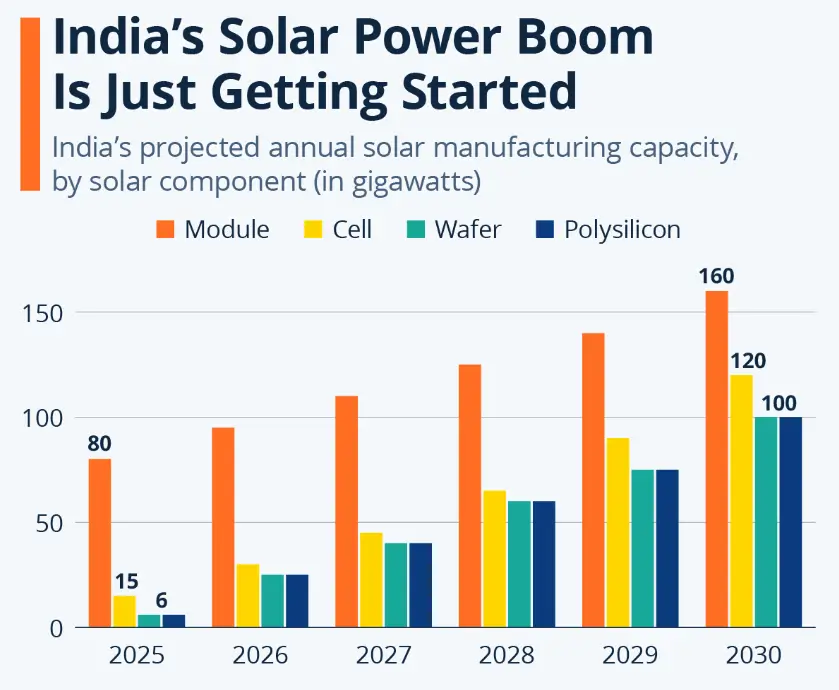
India still imports a significant share of solar panels and components, particularly from China. Reducing this dependence is critical to ensuring the long-term sustainability of the solar industry.

Land Use and Policy Coordination
Large solar projects require vast tracts of land, which could result in conflicts with agricultural use. Additionally, policies to promote faster land acquisition for renewable projects are needed.
The Global Context: India’s Solar Role in a Changing World
India’s solar roadmap must be understood within the broader context of global energy transitions. Countries such as China, the United States, and European Union members are heavily investing in renewable energy.
China, in particular, has been leading in solar panel manufacturing, making it a dominant player in the global supply chain. Europe, on the other hand, is focusing heavily on green hydrogen infrastructure, seeing it as a way to decarbonize heavy industry.
India’s approach combines both large centralized installations and decentralized rooftop solar, providing a hybrid model suited to the country’s diverse geographical and economic landscape.
Related Links
Mining the Roof: How a New Start-up is Recovering 99% of Silver from 20-Year-Old Dead Panels
Market Volatility: Why Analysts Recommend ‘Stock-Specific’ Bets in Solar
The Roadmap to 2030
India’s solar roadmap is an ambitious and multi-faceted strategy, combining rooftop solar, solar parks, and green hydrogen production. By 2030, the country aims to become a global leader in renewable energy, powered by solar and hydrogen technologies.
The next decade will be critical. If the country can overcome challenges related to infrastructure, financing, and supply chain issues, India could emerge as a dominant player in the global renewable energy market.
FAQs
What is PM Surya Ghar?
PM Surya Ghar Muft Bijli Yojana is a government initiative aimed at providing financial assistance for rooftop solar installations in residential areas. It aims to cover 10 million homes across India.
How will green hydrogen benefit India?
Green hydrogen will help decarbonize industrial sectors like steel, cement, and heavy transport, while also serving as a clean energy alternative to fossil fuels.
What are the main challenges India faces with solar energy?
Challenges include grid integration, high land requirements for solar parks, dependency on imported components, and the high costs of green hydrogen production.