Scientists have developed a novel organic electronic device capable of operating both as an indoor solar cell and as a photodetector, potentially transforming the design of energy-autonomous sensors for the Internet of Things (IoT).
The innovation, reported by researchers from Dongguk University and Korea University, integrates energy harvesting and light sensing into a single compact system.
Indoor Solar Cell and Photodetector
| Key Fact | Detail |
|---|---|
| Dual functionality | Device works as solar cell and photodetector |
| Technology platform | Organic semiconductor optoelectronics |
| Key material | Benzene-phosphonic acid self-assembled monolayer |
| Primary use case | Battery-free IoT sensors and smart electronics |
Game-Changer in IoT: New Organic Device Works as Both Indoor Solar Cell and Photodetector
Breakthrough in Organic Optoelectronics
Researchers from Dongguk University’s Department of Energy and Materials Engineering and Korea University’s School of Electrical Engineering have created a multifunctional organic optoelectronic device capable of performing two critical electronic functions simultaneously.
The device operates both as:
- an indoor photovoltaic cell, converting ambient light into electricity
- a photodetector, sensing light intensity and optical signals.
Traditionally, electronic systems require separate components to perform these tasks. Integrating them into a single device could significantly reduce circuit complexity and energy consumption.Lead researcher Professor Jin Young Kim said the approach could enable compact, energy-autonomous sensors for next-generation smart electronics.
The findings demonstrate how advances in organic materials science are enabling multifunctional electronic components that were previously difficult to achieve.
How the Device Works
The new technology relies on organic semiconductor materials, which are carbon-based compounds capable of conducting electricity under specific conditions. Organic semiconductors differ from conventional silicon in several important ways:
- they can be processed at lower temperatures
- they are compatible with flexible substrates
- they enable lightweight electronic devices.
The research team introduced a benzene-phosphonic acid (BPA) self-assembled monolayer that acts as a hole transport layer within the device. This ultra-thin molecular layer improves charge transfer while simplifying the overall device structure. As a result, the device can efficiently:
- convert light into electrical energy
- detect optical signals.
Researchers say the simplified architecture reduces manufacturing complexity while maintaining high optoelectronic performance.
Why the Breakthrough Matters for IoT
The Internet of Things (IoT) refers to networks of connected devices that collect and exchange data through sensors and wireless communication. These systems are widely used in:
- smart homes
- industrial automation
- healthcare monitoring
- environmental sensing.
According to technology analysts, the number of connected IoT devices worldwide could exceed 25 billion devices within the next decade. Powering these sensors is one of the largest challenges facing IoT deployment.
Many IoT devices currently rely on small batteries that require periodic replacement. In large sensor networks, maintaining batteries can be expensive and logistically difficult.
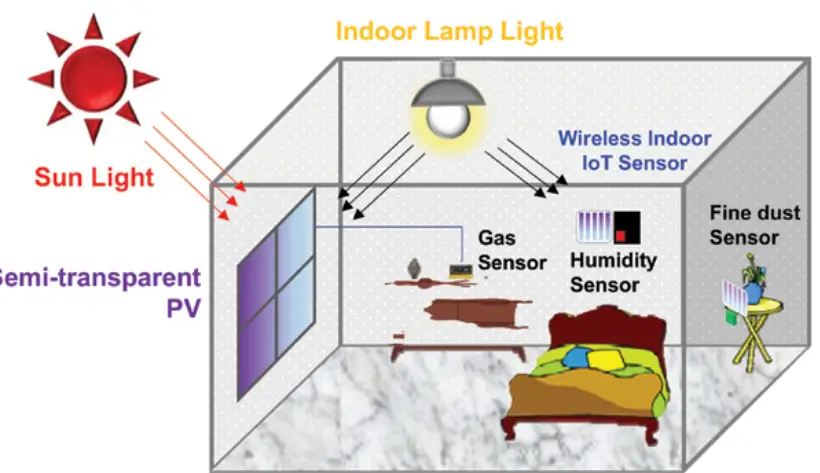
The newly developed organic device offers a potential solution by enabling self-powered sensors that harvest energy from indoor lighting. Such systems could operate for extended periods without maintenance.
Indoor Solar Cells: A Growing Technology
Solar panels are typically associated with outdoor installations. However, indoor solar cells represent an emerging field focused on capturing energy from artificial lighting sources such as LED bulbs.
Organic photovoltaic materials are particularly effective in indoor environments because they can operate efficiently under low light conditions. Indoor solar cells are especially suitable for low-power devices such as:
- wireless sensors
- electronic tags
- smart building controls.
By integrating solar energy harvesting directly into sensing devices, the new technology could enable fully autonomous electronics.
Photodetectors in Modern Electronics
Photodetectors are components that convert light into electrical signals.They are widely used in technologies including:
- optical communication systems
- image sensors
- environmental monitoring devices
- gesture recognition interfaces.
Combining photodetection with energy harvesting allows a single device to both sense environmental conditions and power itself. This integration is particularly valuable for IoT systems where minimizing power consumption is essential.

Organic Electronics: An Expanding Field
Organic electronics represent one of the fastest-growing areas of semiconductor research. Unlike traditional electronics, which rely on inorganic materials such as silicon, organic electronics use carbon-based molecular compounds. These materials offer several advantages:
- mechanical flexibility
- lightweight construction
- potential for low-cost manufacturing through printing techniques.
Organic electronics have already enabled commercial technologies such as OLED displays, widely used in smartphones and televisions. Researchers believe organic photovoltaics and sensors could represent the next major wave of innovation in this field.
Performance Metrics of the Device
According to the research team, the device demonstrated strong performance in both photovoltaic and photodetection modes.Key characteristics include:
- efficient charge transport through the BPA monolayer
- strong response to indoor light conditions
- stable electrical performance during laboratory testing.
The device also demonstrated rapid switching between energy harvesting and sensing functions. This versatility could allow the same component to perform multiple roles within an electronic system.
Potential Applications Across Industries
Researchers believe the technology could have applications across several sectors.
Smart Buildings
Self-powered sensors could monitor lighting, temperature, and occupancy without battery maintenance.
Wearable Electronics
Flexible organic devices could power health monitoring sensors integrated into clothing.
Industrial Monitoring
Factories could deploy networks of maintenance-free sensors for equipment monitoring.
Environmental Tracking
Autonomous sensors could monitor air quality, humidity, and pollution levels inside buildings. Such applications could significantly reduce maintenance costs and electronic waste.
Environmental Benefits
Battery production and disposal represent significant environmental challenges. Large IoT networks that rely on disposable batteries can generate substantial waste. Self-powered sensors powered by indoor light could reduce reliance on batteries, lowering environmental impact.
In addition, organic semiconductor materials often require less energy-intensive manufacturing processes compared with traditional silicon electronics. Researchers say these characteristics could contribute to more sustainable electronic systems.
Challenges Before Commercialization
Despite the promising results, several obstacles remain before the technology can reach commercial markets. Organic semiconductor devices generally have shorter lifetimes than silicon-based electronics.
Exposure to moisture, oxygen, and heat can degrade organic materials over time.Researchers must therefore improve device stability and protective packaging. Another challenge involves scaling laboratory fabrication techniques to industrial manufacturing processes. Large-scale production methods must be developed to ensure consistent device performance.

Global Research Race in Self-Powered Electronics
Scientists worldwide are exploring technologies that combine energy harvesting and sensing capabilities. Current research areas include:
- indoor photovoltaic energy harvesting
- piezoelectric generators that convert motion into electricity
- thermoelectric generators that convert heat into power.
Among these approaches, indoor solar energy harvesting remains one of the most promising options for low-power electronics. Researchers believe integrating multiple functions into a single device could accelerate adoption of self-powered electronic systems.
Future Research Directions
The research team plans to continue improving the device architecture and materials. Future studies may focus on:
- increasing power conversion efficiency
- enhancing device durability
- integrating wireless communication modules.
Researchers also aim to test the technology in real-world IoT environments such as smart homes and industrial monitoring systems.

Continued collaboration between materials scientists, electrical engineers, and device manufacturers will be essential for translating laboratory breakthroughs into commercial technologies.
Related Links
Solar vs. Nature: Jefferson County Project Faces Backlash Over Rare Ecosystem Impact
New CPCB Guidelines: How India Plans to Manage Growing Solar E-Waste Challenges
The development of a multifunctional organic device capable of serving as both an indoor solar cell and a photodetector highlights the rapid progress being made in organic electronics research.
While additional work is needed before large-scale commercialization, the innovation suggests that future IoT systems may rely increasingly on self-powered technologies that harvest ambient energy while simultaneously sensing the environment.
FAQs
What is the key innovation in this IoT device?
The device integrates energy harvesting and photodetection functions into a single organic semiconductor system.
Why is indoor solar power important for IoT?
Indoor solar cells allow sensors to generate electricity from artificial lighting, reducing the need for battery replacements.
Which institutions developed the technology?
Researchers from Dongguk University and Korea University led the development.
When could the technology reach commercial use?
Further research is required to improve durability and manufacturing scalability before commercial deployment.