

In 2026, the U.S. solar market is navigating a pivotal juncture. After years of dependence on Chinese solar imports, new tariff regimes aim to bolster domestic manufacturing. While tariffs raise the cost of imported modules, enabling U.S. firms to scale, questions remain: Can American manufacturers truly outpace Chinese dominance, or will global supply chain dependencies and production bottlenecks limit progress?
Experts suggest that achieving a “Made in America” solar industry capable of meeting U.S. demand requires more than tariffs—it needs investment, technology innovation, and workforce development.
Historical Context – U.S. vs China
Over the past two decades, China has become the dominant force in global solar manufacturing, producing over 70% of photovoltaic modules worldwide. Low labor costs, vertically integrated supply chains, and aggressive government incentives have enabled China to control polysilicon, wafers, cells, and module assembly, giving it a substantial competitive advantage.
U.S. manufacturers, while historically strong in thin-film solar (e.g., First Solar), have struggled to compete on cost for silicon-based panels, which dominate residential and utility-scale solar markets.
Tariffs and Trade Measures in 2026
Timeline of U.S. Tariffs
- 2018–2020: Initial tariffs on Chinese solar panels at 30%–35%.
- 2023–2025: Expanded duties on imports via Southeast Asia to counter circumvention.
- 2026: Countervailing duties on imports from India, Indonesia, and Laos linked to Chinese production (~126% in some cases).
These tariffs aim to level the playing field for domestic manufacturers, making imported panels less cost-competitive.
Impact on Pricing
While tariffs protect domestic firms, they have raised overall system costs for U.S. installers. Residential solar prices are projected to increase by 5–10% in some states, potentially slowing adoption if domestic production cannot scale efficiently.
Can U.S. Manufacturers Compete?
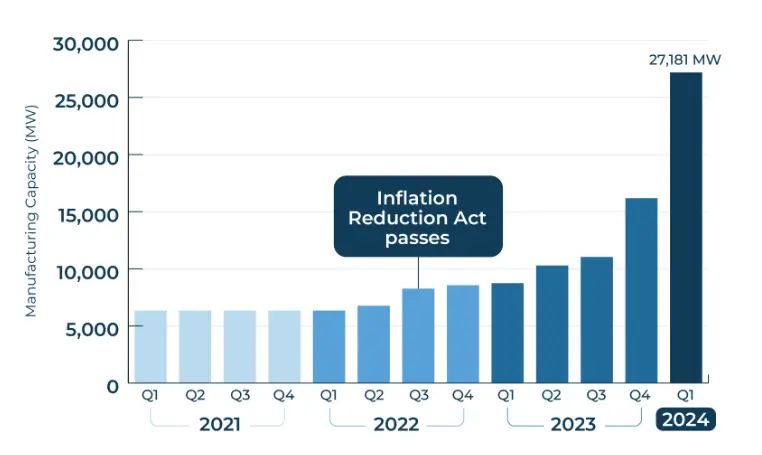
Domestic Production Capacity
- Companies like First Solar and Hanwha Qcells USA are expanding U.S. production.
- U.S. annual production is projected to reach 10–12 GW by 2026, still far below Chinese output (~150 GW globally).
Supply Chain Bottlenecks
- Critical materials like polysilicon, tempered glass, and aluminum racking are still largely imported.
- Equipment for wafer processing and cell fabrication is often sourced from China.
This means tariffs alone cannot make U.S. manufacturers fully independent—they still rely on imported inputs.
Consumer Perspective – Cost, ROI, and Installations
Residential Solar Costs
- A typical U.S. home solar system now costs $2.50–$3.50 per watt, slightly higher than 2025 due to tariffs.
- Domestic panels may cost 10–20% more than imported alternatives, despite tariffs.
Return on Investment
- Tariffs slightly increase ROI for domestic manufacturers but may extend payback periods for homeowners.
- Strategic policy incentives (state rebates, IRA tax credits) are crucial to maintain adoption rates.
Workforce Development and Jobs
Scaling “Made in America” solar could generate up to 1.5 million new U.S. jobs by 2030, including positions in:
- Manufacturing and assembly
- Engineering and R&D
- Installation and maintenance
However, workforce shortages, training requirements, and competition for skilled labor could limit growth without targeted programs.
Environmental and Sustainability Considerations
- Domestic manufacturing reduces the carbon footprint of imported modules due to shorter supply chains.
- LFP (lithium iron phosphate) and advanced recycling technologies for U.S. panels could improve long-term sustainability.
- However, sourcing raw materials like silicon still relies partially on global supply chains, including China, which affects overall lifecycle emissions.
Scenario Analysis
| Scenario | Outcome | Likelihood |
|---|---|---|
| Best Case | U.S. ramps up domestic production, achieves economies of scale, reduces dependency on imports, drives domestic jobs, and stabilizes pricing. | Medium |
| Worst Case | Domestic production fails to scale, tariffs inflate costs, adoption slows, China maintains dominance, and supply chain bottlenecks persist. | Medium-High |
| Moderate Case | Partial growth in U.S. manufacturing, moderate reduction in imports, mixed impact on pricing and installation rates. | High |
Global Competitiveness
Even with tariffs, U.S. firms must innovate to remain competitive:
- Advanced materials (e.g., perovskite solar cells)
- Automated production lines for efficiency
- Higher efficiency modules for commercial and residential use
Without innovation, U.S. panels may remain less competitive than low-cost Chinese imports, even under tariff protections.

सोलर पैनल सब्सिडी में नंबर 1 है ये राज्य! मिलते हैं सबसे ज्यादा सब्सिडी के पैसे Solar Panel Subsidy
Policy Recommendations for Success
Experts recommend:
- Targeted subsidies and tax credits for domestic solar manufacturing.
- Investment in R&D for next-generation solar technologies.
- Workforce development programs to build skilled labor for production and installation.
- Strategic sourcing of raw materials to reduce reliance on China.
- Long-term procurement agreements for utility-scale and residential projects to ensure market stability.
Related Links
Tesla Powerwall 3 vs Enphase IQ: The Best Home Battery Storage for US Homeowners in 2026
The 33% Solar Slump: Why Financing Hurdles and Policy Shifts are Cooling US Home Solar Demand
While U.S. tariffs in 2026 aim to support “Made in America” solar, domestic manufacturers face significant challenges, including supply chain dependencies, high production costs, and global competition.
Success will require more than trade barriers—investment, innovation, workforce development, and strategic policy coordination are essential.
If these measures succeed, U.S. solar manufacturers could capture a larger share of the domestic market and become competitive internationally. Otherwise, Chinese imports and their global supply chain will continue to dominate.
FAQs
Do tariffs guarantee U.S. solar dominance?
No, tariffs help level the playing field but must be paired with investment and innovation.
Are U.S. panels more expensive than Chinese panels?
Yes, but tariffs make imports less competitive, partially offsetting the price gap.
Can domestic solar create significant jobs?
Yes, potentially 1–1.5 million by 2030, if production scales.
Is U.S. solar fully independent of China?
Not yet; raw materials and equipment still rely heavily on China.
What is the long-term outlook?
With strategic policy, investment, and technological innovation, U.S. manufacturers could gradually reduce dependency on imports and capture a larger domestic and international market share.