

India’s renewable energy major, Adani Green Energy Ltd, is under scrutiny as its price-to-earnings (PE) ratio approaches 80, significantly above industry norms.

While the company continues to expand aggressively in the clean energy sector, analysts remain divided on whether the stock represents a long-term opportunity or a valuation risk amid rising debt and earnings pressure.
Understanding the Adani Green Valuation Debate
Adani Green’s valuation has become a focal point in Indian equity markets. The company trades at a PE ratio far exceeding sector averages of 20–30, reflecting strong expectations of future growth.
Such valuations typically indicate that investors are pricing in significant expansion in earnings. However, this also means the stock is vulnerable if growth fails to meet expectations.
Market analysts emphasise that “high PE multiples are sustainable only when backed by consistent earnings growth and strong cash flows.”
Why the High PE Ratio Is Raising Concerns
Earnings Growth vs Expectations
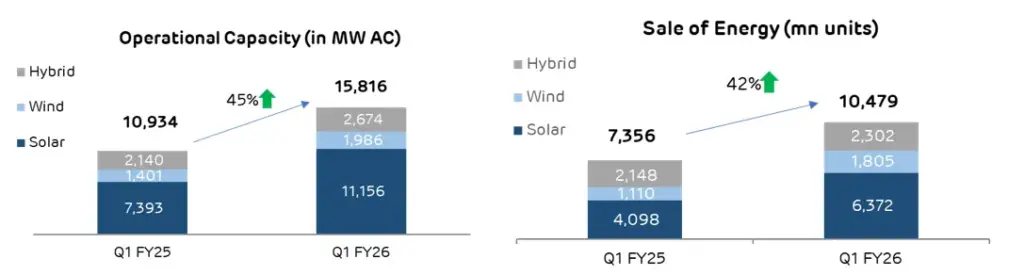
Adani Green has reported steady revenue growth, supported by capacity additions and long-term power purchase agreements. However, profitability has come under pressure.
Rising finance costs have reduced net profit margins, creating a divergence between revenue growth and bottom-line performance. This gap has led some analysts to describe the stock as “priced for near-perfect execution.”
Debt-Funded Expansion Strategy
The company’s aggressive expansion has relied heavily on debt financing. While this strategy has enabled rapid growth, it has also increased financial risk.
Higher interest rates globally have made borrowing more expensive, affecting companies with large capital expenditure commitments. According to sector analysts, “renewable energy projects require significant upfront investment, and financing costs can materially impact returns.”
The Bull Case — Why Some Investors Remain Optimistic
Leadership in India’s Renewable Energy Sector
Adani Green is among India’s largest renewable energy companies, with a growing portfolio of solar and wind assets. The company continues to add gigawatts of capacity annually.
India’s policy push towards clean energy, including incentives and infrastructure support, strengthens the long-term outlook for companies in this sector.
Strong Long-Term Demand Drivers
India’s electricity demand is expected to grow steadily due to urbanisation, industrial expansion, and digital infrastructure development. Renewable energy is likely to play a central role in meeting this demand, providing companies like Adani Green with a long runway for growth.
Potential Valuation Normalisation
Some analysts argue that current valuations may become reasonable if earnings grow at projected rates. Forward PE ratios, based on expected earnings, are lower than current levels, suggesting potential valuation normalisation over time.
The Bear Case — Key Risks Investors Should Watch
Elevated Valuation Risk
High valuations leave limited margin for error. Even minor deviations in growth or execution can trigger sharp stock corrections.
Earnings Volatility
The gap between revenue growth and profitability remains a concern. Sustained pressure on margins could challenge the growth narrative.

IPO Alert: Don't miss these 3 massive Green Energy IPOs hitting the market this week (Feb 23-27).
Execution Risks in Large Projects
Renewable energy projects involve regulatory approvals, land acquisition, and logistical challenges. Delays or cost overruns can impact returns.
Market Sentiment Sensitivity
Stocks within the Adani Group have historically shown sensitivity to market sentiment. External developments can influence investor confidence.
Peer Comparison — How Adani Green Stacks Up
Compared to peers such as Tata Power Renewable Energy and NTPC Green Energy, Adani Green trades at a significantly higher valuation multiple.
While peers offer more diversified revenue streams and relatively stable earnings, Adani Green commands a premium due to its pure-play renewable focus and aggressive growth strategy. However, analysts caution that “premium valuations must be justified by superior execution and consistent earnings delivery.”
Corporate Governance and Transparency Considerations
Corporate governance remains an important factor for institutional investors evaluating Adani Group companies. Following past scrutiny of the group’s financial practices, investors have increasingly focused on transparency, disclosure standards, and debt management.
Improved governance practices and clearer financial reporting could play a key role in sustaining investor confidence.
Regulatory and Policy Environment
India’s renewable energy sector benefits from strong policy support, including subsidies, tax incentives, and long-term power purchase agreements.
The government’s target of achieving 500 GW of non-fossil fuel capacity by 2030 provides a favourable environment for sector growth. However, regulatory changes, tariff revisions, or policy shifts could impact project economics and profitability.
Global Context — Renewable Energy Investment Trends
Globally, renewable energy investments have been rising, driven by climate commitments and energy security concerns. Countries across Europe, the United States, and Asia are increasing investments in solar, wind, and green hydrogen.
Adani Green’s expansion aligns with these global trends, but it also faces competition from international players with strong balance sheets and technological capabilities.

Investor Strategy — Buy the Dip or Wait?
Market experts suggest that investment decisions should be guided by individual risk profiles and time horizons.
Long-Term Investors:
May consider gradual accumulation if they believe in the long-term growth story and can withstand volatility.
Short-Term Investors:
May prefer to wait for valuation corrections or clearer earnings visibility.
Conservative Investors:
May look at alternatives with lower valuations and more stable earnings. A fund manager noted, “Growth potential is undeniable, but valuation discipline remains critical.”
Related Links
NTPC Share Price Dips from Life-Time High: Why ₹361 is the Crucial Support Level to Watch
Suzlon Energy Stalls at ₹40: Can New Wind Orders Trigger a Breakout Above 200-DMA?
Key Metrics Investors Should Track
To evaluate Adani Green’s future performance, analysts recommend monitoring:
- Debt-to-equity ratio
- Interest coverage ratio
- Capacity addition targets
- Profit margin trends
- Cash flow generation
These indicators provide insight into financial health and operational efficiency.
Adani Green Energy stands at a pivotal point where strong growth prospects intersect with elevated valuation concerns. The company’s leadership in India’s renewable energy sector offers significant long-term potential, but risks related to debt, earnings pressure, and execution remain.
The “buy the dip” argument depends on investor perspective. For long-term investors with high risk tolerance, the stock may present an opportunity. For others, caution and valuation discipline may be more appropriate in the current environment.