
In 2026, agrivoltaics—the innovative practice of using the same land for both agriculture and solar power generation—is gaining significant momentum in India and around the world.
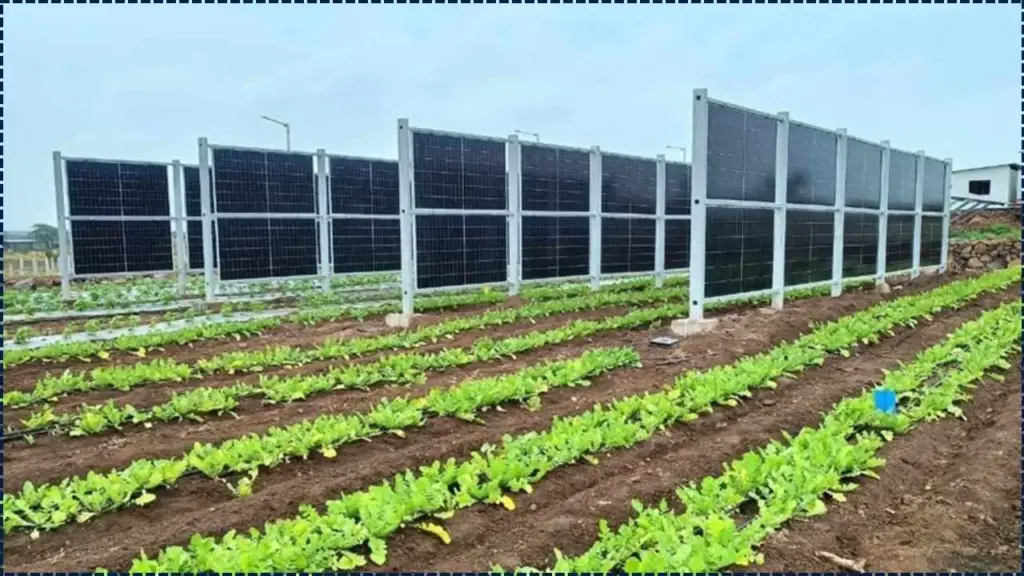
This dual-use approach not only boosts farmers’ incomes but also offers solutions to land constraints, water conservation, and renewable energy generation, making it a game-changer for sustainable farming and energy production.
Agrivoltaics 2026
| Key Fact | Detail |
|---|---|
| Agrivoltaic Area in India | 3,200 GW potential capacity for agrivoltaics |
| Income Boost | Farmers can see 20-30% increase in income |
| Policy Support | PM-KUSUM scheme offers subsidies for solar projects |
| Pilot Projects | 20+ agrivoltaic farms are operational across India |
| Water Savings | Agrivoltaics reduces irrigation demand by 10-15% |
What is Agrivoltaics and How Does It Work?
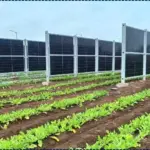
Agrivoltaics refers to the simultaneous use of land for agriculture and solar power generation, typically involving the installation of solar panels elevated above crops or livestock. This dual-use model enables both food production and clean energy generation to co-exist on the same land.
In India, where land is scarce and demand for energy is surging, agrivoltaics offers a solution to increase renewable energy capacity while maintaining food production.
By harnessing sunlight for power without requiring additional land, it reduces the conflict between solar farms and agricultural land.
Key Benefits for Farmers and Agriculture
1. Increased Income and Financial Diversification
Agrivoltaics offers farmers an additional revenue stream. Farmers can sell the electricity generated by solar panels back to the grid, offsetting energy costs for irrigation or providing a steady income from power generation.
Government programs such as PM-KUSUM (Pradhan Mantri Kisan Urja Suraksha evam Utthaan Mahabhiyan) incentivise solar installations on farms, increasing economic resilience. By combining energy and crop production, farmers can diversify their income, reducing their reliance on a single source.
Some reports suggest that agrivoltaics can boost farmer income by 20–30% through revenue from both crops and electricity.
2. Improved Crop Yields and Water Conservation
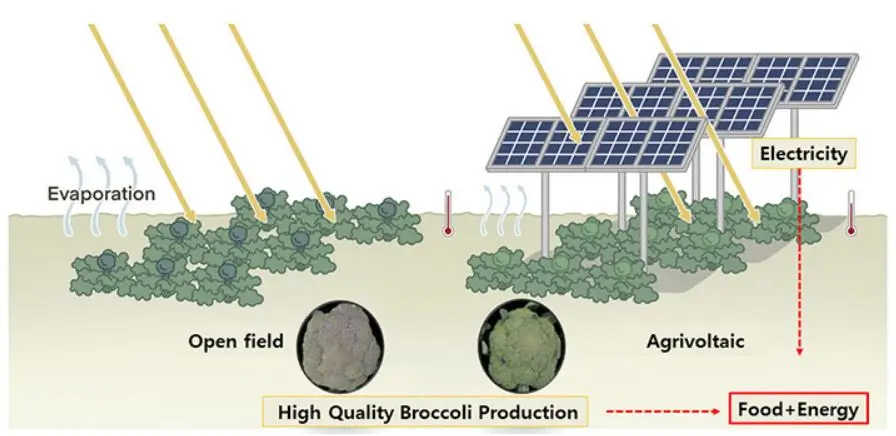
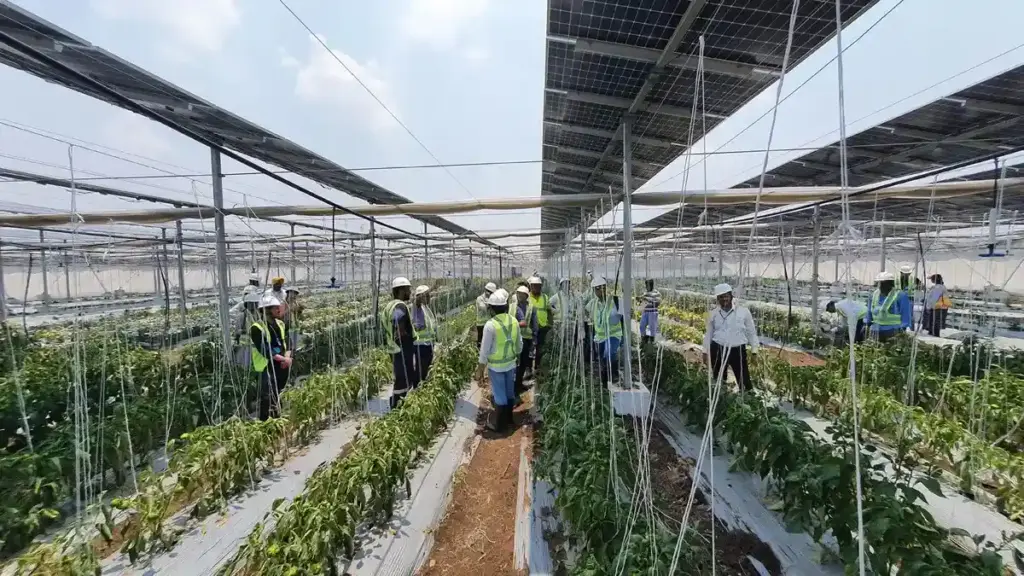
Agrivoltaic systems can help crops thrive by providing shade, reducing heat stress, and improving water retention in soil. Studies have shown that crops such as spinach, tomatoes, and lettuce perform well under partial shading provided by solar panels, which can reduce the need for excessive irrigation.
By covering water reservoirs and irrigation channels, agrivoltaic systems also reduce water evaporation. This can reduce the need for irrigation by 10-15%, making it an ideal solution for areas experiencing water scarcity.
Policy Support and Government Initiatives
India’s government is actively promoting agrivoltaics as part of its broader renewable energy and agricultural policies. Key initiatives include:
PM-KUSUM Scheme
This program provides subsidies to farmers for installing solar-powered irrigation pumps and rooftop solar panels. The scheme also encourages farmers to adopt solar farming, where large solar installations are combined with agricultural practices.
The government has also introduced state-level policies to support the expansion of agrivoltaic systems, offering financial incentives and regulatory support.
Agrivoltaic Design, Engineering, and Technological Innovations
Panel Elevation and Spacing
Agrivoltaic systems are typically designed with elevated panels (3-4 metres above the ground), allowing crops to grow underneath while still receiving sufficient sunlight. Proper panel spacing ensures that the crops below are not overly shaded, which could affect their growth.
Advanced Solar Panels
Recent innovations such as bifacial solar panels—which capture sunlight on both the front and back—have been integrated into agrivoltaic systems. This increases energy output by utilising reflected light from the ground.
Smart Monitoring and Adaptability
Agrivoltaic systems use smart sensors and tracking technology to adjust the angle of solar panels according to the sun’s movement and environmental conditions. This ensures maximum efficiency in both energy generation and crop productivity.
Global and Domestic Market Outlook
India’s Agrivoltaic Potential
India has more than 3,200 GW of potential agrivoltaic capacity, particularly in regions with abundant sunlight and vast irrigation infrastructure. According to industry reports, scaling up agrivoltaics could allow India to meet its renewable energy targets while strengthening food security.
Global Trends
Globally, Japan, Germany, and France have been pioneers in agrivoltaics. In Japan, several successful pilot projects have combined solar farming with rice paddies, and in Germany, agrivoltaic installations are being integrated into vineyards and orchards.
India’s large agricultural base and high solar irradiation make it a leader in agrivoltaic innovation. The technology could transform rural economies and contribute significantly to global renewable energy efforts.
Challenges and Considerations
High Initial Costs
One of the major hurdles for agrivoltaics is the initial investment. Setting up solar panels on elevated structures and ensuring proper land design can make installation costs higher than conventional solar farms. However, as the technology matures, costs are expected to decrease.
Design Complexity
Balancing the needs of both crops and solar panels requires careful planning, particularly in ensuring adequate light for crops while maximising solar energy capture. Specialised engineers and agronomists are needed to design systems that optimise the use of land.
Limited Awareness Among Farmers
Many farmers remain unaware of agrivoltaics, which slows adoption. To address this, government-led awareness campaigns, pilot projects, and farmer training programs are crucial.
Community and Ecological Impact
Agrivoltaics is not without its challenges. Some environmental concerns have been raised regarding potential impacts on local biodiversity. In particular, the shade provided by panels may alter microclimates, affecting soil organisms and insect populations.
Engaging with local communities, particularly fishermen, and conducting thorough environmental impact assessments are key to the long-term success of agrivoltaic projects.
Related Links
Goodbye Lithium? Sodium-Ion Batteries Enter Mass Production for Home Solar in 2026
AI-Powered Solar 2026: How Smart Energy Management Can Cut Your Household Bills by 25%
Future Outlook: Scaling Agrivoltaics Across India
Experts predict that agrivoltaics could become a mainstream solution in India’s agricultural landscape by 2030. As the cost of solar panels decreases, government support continues to grow, and farmers’ awareness improves, agrivoltaics has the potential to significantly contribute to India’s renewable energy and food security goals.
By the end of the decade, agrivoltaics could be generating several gigawatts of power, while also contributing to the livelihoods of millions of farmers across the country.
India’s focus on solar-powered agriculture could pave the way for similar innovations in other developing nations facing land and water constraints.
Agrivoltaics represents a transformative opportunity for India’s agricultural and energy sectors. By allowing farmers to grow crops and generate solar power on the same land, the technology provides a sustainable solution to two of the country’s biggest challenges: food production and energy demand.
With ongoing policy support, technological advances, and the right investment, agrivoltaics could play a central role in India’s journey toward a green economy.