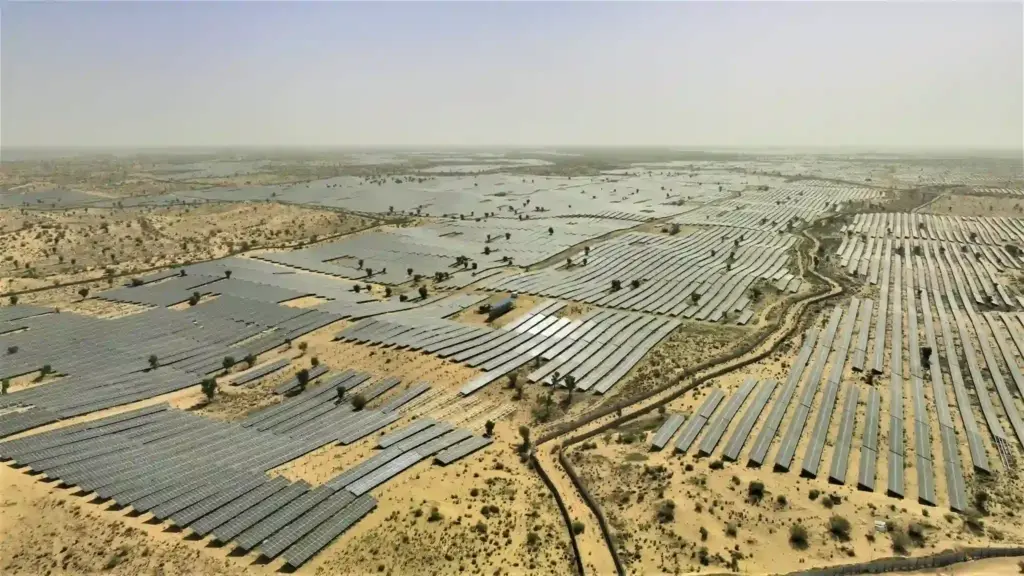
In Rajasthan’s Thar Desert, the India’s largest solar park Bhadla Solar Park stretches across thousands of acres, generating enough electricity to power millions of Indian homes.
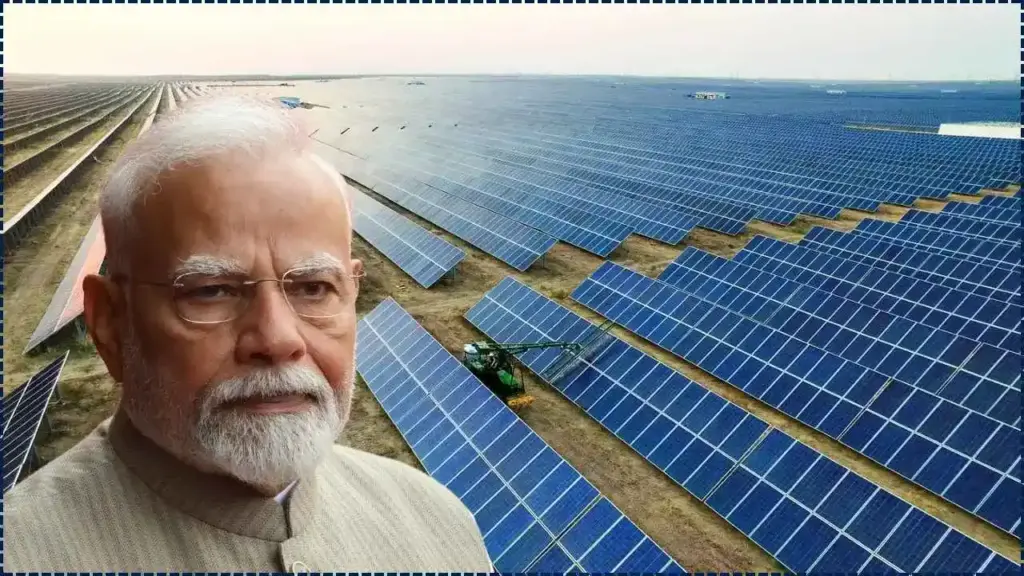
As India moves toward its 2030 pledge of 500 gigawatts of non-fossil fuel capacity, policymakers and analysts are examining whether projects like Bhadla can keep pace with growing demand and climate commitments.
India’s Largest Solar Park
| Key Fact | Detail |
|---|---|
| Installed Capacity | 2,245 MW |
| 2030 National Target | 500 GW non-fossil capacity |
| Solar Growth | India among fastest-growing solar markets |
| Record-Low Tariffs | Solar bids below ₹2.50/kWh in auctions |
The Rise of India’s India’s Largest Solar Park Solar Landmark
The Bhadla Solar Park, located in Rajasthan’s Jodhpur district, has become a flagship of India’s renewable expansion. With an installed capacity of roughly 2,245 megawatts (MW), it ranks among the largest solar parks in the world, according to India’s Ministry of New and Renewable Energy (MNRE).
Developed in phases beginning in 2015, the park brought together multiple private developers under a government-led solar park framework. Rajasthan’s high solar irradiation, flat terrain, and sparse population made it a suitable location for large-scale photovoltaic (PV) deployment.
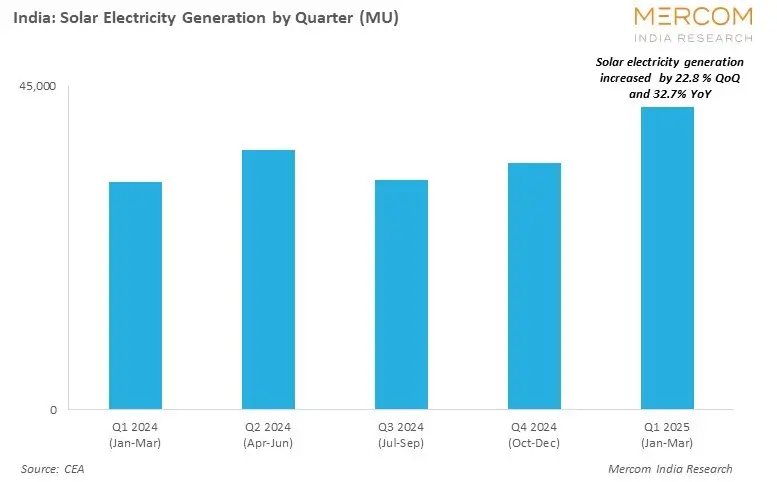
India’s solar capacity has grown dramatically over the past decade. According to MNRE data, installed solar capacity rose from under 10 GW in 2015 to more than 70 GW in recent years. The International Energy Agency (IEA) identifies India as one of the fastest-growing renewable markets globally.
“India has emerged as a major force in solar energy deployment,” said Fatih Birol, Executive Director of the IEA, in previous commentary on India’s energy transformation.
How the India’s Largest Solar Park System Functions (KW2)
Bhadla operates as a cluster of solar arrays connected to substations and transmission lines that feed power into the national grid. Each developer manages its allocated section, selling electricity through long-term power purchase agreements.
The desert climate presents operational challenges. Summer temperatures often exceed 45°C (113°F), and dust can reduce panel efficiency. Operators deploy automated cleaning systems and dry-cleaning technologies to limit water use in the arid environment.
Transmission infrastructure is essential to the project’s viability. The Power Grid Corporation of India Limited (PGCIL) has developed high-voltage transmission corridors to transport solar power from Rajasthan to demand centers such as Delhi and Gujarat.
Economic Effects and Tariff Milestones (KW3)
Bhadla drew global attention when competitive auctions produced record-low solar tariffs. In 2017 and 2018, developers bid prices below ₹2.50 per kilowatt-hour, among the lowest globally at the time, according to reporting by Reuters and MNRE releases.
Lower solar tariffs have made renewable electricity competitive with coal-based power in many regions. However, developers face rising input costs due to global supply chain shifts and domestic manufacturing policies.
The Council on Energy, Environment and Water (CEEW) notes that stable policy and reliable payments from distribution companies remain critical to investor confidence.
“Solar economics have improved significantly,” said Dr. Arunabha Ghosh, CEO of CEEW, in public commentary. “But financial discipline across the power sector remains essential.”
Construction of Bhadla created thousands of short-term jobs, while ongoing operations require fewer permanent staff. Large-scale solar is less labor-intensive than conventional thermal plants once operational.
Community Impact and Land Use
Large solar parks require extensive land. Bhadla spans approximately 5,700 hectares. While the site primarily occupies arid, non-agricultural land, local stakeholders have raised concerns about grazing access and ecological impact.
Environmental assessments are required before project approval. Conservation groups emphasize careful siting to minimize biodiversity disruption.
At the same time, renewable expansion reduces air pollution linked to fossil fuel combustion. According to India’s Central Electricity Authority (CEA), shifting generation toward solar can help lower carbon intensity and local pollution levels.
India’s 2030 Renewable Commitment
At the 2021 United Nations Climate Change Conference (COP26), Prime Minister Narendra Modi announced that India would aim for 500 GW of non-fossil capacity by 2030.
This target includes solar, wind, hydroelectric, and nuclear energy. Solar is expected to account for a substantial share of new additions.
According to the IEA’s recent outlook, India must accelerate annual renewable installations significantly to stay aligned with its 2030 objective. Annual additions would need to remain consistently high through the decade.
Grid Stability, Storage, and Flexibility (KW4)
As solar capacity grows, grid management becomes more complex. Solar generation peaks during midday and declines after sunset, creating supply fluctuations.
The IEA and India’s Central Electricity Authority (CEA) have highlighted the importance of battery energy storage systems, pumped hydro storage, and flexible gas generation to maintain reliability.
India has begun auctioning large battery storage projects, including standalone storage tenders. However, storage deployment remains small relative to projected solar growth.
“Integration is now the central issue,” said an energy systems researcher at the Centre for Policy Research (CPR) during a public energy forum. “Generation targets alone are not sufficient without parallel grid investment.”
Distributed Solar and Rooftop Expansion
While mega-parks dominate headlines, rooftop solar plays a complementary role. The government’s PM Surya Ghar initiative aims to expand rooftop installations in residential sectors.
Distributed solar can reduce transmission losses and empower households to generate electricity locally. However, rooftop adoption faces financing, awareness, and grid-integration challenges.
Analysts argue that a balanced mix of large parks and distributed generation strengthens system resilience.
International Comparison
Globally, solar deployment has accelerated rapidly. The IEA reports that solar became the fastest-growing electricity source worldwide in recent years.
China leads in total installed capacity, while the United States and the European Union have also expanded rapidly. Bhadla positions India among nations capable of executing large-scale renewable projects at competitive prices.
Yet per capita electricity consumption in India remains lower than in many advanced economies, suggesting overall demand will continue to rise as industrialization and urbanization expand.
Financing, Policy Risks, and Supply Chains
Large-scale solar depends on stable long-term contracts. International investors, including development banks such as the World Bank and the Asian Development Bank (ADB), have supported India’s renewable expansion.
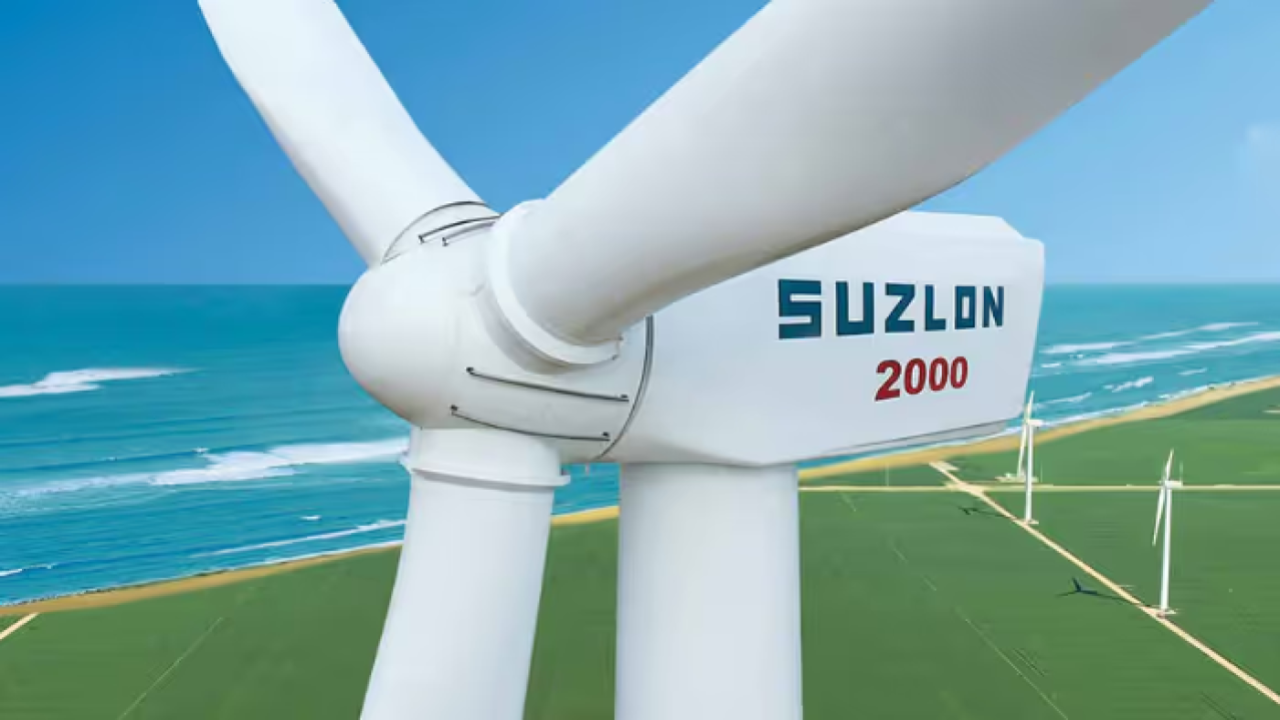
Suzlon Share में आ सकती है 30% की तगड़ी तेजी! दिग्गज ब्रोकरेज ने दी 'BUY' रेटिंग – आज 4% उछला शेयर
However, delayed payments from some distribution companies (DISCOMs) have historically strained cash flows. The Ministry of Power has implemented reforms to improve financial discipline.
Domestic manufacturing incentives aim to reduce reliance on imported solar modules. The government’s production-linked incentive (PLI) scheme supports local solar manufacturing, but supply chain adjustments may influence project costs.
Is Bhadla Enough for 2030?
Bhadla demonstrates that India can build renewable infrastructure at scale. However, analysts consistently note that a single mega-project cannot define national success.
Reaching 500 GW by 2030 requires sustained annual additions, storage integration, and grid modernization. It also requires policy clarity to maintain investor confidence.
“Large solar parks are essential, but they are only part of the solution,” Birol has said in broader IEA commentary. “System flexibility and investment will determine long-term success.”
Related Links
Bhadla Solar Park stands as a landmark in India’s India’s Largest Solar Park energy transformation, symbolizing rapid progress in renewable deployment. Yet the 2030 benchmark will depend on multiplying similar efforts nationwide, expanding storage capacity, strengthening transmission networks, and ensuring financial stability across the power sector.
The desert installation in Rajasthan may be a global emblem of scale, but India’s renewable future will be measured by sustained growth across the entire energy system.
FAQs
How much power does Bhadla generate?
Its 2,245 MW capacity can generate billions of kilowatt-hours annually, powering millions of households.
What is India’s 2030 renewable goal?
India aims to achieve 500 GW of non-fossil fuel capacity by 2030.
Does solar fully replace coal in India?
Coal remains a significant electricity source, though solar’s share is growing steadily.