
The Bihar Free Solar Scheme, under the expanded Kutir Jyoti Yojana, will provide free rooftop solar systems to around 2.5 lakh below-poverty-line (BPL) households in the state.
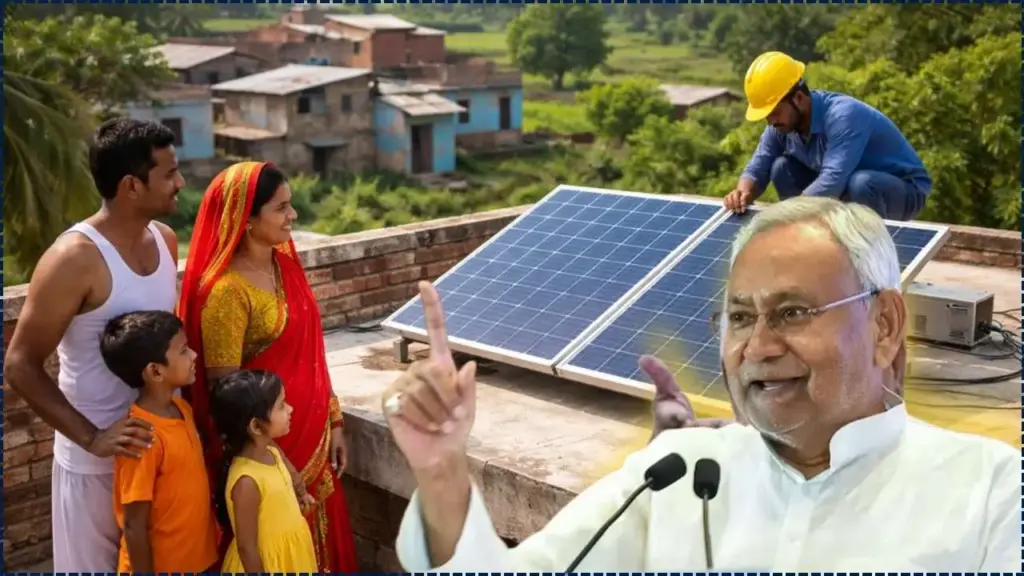
Announced in 2026, the programme aims to reduce electricity costs, improve energy access in rural areas, and support India’s transition to renewable energy.
What is the Bihar Free Solar Scheme?
The scheme is a fully subsidised rooftop solar initiative designed specifically for economically weaker households. Under this programme:
- Each selected household will receive a 1–1.5 kW rooftop solar system
- The entire cost is covered by the government, including installation
- Beneficiaries will not be required to pay upfront or later
Officials from the Bihar Renewable Energy Development Agency (BREDA) have described the scheme as a “targeted intervention to ensure equitable access to clean energy.”
Who Will Benefit?
Eligibility Criteria
The scheme is intended for:
- Below Poverty Line (BPL) households
- Families in rural or semi-urban areas
- Households with usable rooftop space
Priority is expected for regions facing frequent power shortages or limited grid access.
Required Documents
Applicants will likely need:
- Aadhaar card
- Proof of residence
- Electricity bill or connection details
- BPL certificate
Applications may be processed through digital platforms or local government offices.
Why This Scheme Matters
Addressing Energy Poverty
Despite improvements in electrification, many households in Bihar still face intermittent supply and rising electricity costs. According to energy policy observers, decentralised solar systems can provide a reliable alternative.
A senior energy official noted that “solar rooftop systems can significantly reduce dependence on unreliable grid supply in rural regions.”
Financial Relief for Poor Households
Electricity expenses often consume a significant share of household income among low-income families. With solar power:
- Monthly electricity bills could drop sharply
- In some cases, households may pay almost nothing for electricity
Environmental Benefits
The scheme aligns with India’s climate commitments. Solar energy reduces reliance on fossil fuels and helps lower carbon emissions.
How the Scheme Will Be Implemented
Institutional Framework
The programme will be implemented through:
- BREDA (Bihar Renewable Energy Development Agency)
- State electricity distribution companies (DISCOMs)
- Empanelled private solar vendors
Installation Process
- Beneficiary identification
- Rooftop assessment
- System installation
- Testing and commissioning
Officials say installations will be monitored digitally to ensure transparency.
Maintenance and After-Sales Support
One of the key additions to the scheme is expected to be:
- Initial maintenance support by vendors
- Possible service agreements for system upkeep
Experts stress that maintenance will be critical for long-term success.
Comparison with Other Solar Schemes in India
The Bihar Free Solar Scheme differs from central programmes like rooftop solar subsidies, which often require beneficiaries to contribute part of the cost.
Key Differences:
| Feature | Bihar Scheme | Typical Central Scheme |
|---|---|---|
| Cost to beneficiary | Free | Partial payment required |
| Target group | BPL households | General population |
| Scale | State-specific | Nationwide |
| Focus | Welfare + energy access | Energy transition |
Energy analysts say Bihar’s model represents a more welfare-oriented approach.
Economic and Employment Impact
Job Creation
The scheme is expected to generate employment in:
- Solar panel installation
- Technical maintenance
- Supply chain and logistics
Industry experts estimate that large-scale solar deployment can create thousands of local jobs.
Boost to Local Economy
Increased energy access can support:
- Small businesses
- Agricultural activities
- Rural entrepreneurship
Reliable electricity is often linked to improved economic productivity.
Challenges and Risks
While the scheme has been widely welcomed, experts highlight potential risks.
Implementation Challenges
- Ensuring quality installations at scale
- Avoiding delays in procurement and delivery
- Monitoring vendor performance
Financial Sustainability
Some analysts question whether fully subsidised schemes can be sustained over time without strong fiscal planning.
Maintenance Concerns
Poor maintenance could reduce system efficiency over time. Experts recommend:
- Regular servicing
- Community awareness programmes
- Clear accountability mechanisms
Beneficiary Impact: A Ground-Level Perspective
If implemented effectively, the scheme could significantly change daily life for beneficiaries.
Expected Improvements:
- Reliable lighting for homes
- Better access to education (lighting for study)
- Reduced dependence on diesel generators or kerosene
A rural development expert explained, “Access to consistent electricity has a direct impact on health, education, and livelihoods.”
Governance and Transparency Measures
To ensure accountability, the government is expected to introduce:
- Digital tracking systems
- Third-party quality audits
- Public grievance mechanisms
Officials say these steps will help maintain trust and efficiency.
National and Policy Significance
The Bihar Free Solar Scheme reflects a broader shift in India’s energy policy toward inclusive renewable energy access.India aims to significantly expand its renewable capacity in the coming years. State-level initiatives like this can play a critical role in achieving those targets.
Policy experts suggest that if successful, Bihar’s model could be replicated in other states with high levels of energy poverty.
Related Links
USDA REAP 2026: Farmers Can Now Get Up to 50% Funding for Solar Projects
Free Solar PV Training 2026: Gain Industry Skills & Placement Support with Top Solar Programs
Public and Political Response
The announcement has received mixed but largely positive reactions:
- Supporters highlight its social and environmental benefits
- Critics raise concerns about cost and execution challenges
Government officials maintain that long-term gains outweigh short-term costs.
The Bihar Free Solar Scheme under Kutir Jyoti Yojana represents a major step toward combining welfare policy with clean energy goals. By targeting 2.5 lakh BPL households with fully subsidised rooftop solar systems, the state is attempting to address energy poverty while supporting sustainable development.
Its success will depend on efficient implementation, strong oversight, and long-term maintenance. If executed effectively, the scheme could become a model for inclusive energy policy across India.