
India’s India’s 2026 Solar Outlook marks a critical transition from incentive-driven growth to a focus on grid integration and system reliability.
With solar capacity expanding rapidly, policymakers, regulators, and industry stakeholders are prioritising transmission infrastructure, storage, and digital grid management to ensure that renewable energy can be efficiently absorbed and distributed.
India’s 2026 Solar Outlook: From Capacity Expansion to System Optimisation
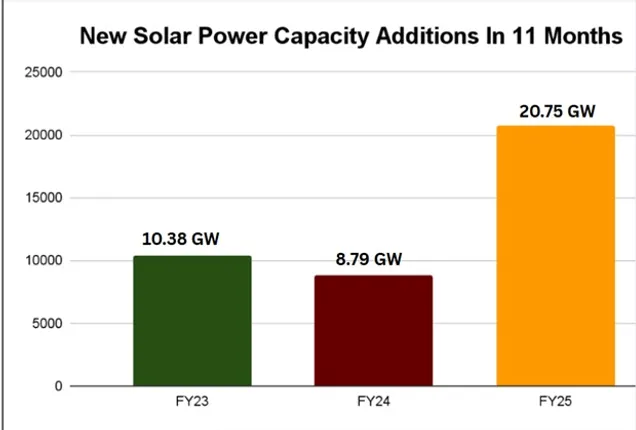
Over the past decade, India has emerged as one of the world’s fastest-growing solar markets. Government-backed auctions, declining module prices, and policy incentives have driven large-scale deployment.
By 2026, solar capacity has crossed significant milestones, making it a central pillar of India’s renewable energy strategy. However, the sector is now entering a new phase. Experts note that the challenge has shifted from building capacity to ensuring that the power system can manage it efficiently.
“India has largely solved the supply-side problem,” said an energy analyst. “The focus now is on integrating that supply into a stable and responsive grid.”
Grid Integration: The Central Challenge
Intermittency and Forecasting Complexity
Solar power generation varies depending on weather and time of day, creating fluctuations in output. This variability poses challenges for grid operators responsible for balancing supply and demand.
To address this, regulators have strengthened forecasting requirements and introduced penalties for deviations from scheduled generation. These measures aim to improve predictability and reduce grid instability.
Transmission Bottlenecks and Curtailment
Despite expansion efforts, transmission infrastructure has struggled to keep pace with solar capacity growth.
In high-generation states such as Rajasthan, Gujarat, and Karnataka, solar power is sometimes curtailed due to insufficient transmission capacity. Curtailment not only reduces efficiency but also affects project economics, raising concerns among developers and investors.
State-Level Disparities
India’s energy landscape is highly decentralised, leading to uneven progress across states.
- Rajasthan and Gujarat: Strong solar growth but transmission congestion.
- Tamil Nadu: Advanced renewable integration but grid stress during peak generation.
- Uttar Pradesh and Bihar: Slower adoption due to infrastructure gaps.
These disparities highlight the need for coordinated national and state-level planning.
Distribution Sector Constraints: The DISCOM Challenge
State-owned distribution companies (DISCOMs) remain a key bottleneck in the renewable transition.
Persistent Issues:
- Financial losses and delayed payments.
- Resistance to rooftop solar due to revenue impact.
- Limited investment in grid modernisation.
Experts emphasise that strengthening DISCOM finances is essential for long-term sustainability.
Role of Energy Storage: From Supportive to Strategic
Energy storage is becoming indispensable in India’s solar ecosystem. Battery Energy Storage Systems (BESS) help:
- Store excess daytime generation.
- Supply power during evening peaks.
- Stabilise grid frequency.
Government tenders increasingly include storage components, signalling a shift towards integrated energy solutions.
Policy Evolution: From Megawatts to Reliability
India’s renewable policy is evolving from a focus on capacity targets to system reliability.
Earlier Approach:
- Rapid capacity addition.
- Subsidies and incentives.
- Competitive bidding.
Current Approach
- Round-the-clock renewable power.
- Hybrid systems (solar + wind + storage).
- Grid resilience and flexibility.
This shift reflects the increasing complexity of managing a renewable-heavy power system.
Emerging Role of Green Hydrogen
Green hydrogen is gaining attention as a complementary solution to solar integration challenges. By using excess solar energy to produce hydrogen, India can:

- Reduce curtailment.
- Store energy for long-term use.
- Support industrial decarbonisation.
Government initiatives are already promoting green hydrogen as part of the broader clean energy strategy.
Corporate Demand and Private Sector Participation
Corporate buyers are playing an increasingly important role in driving solar demand.
Key Trends
- Growth of corporate power purchase agreements (PPAs).
- Demand from data centres and manufacturing sectors.
- Increasing focus on sustainability commitments.
Private sector participation is helping diversify demand beyond traditional utility procurement.
Land, Environment, and Social Constraints
Large-scale solar projects face challenges beyond grid infrastructure.
Key Issues
- Land acquisition delays.
- Environmental clearances.
- Community concerns.
Balancing rapid deployment with sustainable land use remains a critical policy challenge.
Technology and Digitalisation: The Next Enabler
Advanced technologies are becoming essential for managing grid complexity.
Innovations Include
- Smart grids.
- Artificial intelligence for demand forecasting.
- Real-time monitoring systems.
- Automated grid balancing tools.
Experts note that digitalisation will play a crucial role in improving efficiency and reliability.
Workforce and Skill Gaps
As the solar sector evolves, the need for skilled professionals is increasing.
Areas of Demand
- Grid management.
- Energy storage systems.
- Data analytics and forecasting.
Addressing skill gaps will be essential to support the next phase of growth.
Global Context: A Shared Transition Challenge
India’s experience reflects a broader global trend. Countries with high renewable penetration are facing similar issues:
- Grid congestion.
- Need for storage.
- Policy coordination challenges.
India’s approach will be closely watched as a model for other emerging economies.
Related Links
ECO4 Final Countdown: You Have Only 5 Days Left to Claim Free Solar Before the Scheme Ends
Smart Inverters & Dynamic Exports: How New Rules in SA and VIC Affect Your Solar Earnings
What Lies Ahead: The Next Phase of Solar Growth
India’s solar outlook remains positive, supported by:
- Strong policy commitment.
- Falling technology costs.
- Growing investor interest.
However, future growth will depend on:
- Transmission expansion.
- Storage deployment.
- DISCOM reforms.
- Regulatory clarity.
Experts emphasise that integration, not installation, will define success.
India’s India’s 2026 Solar Outlook signals a turning point in the country’s energy transition. While incentives and cost reductions have driven rapid expansion, the focus is now on building a resilient, flexible power system capable of integrating renewable energy at scale.
The success of this phase will determine India’s ability to achieve its long-term clean energy goals.