

Japanese researchers have set a new efficiency benchmark in photovoltaic technology, achieving 12.28% power conversion efficiency in copper gallium selenide solar cells.

The breakthrough, reported by scientists at the National Institute of Advanced Industrial Science and Technology (AIST) in Japan, marks the highest efficiency recorded for indium-free wide-bandgap chalcopyrite solar cells and could support future high-efficiency tandem photovoltaic systems.
Copper Gallium Solar Cells
| Key Fact | Detail |
|---|---|
| Efficiency record | 12.28% power conversion efficiency |
| Technology | Copper gallium selenide (CuGaSe₂) thin-film solar cell |
| Bandgap | ~1.68 eV, suitable for absorbing visible light |
| Research institute | National Institute of Advanced Industrial Science and Technology (AIST) |
New World Record: Japanese Scientists Achieve 12.28% Efficiency in Copper Gallium Solar Cells
Breakthrough in Indium-Free Solar Technology
The achievement announced by the National Institute of Advanced Industrial Science and Technology (AIST) represents an important step in the development of alternative photovoltaic materials.
Scientists developed a solar cell based on copper gallium selenide (CuGaSe₂), a semiconductor belonging to the chalcopyrite family of compounds. Laboratory testing showed the device achieved 12.28% power conversion efficiency, the highest recorded performance for indium-free wide-bandgap chalcogenide solar cells in the 1.65–1.75 electron-volt range.
Lead researcher Shogo Ishizuka said the result demonstrates that copper gallium materials can achieve strong performance without relying on scarce elements. The measurement was independently verified by AIST’s Photovoltaic Calibration, Standards and Measurement Team, confirming the accuracy of the reported efficiency.
Understanding Copper Gallium Selenide Solar Cells
Copper gallium selenide is part of the broader chalcopyrite semiconductor family, which includes materials widely used in thin-film solar technology. The compound has several characteristics that make it attractive for photovoltaic applications:
- A direct bandgap of about 1.68 electron volts, enabling efficient absorption of visible light
- A high optical absorption coefficient, allowing thin layers to capture sunlight effectively
- Strong defect tolerance, helping maintain performance even when microscopic structural imperfections are present.
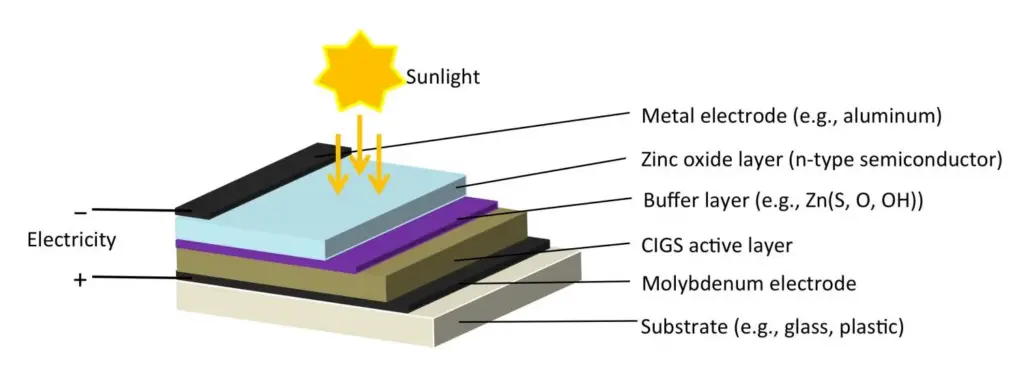
These properties allow copper gallium solar cells to convert sunlight into electricity even when the absorber layer is only a few micrometers thick. This thin-film structure can reduce material usage and manufacturing costs compared with traditional silicon solar cells.
How the Researchers Achieved the Record Efficiency
The Japanese research team improved device performance through several engineering innovations. One key modification involved introducing aluminum within the absorber layer to create a back-surface field. This electric field improves the movement of charge carriers and reduces recombination losses inside the cell.
Researchers also optimized the cadmium sulfide buffer layer and refined deposition processes used to create the thin semiconductor layers. These changes improved several critical electrical parameters, including:
- an open-circuit voltage of 0.996 volts
- a short-circuit current density of 17.9 mA/cm²
- a fill factor of about 68.8%.
Together, these improvements resulted in the record-setting conversion efficiency.
Why Indium-Free Solar Cells Matter
The absence of indium in the copper gallium absorber layer is one of the most important aspects of the research. Indium is a relatively rare element widely used in electronics such as flat-panel displays and semiconductors. Increasing demand has raised concerns about long-term supply availability.
By eliminating indium, copper gallium solar cells could offer a more sustainable and scalable alternative to conventional thin-film technologies. Researchers say developing photovoltaic materials made from more abundant elements will be essential if solar energy is to expand rapidly worldwide.
Thin-Film Solar Technology in Context
Thin-film solar cells represent the second generation of photovoltaic technology. Unlike traditional silicon panels, which require thick crystalline wafers, thin-film solar cells use extremely thin semiconductor layers deposited onto substrates such as glass or metal.
This approach can provide several advantages:
- lower material consumption
- lightweight module designs
- potential for flexible solar panels.
Related thin-film technologies, such as copper indium gallium selenide (CIGS) solar cells, have achieved laboratory efficiencies exceeding 23%, demonstrating the long-term potential of this material family.

सोलर इन्वर्टर में सबसे ज़्यादा खराबी कहां आती है? जानिए वो पार्ट जिसे बदलवाना पड़ता है सबसे पहले
Role in Tandem Solar Cell Development
Scientists believe copper gallium solar cells could play a significant role in tandem photovoltaic devices, which combine multiple semiconductor layers to capture different wavelengths of sunlight.
Wide-bandgap materials like CuGaSe₂ are particularly useful for the top layer of tandem solar cells. In these devices:
- the top layer absorbs high-energy photons
- lower-energy light passes through to a second absorber layer.
This architecture can significantly increase total energy conversion efficiency. Researchers say the new record efficiency demonstrates that copper gallium materials may be suitable candidates for such advanced solar technologies.
Global Race to Improve Solar Efficiency
The development comes amid a global effort to improve solar cell performance. Higher efficiency allows solar panels to produce more electricity from the same surface area, reducing installation costs and land requirements.
Several emerging technologies are competing to push the limits of photovoltaic performance, including:
- perovskite solar cells
- silicon-perovskite tandem cells
- organic photovoltaics
- advanced thin-film semiconductors.
Each approach seeks to overcome the theoretical efficiency limits of traditional single-junction solar cells.
Japan’s Leadership in Solar Research
Japan has long been a major contributor to solar technology research. Government-supported institutions such as AIST conduct advanced research in materials science, renewable energy systems, and next-generation photovoltaic technologies.
Japanese scientists have also played key roles in pioneering new solar materials. For example, chemist Tsutomu Miyasaka helped develop perovskite solar cells, one of the fastest-growing photovoltaic technologies.
Japan has committed to achieving carbon neutrality by 2050, which has increased national investment in renewable energy innovation.
Commercialization Challenges
Despite the promising record, copper gallium solar cells remain primarily a laboratory technology. Researchers must address several challenges before large-scale commercial deployment becomes possible. These include:
- improving efficiency further
- ensuring long-term device stability
- scaling manufacturing processes
- reducing production costs.
Silicon solar panels currently dominate the global photovoltaic market because their manufacturing supply chains are mature and highly efficient.

Suzlon Energy Near 52-Week Low: Is This Multibagger Now a 'Buy' After a Month of Consolidation?
Nevertheless, researchers say emerging materials could complement existing technologies rather than replace them.
Implications for the Renewable Energy Transition
Solar power is already one of the fastest-growing sources of electricity worldwide. According to energy analysts, continued improvements in photovoltaic efficiency and manufacturing techniques will be essential for meeting global climate goals.
Innovations such as indium-free solar materials could help reduce supply chain risks and lower the cost of renewable energy deployment. The new efficiency record demonstrates how ongoing research continues to expand the range of viable solar technologies.

Related Links
Global Solar Market Outlook (2025-2033): Key Trends and Growth Drivers Revealed
Solar vs. Nature: Jefferson County Project Faces Backlash Over Rare Ecosystem Impact
The new efficiency record achieved by Japanese scientists highlights the rapid pace of innovation in solar energy research. While copper gallium solar cells remain in the experimental stage, the breakthrough underscores the growing potential of indium-free materials to support future high-efficiency photovoltaic systems.
FAQs
What is copper gallium selenide?
Copper gallium selenide (CuGaSe₂) is a semiconductor material used in thin-film solar cells that belongs to the chalcopyrite family of photovoltaic materials.
Why is the 12.28% efficiency record important?
It represents the highest efficiency achieved for indium-free wide-bandgap chalcopyrite solar cells, demonstrating the potential of alternative photovoltaic materials.
Can copper gallium solar cells replace silicon panels?
Not immediately. Silicon technology remains dominant. Copper gallium cells may initially be used in tandem solar systems or specialized applications.
What are tandem solar cells?
Tandem solar cells stack multiple semiconductor layers to capture different wavelengths of sunlight, allowing higher overall efficiency.