
Karnataka’s Green Budget outlines an ambitious plan to expand renewable energy and electric mobility infrastructure across the state.
The government has announced plans to install 3,000 megawatts of solar power, build 1,250 EV charging stations, and deploy ₹3,400 crore worth of battery energy storage systems to strengthen the electricity grid and accelerate the transition to cleaner energy.
Karnataka’s Green Budget Marks a Major Energy Policy Shift
The announcement represents one of the most significant renewable energy initiatives announced by an Indian state government in recent years. Officials from the Government of Karnataka say the policy is designed to improve energy reliability, reduce fossil fuel dependence, and support India’s climate commitments.
The plan was presented during the state’s latest budget session in the Karnataka Legislative Assembly. The strategy combines renewable power generation, grid stabilisation through battery storage, and infrastructure for electric vehicles.
Energy analysts say such integrated policy frameworks are increasingly necessary as renewable power becomes a larger share of electricity generation.
“Solar power growth must be accompanied by grid upgrades and storage capacity,” said Rahul Tongia, senior fellow at the Brookings Institution India Center. “States that address these issues together will be better positioned to manage future energy demand.”
Expanding Solar Capacity by 3,000 MW
Solar Power for Agricultural Electricity
A central component of Karnataka’s Green Budget is the addition of 3,000 megawatts (3 GW) of solar generation capacity. Much of this electricity will be used to supply agricultural pump sets under the Mukhya Mantri Saura Krishi Yojane scheme.
Farmers in many parts of India often receive electricity at night because daytime power demand is prioritised for industrial and residential consumers. Solar power installations connected to agricultural feeders could allow farmers to receive power during daylight hours.
Officials say solar plants will be built near substations operated by the Karnataka Power Transmission Corporation Limited (KPTCL).
The projects will likely follow the Renewable Energy Service Company (RESCO) model, where private developers finance and operate the solar installations while the state purchases the electricity.
Investment and Economic Scale
The solar expansion programme is expected to attract investments exceeding ₹10,000 crore. Energy sector experts say large renewable projects often create employment across multiple sectors including construction, engineering, logistics, and operations.
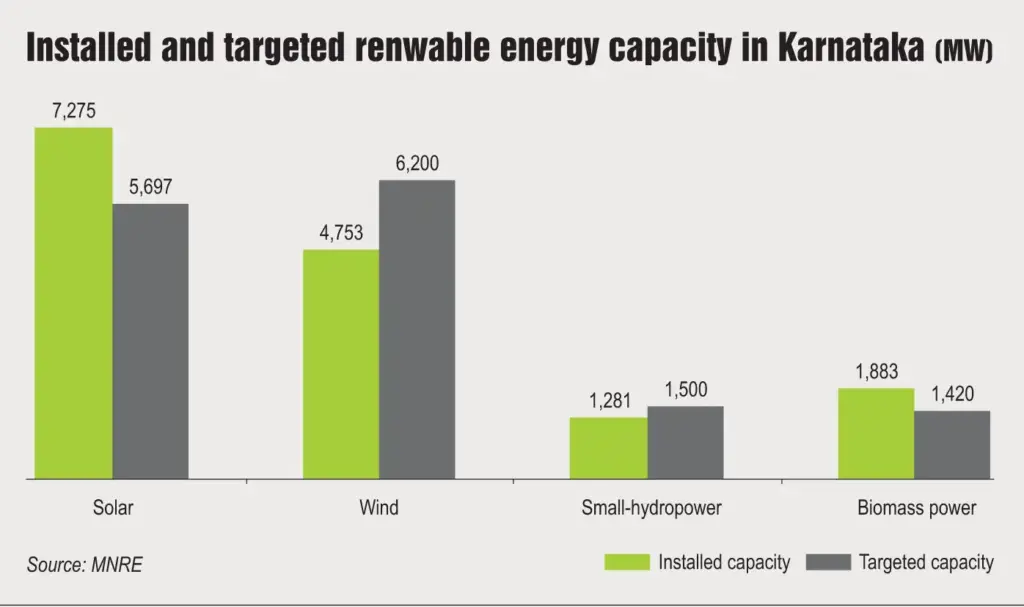
Karnataka already hosts the Pavagada Solar Park, which has more than 2,000 MW of installed capacity. The new projects could further strengthen the state’s position as one of India’s largest solar power producers.
₹3,400 Crore Battery Storage Programme
Role of Battery Energy Storage Systems
Another key feature of Karnataka’s Green Budget is the deployment of Battery Energy Storage Systems (BESS) worth about ₹3,400 crore. The proposed system will provide 2,000 megawatt-hours (MWh) of storage capacity.
Battery storage plays a crucial role in renewable energy systems because solar and wind power fluctuate depending on weather conditions and time of day.
Energy stored during peak solar generation periods can be released later when electricity demand rises.
According to officials, storage projects are planned at substations including Huliyur, Pavagada, and Kushtagi, locations already connected to renewable power infrastructure.
“Energy storage will be essential for India’s clean power transition,” said Dr. Ajay Mathur, Director General of the International Solar Alliance. “It ensures renewable electricity remains reliable and available even when generation fluctuates.”
Building 1,250 EV Charging Stations
Expanding Electric Mobility Infrastructure
The budget also includes plans to install 1,250 electric vehicle charging stations across Karnataka. Officials estimate the project will require ₹777 crore in investment and will be implemented through the state’s electricity distribution companies.
Charging infrastructure will be installed in cities, highways, and commercial zones. The expansion aims to support the rapid growth of electric mobility across India.
According to the International Energy Agency (IEA), access to reliable charging networks is a critical factor influencing EV adoption.
Karnataka’s Position in India’s EV Industry
Karnataka has already established itself as a hub for electric mobility manufacturing and technology. Several EV companies and battery manufacturers operate in and around Bengaluru, which has become a centre for electric vehicle innovation and startups.
“Karnataka has been one of the early adopters of EV policies in India,” said Sohinder Gill, Director General of the Society of Manufacturers of Electric Vehicles (SMEV). “Expanding charging infrastructure will further accelerate adoption.”
Strengthening the State’s Electricity Grid
The renewable energy push will also require improvements in transmission infrastructure. Officials say the government plans to construct 100 new substations to support increasing renewable power capacity.
Transmission upgrades are necessary because solar and wind power plants are often located in remote areas. Without adequate transmission lines, electricity cannot be delivered efficiently to cities and industrial centres.
According to the Central Electricity Authority (CEA), India must significantly expand its transmission network to integrate the renewable energy projects planned for the coming decade.
Research and Innovation Partnerships
The government has also announced plans to create a renewable energy incubation centre. The centre will operate in collaboration with:
- Indian Institute of Science (IISc), Bengaluru
- Indian Institute of Management Bangalore (IIMB)
- University of New South Wales (UNSW), Australia
The initiative aims to promote research in battery technology, smart grids, and renewable energy integration. Experts say academic partnerships are essential for developing new technologies that support large-scale renewable energy systems.
Economic Impact and Job Creation
The renewable energy and infrastructure investments proposed under Karnataka’s Green Budget could generate significant economic activity. Energy analysts say projects of this scale typically create thousands of jobs in construction, engineering, manufacturing, and project management.
Renewable energy development also attracts private investment from both domestic and international companies.
According to industry estimates, India’s renewable energy sector could attract over $200 billion in investment by 2030. State policies that provide clear regulatory frameworks are considered important for attracting such capital.
Comparison with Renewable Policies in Other States
Karnataka’s announcement comes as several Indian states accelerate renewable energy investments.

- Gujarat has expanded solar parks and offshore wind plans.
- Rajasthan continues to develop large-scale solar and wind projects in desert regions.
- Tamil Nadu remains a leader in wind energy production.
Energy policy analysts say competition between states often accelerates renewable deployment across India. “State governments play a decisive role in India’s clean energy expansion,” said Karthik Ganesan, fellow at the Council on Energy, Environment and Water (CEEW).
Timeline and Implementation
While the budget outlines the scale of the initiative, implementation will occur in phases. Officials say project tenders for solar plants and battery storage facilities could begin within the next year.
The rollout of EV charging stations is expected to take place gradually across major cities and highways. Industry observers say clear timelines and transparent bidding processes will be critical for project success.
Challenges and Risks
Despite broad support for the initiative, experts note several potential challenges. These include:
- Land acquisition for solar installations
- Financing and investor participation
- Integration of renewable power into existing grid infrastructure
Battery storage deployment also remains relatively new in India. Developing regulatory frameworks and pricing mechanisms will be essential for ensuring financial viability.
Global Context: India’s Energy Transition
The initiatives announced in Karnataka’s Green Budget align with India’s broader climate commitments. India has pledged to reach net-zero carbon emissions by 2070, a target announced during the United Nations Climate Change Conference (COP26).
The country has also committed to installing 500 gigawatts of non-fossil fuel electricity capacity by 2030. Achieving these targets will require major investments in renewable energy, electric transport, and grid modernisation.
State-level policies such as Karnataka’s renewable expansion play a key role in meeting those national goals.
Related Links
Sun Sheroes: Women Empowerment at the Forefront of Tata Power’s 300 MW Koppal Solar Project
India’s Cleantech Job Market Booms: Delhi-NCR Leads with 44% of New Hires
Karnataka’s Green Budget represents a significant step toward expanding renewable energy and strengthening electricity infrastructure in one of India’s fastest-growing states.
By combining solar expansion, battery storage deployment, and EV charging infrastructure, the government aims to create a more resilient energy system while supporting the country’s climate commitments.
The success of the initiative will depend on efficient project execution, private sector participation, and continued investment in grid infrastructure and technological innovation.