The U.S. solar sector faces a critical inflection point in 2026 as trade tariffs and domestic manufacturing incentives reshape pricing dynamics.
In Made in America’ Solar vs. 2026 Tariffs: Will Panel Prices Surge This Year?, the central issue is whether rising import duties—combined with policies favoring U.S.-made panels—will increase solar costs in the near term while building a domestic supply chain for the future.
Made in America’ Solar vs. 2026 Tariffs
| Key Fact | Detail |
|---|---|
| Tariff Levels | Some duties exceed 100% on imports |
| Cost Impact | Tariffs historically raise panel prices |
| Domestic Push | Strong federal incentives for U.S. manufacturing |
| Risk | Higher costs may slow solar adoption |
The Policy Conflict Behind Made in America’ Solar vs. 2026 Tariffs: Will Panel Prices Surge This Year?
At the center of Made in America’ Solar vs. 2026 Tariffs: Will Panel Prices Surge This Year? is a policy conflict between industrial strategy and affordability. The U.S. government is pursuing two goals simultaneously:
- Expanding domestic solar manufacturing
- Maintaining affordable solar deployment
Tariffs are being used to protect domestic manufacturers from foreign competition, particularly from Asia, where production costs are lower. However, these tariffs also increase the cost of imported panels, which still supply a large share of the U.S. market.
A Brief History of U.S. Solar Tariffs
Early Trade Actions (2012–2018)
The U.S. first imposed anti-dumping and countervailing duties on Chinese solar panels in 2012. In 2018, safeguard tariffs were introduced under Section 201 of U.S. trade law.
Expansion and Circumvention Cases (2020–2024)
Investigations expanded to Southeast Asia, where manufacturers shifted production to avoid tariffs.The U.S. Commerce Department launched anti-circumvention probes targeting imports from Vietnam, Malaysia, Thailand, and Cambodia.
Escalation in 2025–2026
New tariff proposals and enforcement actions have pushed duties on some imports above 100%, significantly altering market dynamics.
How Solar Pricing Actually Works
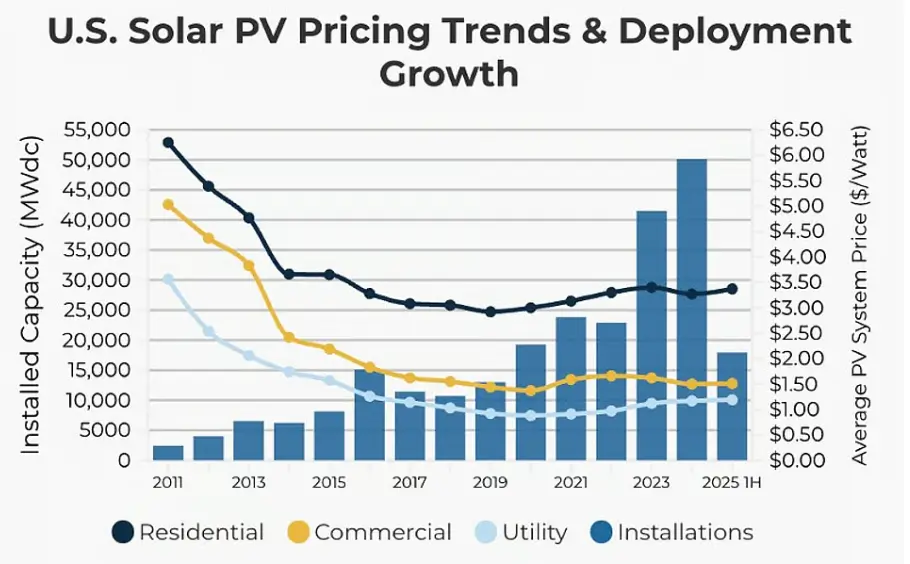
Understanding the impact of tariffs requires breaking down solar system costs.
Typical Cost Structure
- Solar panels: 30–40% of total system cost
- Inverters and equipment: 10–20%
- Labor and installation: 30–40%
- Permitting and soft costs: 10–20%
Because panels are only part of total costs, tariffs do not affect the entire system equally. However, panel price increases still have a significant impact on overall project economics.
Real Cost Impact: Residential and Utility Projects
Residential Example
- Base system cost: $20,000
- Panel share: ~$7,000
If tariffs increase panel costs by 30%:
- Additional cost: ~$2,100
- Total system cost: ~$22,100
Utility-Scale Example
Large solar farms are more sensitive to panel pricing. A 100 MW project could see cost increases in the millions if panel prices rise significantly. This affects project viability and financing decisions.
Why Tariffs Are Being Enforced
Protecting Domestic Industry
U.S. manufacturers argue that foreign competitors benefit from:
- Government subsidies
- Lower labor costs
- Integrated supply chains
Tariffs are intended to create fair competition.
Encouraging Investment
Federal policy aims to attract investment in domestic manufacturing. The U.S. Department of Energy (DOE) reports that dozens of new solar factories have been announced since 2022.
The Role of the Inflation Reduction Act
The Inflation Reduction Act (IRA) plays a central role in shaping the solar market. It includes:
- Tax credits for domestic manufacturing
- Bonus incentives for projects using U.S.-made components
- Long-term policy certainty for investors
These incentives are designed to offset the higher costs of domestic production. However, analysts note that scaling up manufacturing will take time.

Toyota’s 1200KM Miracle: Why US car buyers are waiting for the late 2026 Solid-State EV launch
Supply Chain Challenges
Despite policy support, the U.S. solar supply chain remains incomplete. Key gaps include:
- Solar cell production
- Wafer manufacturing
- Polysilicon processing
Many “Made in America” panels still rely on imported components. This limits the immediate impact of domestic manufacturing on pricing.
Industry Divide: A Split Market
Manufacturers’ Perspective
Domestic manufacturers support tariffs as essential for industry growth. They argue that:
- Without protection, U.S. factories cannot compete
- Domestic production enhances energy security
Developers’ Perspective
Solar developers and installers emphasize affordability. They warn that:
- Higher costs reduce project demand
- Installation jobs could be affected
- Consumers may delay adoption
According to the Solar Energy Industries Association (SEIA), installation jobs make up the majority of solar employment.
Investor and Financing Perspective
Tariffs also affect how solar projects are financed. Banks and investors evaluate:
- Project cost stability
- Long-term returns
- Policy certainty
Higher costs can increase financial risk. Tax equity investors, who fund many large solar projects, may require higher returns if costs rise. This can slow project development.
Global Comparison: How the US Differs
The U.S. approach contrasts with other major markets.
China
- Dominates global solar manufacturing
- Benefits from economies of scale
- Produces panels at lower cost
European Union
- Focuses on diversification rather than tariffs
- Balances imports with local production incentives
The U.S. strategy emphasizes domestic manufacturing more heavily than most other regions.
Climate Goals vs Industrial Policy
The tariff debate highlights a broader policy challenge. Solar energy is essential for meeting U.S. climate targets. However, higher costs may slow deployment. A report cited by Reuters warned that rising solar costs could complicate efforts to expand renewable energy capacity.

This creates a trade-off:
- Faster deployment with cheaper imports
- Stronger domestic industry with higher costs
Short-Term vs Long-Term Price Outlook
Short-Term (2026–2028)
- Prices likely to increase due to tariffs
- Supply chain adjustments may cause volatility
- Project delays may occur
Long-Term (Beyond 2028)
- Domestic manufacturing could reduce costs
- Technological improvements may offset tariffs
- Global competition may stabilize pricing
Most analysts expect temporary price increases followed by gradual stabilization.
Related Links
Global Solar Market Outlook (2025-2033): Key Trends and Growth Drivers Revealed
New CPCB Guidelines: How India Plans to Manage Growing Solar E-Waste Challenges
The question at the heart of Made in America’ Solar vs. 2026 Tariffs: Will Panel Prices Surge This Year? reflects a broader transformation in U.S. energy policy. While tariffs may strengthen domestic manufacturing, they also introduce short-term cost pressures.
The balance between affordability and industrial growth will shape the future of solar adoption in the United States.
FAQs
Why are tariffs increasing?
To protect domestic manufacturers from subsidized foreign competition.
Will solar prices rise in 2026?
Short-term price increases are likely due to tariffs and supply constraints.
Are U.S.-made panels cheaper?
Currently, domestic panels often cost more due to higher production expenses.
Do tariffs affect all solar imports?
No. Tariffs target specific countries and products.
Is solar still a good investment?
Yes, in many cases, due to long-term energy savings and incentives.