
Indian firms NeevCloud and Agnikul Cosmos have announced plans to deploy solar-powered space data centres in low Earth orbit (LEO) by late 2026, marking a significant step in the evolution of India’s artificial intelligence infrastructure.

The NeevCloud & Agnikul Cosmos initiative aims to combine orbital solar power, reusable rocket technology, and high-performance AI computing to create a new layer of cloud services operating beyond terrestrial limits.
According to company statements reported by national business publications, a pilot mission is expected before the end of 2026, with phased commercial operations planned from 2027 onward.
NeevCloud & Agnikul Cosmos Initiative: Extending Cloud Infrastructure into Orbit
The NeevCloud & Agnikul Cosmos concept proposes hosting AI inference hardware aboard a modified upper stage of Agnikul’s launch vehicle. Instead of discarding the rocket stage after payload deployment, the companies plan to convert it into an operational computing platform.
Srinath Ravichandran, Co-founder and Chief Executive Officer of Agnikul Cosmos, stated in media briefings that the company’s modular launch design allows post-mission stage utilisation. “Our convertible upper-stage architecture enables the stage to function as an active orbital platform rather than debris,” he said.
Narendra Sen, Founder and CEO of NeevCloud, described the initiative as a step towards building a “sovereign AI infrastructure layer” that reduces dependence on overseas data centres.
The orbital data centre is expected to operate at an altitude of approximately 350 to 500 kilometres, within low Earth orbit, allowing frequent communication with ground stations.
Why Consider Space-Based Data Centres?
AI workloads are expanding rapidly, driven by generative AI models, real-time analytics, and edge computing applications. According to the International Energy Agency (IEA), global electricity demand from data centres, AI, and cryptocurrency operations has risen steadily and may continue increasing due to the proliferation of AI services.
Terrestrial data centres face multiple constraints:
- High energy consumption and grid dependency
- Cooling infrastructure that often relies on water-intensive systems
- Land availability challenges in urban regions
The space-based model proposes to address some of these challenges by leveraging near-continuous solar exposure in orbit and radiative cooling through the vacuum of space.
However, experts note that transmitting data to orbit and back introduces additional technical complexities and may not eliminate latency for all use cases.
Technical Architecture and Payload Details
According to company disclosures cited in business media, the first orbital platform may carry a payload weighing approximately 300 to 350 kilograms. The system is expected to include high-performance AI processors optimised for inference workloads.
Power will be supplied by deployable solar panels combined with onboard battery storage for periods of orbital eclipse. Data transmission is likely to occur via radio frequency or optical communication links.
Space-qualified electronics must endure radiation, vacuum conditions, and temperature fluctuations. These requirements increase engineering complexity compared to ground-based hardware.
Dr. Rajeswari Pillai Rajagopalan of the Observer Research Foundation has previously emphasised that commercial expansion in orbit must balance innovation with responsible space operations to prevent debris accumulation.
Environmental Considerations
Supporters argue that orbital data centres could reduce terrestrial cooling requirements and reliance on fossil-fuel-based power generation.
India’s electricity mix continues to include a substantial share of coal-based generation, according to data from the Central Electricity Authority (CEA). Shifting compute energy consumption to solar-powered orbital systems may contribute to long-term emissions reductions.
However, rocket launches generate emissions, and lifecycle environmental impacts remain under study. Experts say comprehensive assessment is needed to evaluate whether space-based infrastructure delivers net climate benefits.

Regulatory Framework and Oversight
India’s private space activities operate under the oversight of the Indian National Space Promotion and Authorisation Centre (IN-SPACe) and the Department of Space.
Orbital deployments must comply with international space law, including obligations under the Outer Space Treaty. Frequency allocation and collision avoidance coordination also require regulatory approvals.
The United Nations Office for Outer Space Affairs (UNOOSA) has repeatedly called for sustainable practices in low Earth orbit as satellite numbers increase globally.
Global Competition in Orbital Computing
India’s initiative joins a broader international exploration of space-based computing. Reports by Reuters and Data Center Dynamics indicate that companies in the United States and Europe are evaluating similar concepts involving GPU-equipped satellites.
While several startups have announced plans, large-scale commercial viability remains unproven. Launch costs, insurance requirements, maintenance, and hardware longevity in orbit are key uncertainties.
Analysts say India’s comparatively lower launch costs and expanding private space sector could provide a competitive advantage.
Economic and Strategic Implications
From a strategic perspective, hosting AI workloads in orbit may enhance national technological autonomy. Sovereign AI infrastructure has become a policy priority as countries seek to control sensitive data and reduce foreign dependence.
Industry analysts suggest potential applications in:
- Remote sensing and satellite imagery processing
- Defence and border monitoring analytics
- Maritime tracking and disaster response modelling
- Autonomous systems requiring rapid inference
Financial feasibility remains a central question. Experts note that maintaining hardware reliability in orbit may require frequent upgrades or replacement missions.
Venture capital funding and strategic partnerships will likely play a role in scaling the initiative beyond the pilot phase.
Cybersecurity and Data Protection
Operating AI systems in orbit introduces cybersecurity considerations. Secure communication channels and encryption protocols will be essential to prevent interception or data breaches.
Cybersecurity analysts note that while physical access to orbital systems is restricted, communication links remain potential vulnerabilities. Ensuring compliance with India’s Digital Personal Data Protection Act and other regulatory frameworks will be critical for commercial deployment.
बिजली बिल से मिलेगा छुटकारा! सरकार दे रही 78% अनुदान, लगाएं सोलर सिस्टम जानें कैसे करें आवेदन
Risk Factors and Engineering Challenges
Several technical risks remain:
- Radiation-induced hardware degradation
- Orbital debris collision threats
- Signal latency variability
- High capital expenditure
Space insurance costs may further influence commercial viability. Industry experts stress that rigorous testing will be essential before scaling operations.
Potential Benefits for India’s Space Ecosystem
The initiative reflects India’s broader ambition to expand its private space sector following reforms in 2020 that opened the industry to private participation.
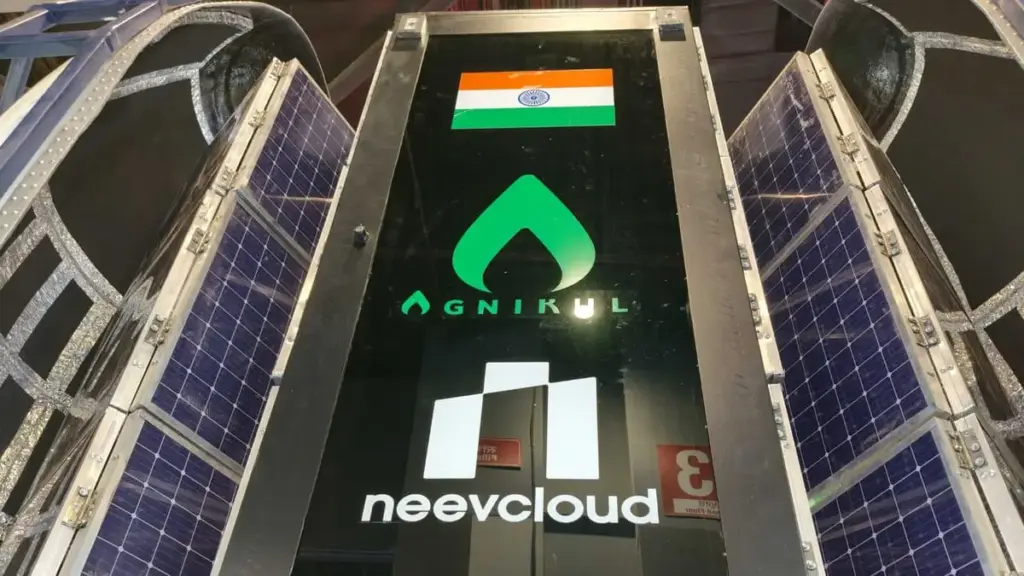
Agnikul Cosmos represents one of several emerging Indian launch providers contributing to this ecosystem. By combining launch services with orbital infrastructure, the company aims to integrate vertically within the space value chain.
If successful, the NeevCloud & Agnikul Cosmos initiative could position India among early adopters of orbital computing infrastructure.
Related Links
Get Certified by Govt of India! Join the ‘Surya Mitra’ Program for Free Training and Solar Jobs.
The pilot launch planned for late 2026 will serve as a proof-of-concept demonstration. Performance data from this mission will determine whether the companies proceed toward scaling a constellation of orbital data centres.
Industry observers say sustained performance, regulatory approval, financial backing, and client demand will shape the project’s trajectory.
The NeevCloud & Agnikul Cosmos initiative represents an ambitious intersection of AI, renewable energy, and space technology. Whether it evolves into mainstream infrastructure will depend on engineering reliability and economic viability in the years ahead.
NeevCloud and Agnikul Cosmos’ plan to launch solar-powered space data centres by late 2026 marks a notable development in India’s private space and AI sectors. The project reflects growing ambition to build sovereign AI infrastructure and leverage solar energy in orbit.
While technical and regulatory challenges remain, the initiative signals India’s entry into a global race to redefine the future of cloud computing beyond Earth.