

In Nova Scotia Solar 2026, homeowners are increasingly favoring 1:1 net metering over one-time government grants, as long-term savings and energy independence take priority over upfront discounts.

Analysts say the policy’s ability to generate ongoing financial returns is reshaping how residents evaluate solar investments across the province.
Nova Scotia Solar 2026
| Key Fact | Detail |
|---|---|
| Net metering value | Credits equal retail electricity rates |
| Financial impact | Lifetime savings often exceed upfront grants |
| Energy flexibility | Functions like a virtual battery |
| Policy durability | Net metering is more stable than grants |
As Nova Scotia Solar 2026 evolves, the shift toward long-term policy mechanisms is becoming clear. While grants provide immediate relief, 1:1 net metering delivers sustained financial, environmental, and operational benefits.
For many homeowners, the decision increasingly hinges on long-term value rather than short-term savings.
Understanding Nova Scotia Solar 2026 Policy Landscape
Nova Scotia has positioned itself as a leader in distributed renewable energy adoption in Canada. At the center of its strategy is a 1:1 net metering policy, which allows solar users to export surplus electricity to the grid and receive full retail credit.
This means each unit of electricity sent to the grid offsets an equal unit consumed later. Credits can be carried forward, helping homeowners balance seasonal changes in solar production.
By contrast, one-time grants provide an upfront financial incentive but do not affect long-term energy costs once the system is installed.
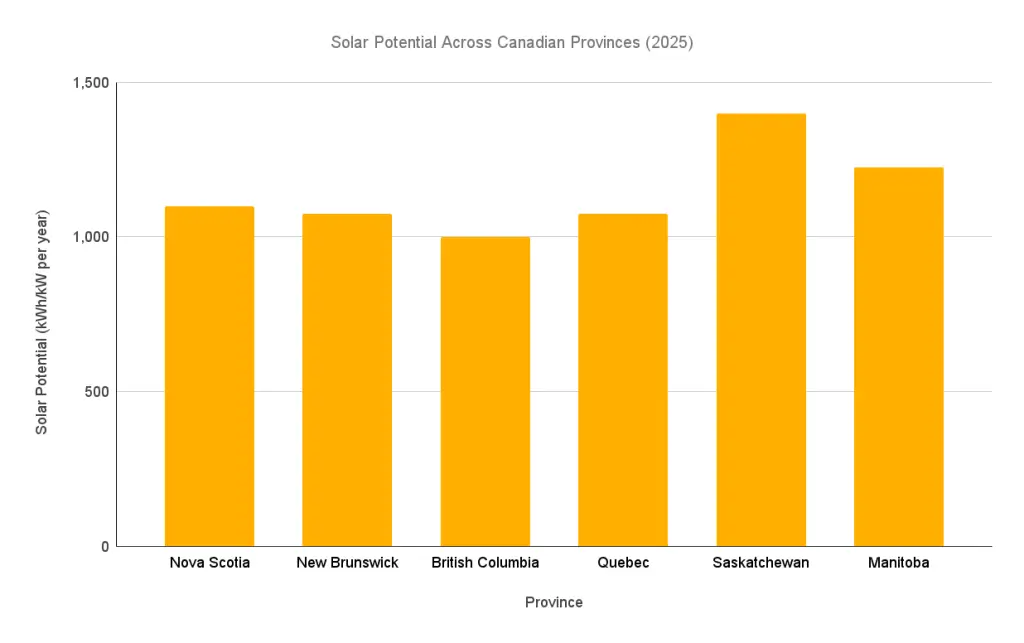
Nova Scotia Solar 2026: Long-Term Economics of Net Metering
Recurring Value vs One-Time Savings
The most significant advantage of net metering lies in its long-term financial structure. A one-time grant might reduce installation costs by several thousand dollars. However, net metering creates continuous savings over decades.
Every kilowatt-hour generated reduces future electricity bills, effectively turning solar panels into a revenue-generating asset. Over a 25-year system lifespan, these recurring benefits can exceed initial grant values several times over.
Real-World Financial Example
Consider a typical residential solar system:
- System size: 6 kW
- Annual generation: ~7,000 kWh
- Electricity rate: ~$0.18 per kWh
With net metering:
- Annual savings: ~$1,260
- 25-year savings: ~$31,500 (excluding rate increases)
With a $5,000 grant:
- Immediate benefit: $5,000
- No additional long-term value
This simplified example highlights why many homeowners view net metering as a stronger financial tool.
Electricity Price Trends and Inflation Protection
Electricity costs in Canada have historically increased due to infrastructure upgrades, fuel costs, and decarbonization efforts. Net metering offers built-in protection against these increases. As electricity prices rise, the value of solar-generated credits also increases.
A grant, by contrast, is fixed and loses relative value over time. This difference becomes critical in long-term financial planning.
Operational Flexibility: The “Virtual Battery”
Solar panels produce the most energy during daylight hours, often when household demand is low. Net metering allows homeowners to:
- Export excess power during the day.
- Use credits at night or during winter.
This effectively creates a virtual energy storage system, reducing the need for expensive batteries. Industry experts note that this feature significantly improves the practicality of residential solar systems.
Consumer Case Study
A homeowner in Halifax installs a solar system designed to meet 100% of annual electricity needs. During summer:
- Excess energy is exported to the grid.
- Credits accumulate.
During winter:
- Lower solar output is offset by stored credits.
Result:
- Stable annual electricity costs.
- Reduced exposure to seasonal price fluctuations.
Without net metering, much of the excess summer production would lose value.
Policy Stability and Market Confidence
Structural Policy vs Temporary Incentives
Government grants are often tied to budget cycles and political priorities. Many programs are reduced or discontinued as markets mature. Net metering, however, is embedded in regulatory frameworks governing electricity distribution. This makes it more predictable and reliable for long-term investments.
Energy policy analysts emphasize that stability is critical for consumer confidence and market growth.
Environmental and Grid Impact
Supporting Clean Energy Transition
Net metering contributes to:
- Increased renewable energy generation.
- Reduced greenhouse gas emissions.
- Lower dependence on fossil fuels.
By encouraging distributed energy production, it also reduces strain on centralized power plants. However, some utilities argue that widespread net metering can create challenges in grid management and cost distribution. Policymakers continue to balance these concerns.
International Context
Nova Scotia’s 1:1 net metering policy aligns with similar programs in parts of the United States and Europe. However, some regions have reduced compensation rates or introduced export fees, citing grid cost concerns.
This global trend highlights the importance of policy design in maintaining solar adoption while ensuring grid sustainability.

Potential Risks and Future Outlook
Could Net Metering Change?
While currently favorable, net metering policies are not guaranteed to remain unchanged. Possible future adjustments include:
- Reduced credit rates.
- Time-of-use pricing.
- Grid access fees.
Energy experts advise homeowners to consider current policy benefits while remaining aware of potential regulatory shifts.
Related Links
Canada’s ‘Sun-Tax’ Debate: Are Utilities About to Charge You for Exporting Solar?
Australia’s New Solar Recycling Mandate: How Panel Disposal Fees Affect You
Balancing Perspectives: The Role of Grants
Despite their limitations, grants still play an important role in:
- Lowering entry barriers for first-time adopters.
- Supporting low-income households.
- Accelerating early-stage market growth.
Some experts advocate for hybrid models that combine modest grants with strong net metering policies.
FAQs
What is 1:1 net metering?
A system where exported solar energy is credited at the same rate as electricity consumed from the grid.
Why is it better than a grant?
Because it provides continuous savings over the system’s lifespan rather than a one-time benefit.
Does it eliminate electricity bills?
It can significantly reduce them, but fixed charges and net consumption may still apply.
Is net metering guaranteed forever?
No. Policies may evolve, though they are generally more stable than grant programs.