

In a groundbreaking development, scientists have unveiled New 100V Perovskite Cells technology that allows perovskite solar cells to generate up to 100 volts from a single raindrop.
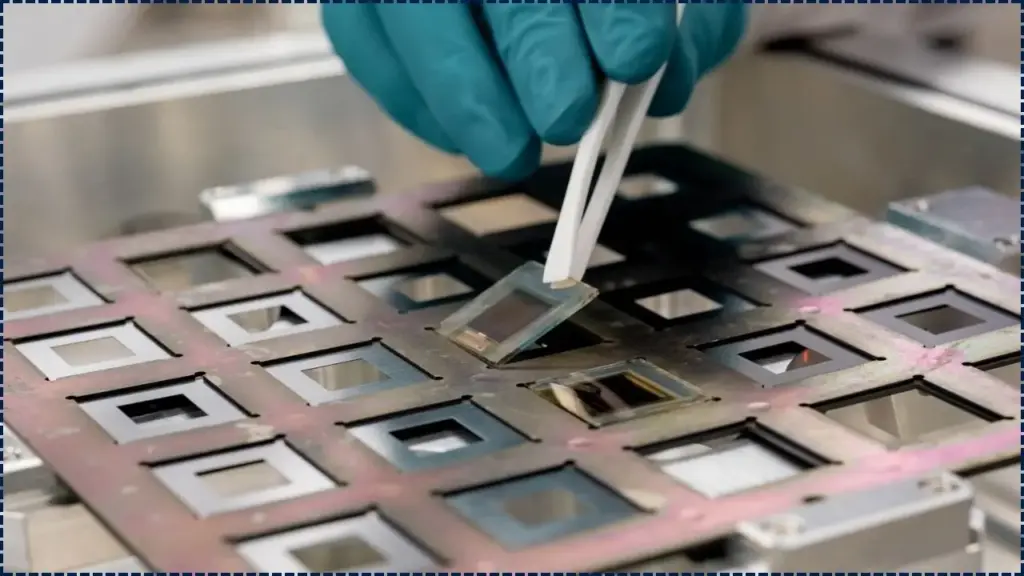
By combining solar power and energy-harvesting technologies, this innovation enables solar cells to work even when the sun isn’t shining, marking a potential game-changer for renewable energy sources, especially in regions with frequent rain.
What Makes Perovskite Solar Cells Special?
Perovskite solar cells are an exciting alternative to traditional silicon-based solar panels due to their high efficiency and low production costs. The materials used in perovskite solar cells can absorb a broad spectrum of light, including blue and ultraviolet rays, which traditional silicon cells cannot fully utilize.
These cells have reached impressive efficiencies in the laboratory and have the potential to reduce solar panel costs by simplifying the manufacturing process. Unlike silicon, which is rigid and often difficult to work with, perovskite materials are flexible and lightweight, enabling innovative uses in both residential rooftops and commercial buildings.
However, until recently, perovskite solar cells struggled with environmental challenges, particularly degradation from moisture and exposure to sunlight. Overcoming these issues has been a key area of research, especially for scaling up perovskite solar cells to meet global energy demands.
A Breakthrough: Harnessing Energy from Rain
How Does the New Technology Work?
Researchers at Helmholtz-Zentrum Berlin and University of Seville have combined perovskite solar technology with triboelectric nanogenerators (TENGs) to create hybrid devices capable of generating energy not just from sunlight but also from raindrops.
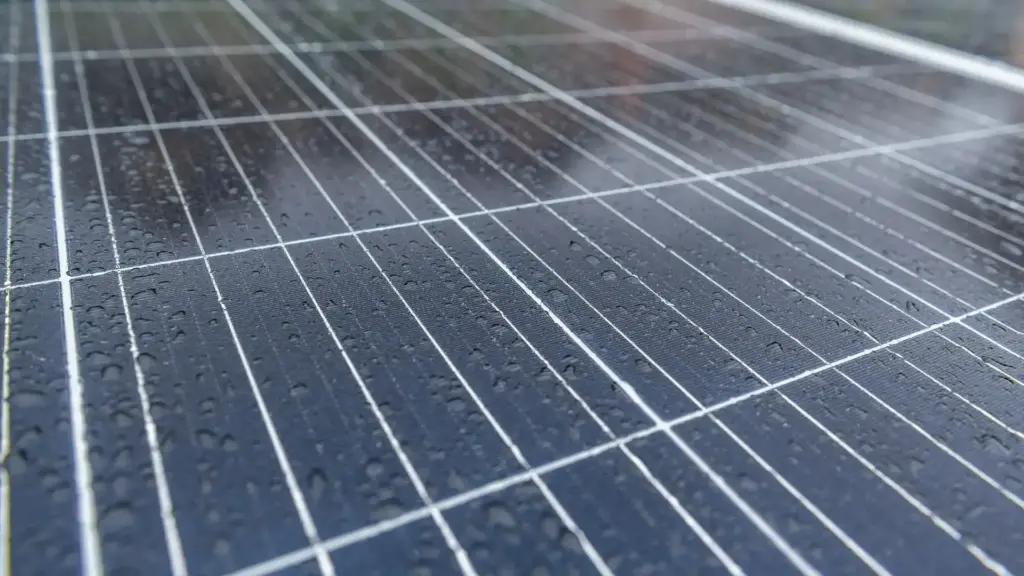
In this hybrid system, the perovskite solar cell absorbs sunlight, while the triboelectric nanogenerator harvests kinetic energy from the impact of raindrops. Perovskite is already known for its high efficiency in sunlight, but this new technology takes it a step further by harnessing the mechanical energy of falling raindrops.
When raindrops hit the surface of the hybrid perovskite cell, they generate electric charge through the triboelectric effect (the same phenomenon that causes static electricity). This energy is then stored and can be used to power small electronics or low-power devices.
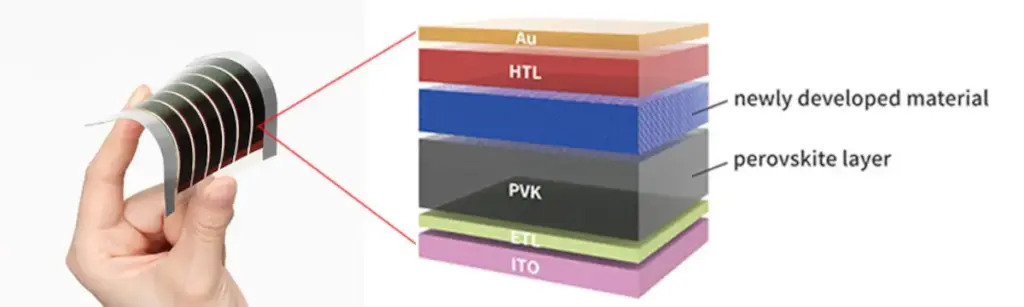
The 100V output from a single raindrop is significant. The triboelectric generator adds an additional energy layer, providing electricity even in the absence of sunlight, which is a huge advantage in regions with frequent cloud cover or rain.
The Science Behind Raindrop Harvesting
Triboelectric Nanogenerators (TENGs): A Key to the Breakthrough
TENGs work by exploiting the triboelectric effect, which is the transfer of electric charge between materials when they come into contact and then separate. In the case of the perovskite-rain hybrid device, the impact of raindrops on the surface causes an exchange of charges between the perovskite material and the nanogenerator’s surface.
This charge is then converted into usable electrical energy. TENGs have been researched for some time as a method to capture kinetic energy from sources like human movement, wind, and rain.
However, combining them with solar technology to create a dual-function device is what makes this particular development a major step forward. This integration enables the technology to function continuously, regardless of the weather, by using both solar and rain energy.
Power Potential: 100 Volts from a Single Raindrop
In laboratory tests, this hybrid perovskite-TENG device produced 100V from a single raindrop, enough to power small electrical devices such as LED lights, sensors, or communication devices. Researchers believe that this system could also be scaled up for larger applications, such as charging stations for IoT devices or even powering remote monitoring systems in areas where access to the grid is limited.
With rainfall becoming a more predictable energy source, this technology offers a potential solution to regions that face issues with consistent solar power generation.
It could fill the gaps in solar energy production during the cloudy or rainy months, ensuring a steady supply of renewable energy year-round.
Why This Matters: A New Energy Frontier
Reliability in All Weather
Most solar systems rely on direct sunlight, and their efficiency drops significantly during cloudy days or at night. This new technology addresses a critical gap by allowing solar systems to function even when the sun is not shining.
By generating power from rainwater, the tandem solar-rain device becomes an all-weather energy solution, offering reliable power generation even in areas with frequent rain or cloudy weather.
With the ability to generate electricity in rainy conditions, homeowners in coastal and tropical regions could benefit from more consistent energy production. This is especially important for off-grid areas where energy storage and self-sufficiency are critical.
The hybrid system provides a way to keep energy production running continuously, providing power even in less-than-ideal conditions.
Sustainability and Reduced Environmental Impact
One of the most significant benefits of this hybrid technology is its environmental impact. Perovskite solar cells are more affordable and easier to manufacture than traditional silicon cells, and now, with the addition of rain-harvesting technology, the environmental footprint is further reduced.
The device can generate power without relying on the grid, decreasing dependence on non-renewable energy sources. By integrating energy from two natural resources—sunlight and rain—the technology supports a sustainable future for renewable energy, with minimal environmental impact.
In addition, triboelectric nanogenerators are low-cost, require minimal maintenance, and provide a scalable solution for global energy needs.
Challenges to Commercializing the Technology
Scaling Production
Although the hybrid perovskite-TENG device shows great promise, scaling production for commercial use presents several challenges. Perovskite cells, while cheaper to produce than silicon cells, still face challenges in manufacturing consistency and long-term durability.
भारत का सबसे सस्ता 5kW सोलर सिस्टम: जानें कितनी होगी इंस्टालेशन की लागत और आपको क्या लाभ मिलेंगे!
Ongoing research aims to enhance the material stability of perovskite under environmental stress factors, such as humidity and UV exposure.
Energy Storage and Efficiency
While the device can produce up to 100V per raindrop, the challenge lies in efficiently storing this energy and delivering it to power systems reliably. New developments in energy management systems and supercapacitors will be crucial to managing this stored energy for continuous use.
Additionally, ensuring the energy conversion efficiency is consistent across varying rain intensities will be critical.
Related Links
The Future: Solar Panels Powered by Sun and Rain
This innovation brings us one step closer to a future where solar technology is not limited by weather conditions. By harnessing the power of both the sun and rain, perovskite solar cells could become a more versatile and reliable energy source for homes and businesses alike.
Researchers believe that within the next five to ten years, hybrid devices like this could be commercially available for widespread use.
The technology could be deployed in remote regions, urban areas, and commercial installations where both sunlight and rain can be captured to generate consistent power.
As the world moves toward clean, renewable energy solutions, perovskite rain-harvesting solar cells could become a major player in the global energy transition.