
Perovskite-Silicon Tandem Cells is emerging as one of the most significant breakthroughs in renewable energy, as perovskite-silicon tandem solar cells surpass 30% efficiency in 2026.

This milestone marks a shift from incremental gains to transformative change, with implications for global energy markets, climate targets, and the economics of solar deployment.
Perovskite-Silicon Tandem Cells
| Key Area | Detail | Why It Matters |
|---|---|---|
| Efficiency | >30% achieved | Breaks silicon limits |
| Technology | Dual-layer cells | Captures more sunlight |
| Deployment | Early commercialization | Industry transition underway |
| Impact | Lower cost, higher output | Faster clean energy adoption |
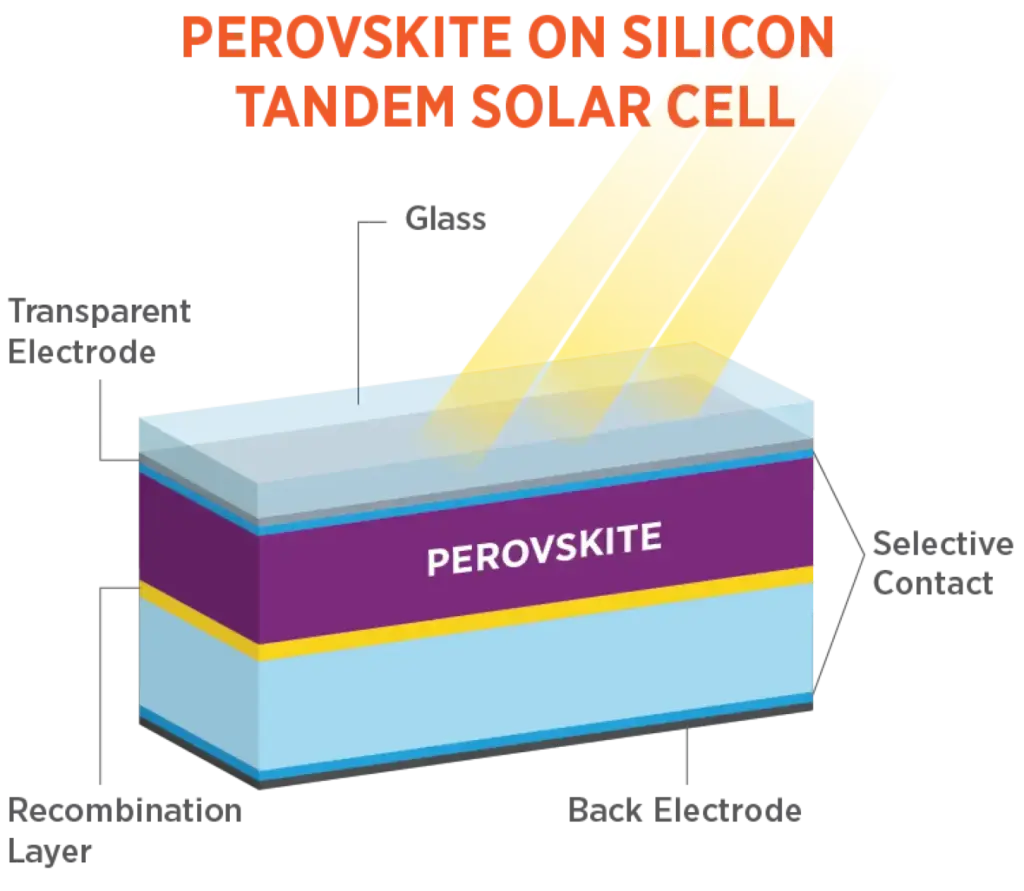
Perovskite-silicon tandem solar cells combine two materials with complementary properties. The perovskite layer absorbs high-energy photons, while silicon captures lower-energy light. This layered structure allows the system to utilize a broader portion of the solar spectrum.
Traditional silicon panels lose excess energy as heat. Tandem cells reduce these losses, converting more sunlight into usable electricity. Researchers describe this as a “paradigm shift” in photovoltaic design rather than a simple efficiency upgrade.
Why Crossing 30% Efficiency Matters
For decades, solar efficiency gains were incremental. The industry was approaching a plateau. Breaking the 30% barrier changes the equation:
- Solar farms generate more power per square meter.
- Rooftop systems become more viable in urban areas.
- Grid integration becomes more efficient.
Energy analysts say this milestone could significantly lower the levelized cost of electricity (LCOE), making solar the cheapest energy source in more regions.
From Lab Breakthrough to Commercial Reality
Until recently, tandem cells were confined to laboratories. That is changing rapidly. Manufacturers are now scaling production, with pilot projects already underway in Europe and Asia. Early modules are entering niche markets such as high-performance rooftops and space-constrained installations.
Industry experts say the next two years will determine whether tandem technology can achieve cost parity with silicon.
Policy Push and Government Support
Governments are playing a crucial role in accelerating adoption.
- The United States is supporting solar innovation through the Inflation Reduction Act.
- The European Union is funding next-generation photovoltaic research.
- India is promoting domestic manufacturing through Production Linked Incentive (PLI) schemes.
These policies aim to reduce reliance on imports and build resilient solar supply chains.
Global Market Competition Intensifies
The race to dominate tandem solar technology is intensifying.
- European firms lead in research breakthroughs.
- Chinese manufacturers dominate large-scale production.
- U.S. companies focus on commercialization and patents.
This competition is shaping a new geopolitical dimension in clean energy.
Comparison with Other Solar Technologies
Tandem cells are not the only innovation in the market.
| Technology | Efficiency | Status |
|---|---|---|
| TOPCon | ~25–27% | Commercial |
| HJT (Heterojunction) | ~26–28% | Growing adoption |
| Thin-film | ~18–22% | Niche use |
| Tandem | 30%+ | Emerging |
Tandem technology stands out due to its higher efficiency potential, though it still faces scaling challenges.
Environmental and Supply Chain Concerns
Despite its promise, tandem technology raises important questions.
Environmental Risks
Some perovskite materials contain lead, raising concerns about toxicity and recycling.

Supply Chain Issues
Scaling production requires stable access to advanced materials and manufacturing expertise.
Manufacturing Complexity
Producing multi-layer cells consistently at scale remains a technical challenge. Experts stress the need for robust recycling systems and safer material alternatives.
Industry and Investor Perspective
Investors are closely watching tandem solar developments. Venture capital funding in next-generation solar startups has increased significantly. Large energy companies are also investing in research partnerships.
However, some analysts caution that timelines for mass adoption may be optimistic, citing past delays in solar innovation cycles.

What It Means for India
For India, tandem solar cells could address key challenges:
- Limited land availability for solar farms.
- Rapidly growing electricity demand.
- Need for higher efficiency rooftop systems.
Experts suggest that integrating tandem technology into existing solar infrastructure could significantly boost output without expanding land use.
Related Links
Illinois Residents Rally in Support of Strong Clean Energy Bills – Public Calls for Action
Illinois Considers Bold Clean Energy Package to Tackle Data Center Energy Demand
Timeline: When Will Tandem Solar Go Mainstream?
Industry estimates suggest:
- 2026–2027: Early commercial adoption.
- 2028–2030: Large-scale deployment begins.
- Post-2030: Tandem becomes mainstream.
The pace will depend on cost reductions and long-term durability performance.
The rise of tandem solar cells marks a pivotal moment in the energy transition. While challenges remain, the shift from experimental success to commercial deployment suggests that solar power is entering a new phase of efficiency and competitiveness. As one analyst noted, “The question is no longer whether tandem solar will succeed, but how quickly it can scale.”
FAQs
1. What makes tandem solar cells different from traditional panels?
They use multiple layers to capture more sunlight, increasing efficiency significantly.
2. Are tandem solar panels available today?
Yes, early commercial versions are emerging, though large-scale adoption is still developing.
3. What are the biggest challenges?
Durability, manufacturing scale, and cost remain key barriers.
4. Will tandem solar replace silicon panels?
Not immediately. It will likely complement and gradually replace them over time.
5. Why is this important for climate goals?
Higher efficiency means faster renewable adoption, reducing carbon emissions globally.