
India’s Green Stock Market Update renewable energy shares came under selling pressure on March 6 as investors responded to broader stock market weakness and profit-taking across infrastructure and power sector equities.

Several prominent green energy companies recorded declines during the session, reflecting cautious investor sentiment even as analysts maintain that the long-term growth outlook for the renewable sector remains strong.
Renewable Energy Shares Face Selling Pressure on March 6
Trading activity on March 6 showed notable selling across several renewable energy companies listed on Indian stock exchanges. Shares of Adani Green Energy, Inox Wind, and Borosil Renewables were among the stocks experiencing downward movement during the session.
Adani Green Energy shares fell approximately 2.4%, while Borosil Renewables declined about 1.5%. Inox Wind also recorded a drop of nearly 2.8% during the trading day.
However, the decline was not uniform across the sector. Clean Max Enviro Energy Solutions registered gains of nearly 6%, while NTPC Green Energy posted modest upward movement.
The mixed performance illustrates the complex dynamics affecting renewable energy equities, which are influenced by both market sentiment and long-term sector fundamentals.
Broader Market Decline Influences Green Stocks
The weakness in renewable energy shares occurred alongside broader market declines. Major benchmark indices such as the S&P BSE Sensex and Nifty 50 both fell during the trading session, reflecting selling pressure across sectors including banking, infrastructure, and technology.
Market analysts say renewable energy companies often move in line with broader market trends because investors classify them as growth-oriented stocks.
During periods of market uncertainty, investors frequently reduce exposure to sectors perceived as high-valuation or capital-intensive.
Historical Performance of Renewable Energy Stocks in India
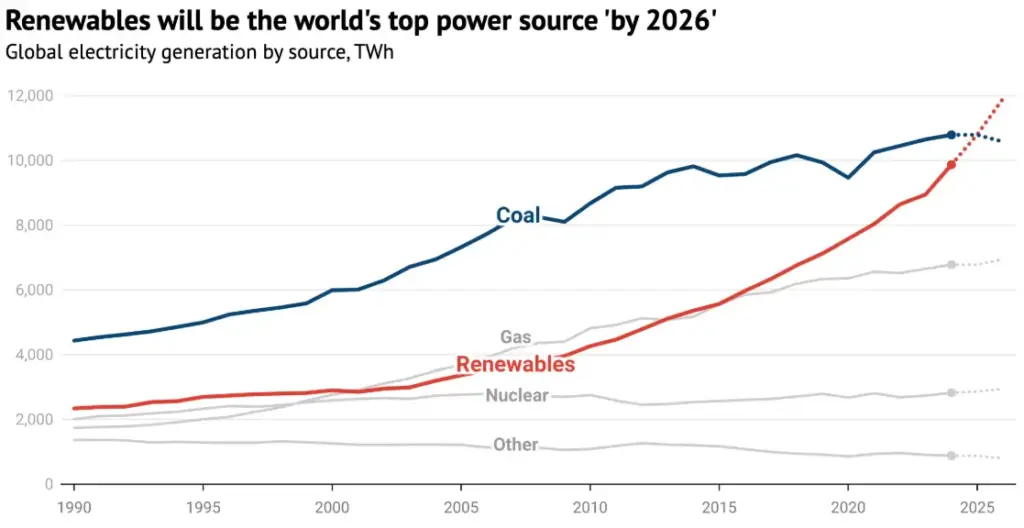
Renewable energy stocks have delivered strong gains in recent years as India expanded clean energy capacity. Companies involved in solar and wind power development benefited from government policies aimed at increasing renewable energy generation.
Over the past decade, renewable energy companies have become an increasingly visible segment of India’s stock market.
Investor interest intensified after the government announced its target of achieving 500 gigawatts of non-fossil fuel electricity capacity by 2030. This policy direction encouraged long-term investment in solar parks, wind projects, and energy storage technologies.
Key Factors Driving the March 6 Sell-Off
Several factors appear to have contributed to the selling pressure observed in renewable energy stocks.
Profit-Taking by Investors
Many renewable energy companies experienced strong rallies earlier in the year. Short-term investors often lock in profits following sustained gains, resulting in temporary price corrections. Profit-taking does not necessarily indicate deterioration in the underlying business outlook.
Global Financial Market Volatility
Global markets have experienced fluctuations due to geopolitical tensions and changing interest rate expectations. These factors influence investor behaviour across sectors, including renewable energy equities.
When uncertainty rises, investors sometimes reduce exposure to growth sectors with higher valuations.
Rising Interest Rates
Renewable energy infrastructure projects require substantial capital investment. Higher interest rates increase financing costs, which can affect profitability for developers operating solar parks and wind farms. As a result, renewable energy companies can be sensitive to interest rate changes.
Sector-Specific Regulatory Risks
Renewable energy developers also face risks related to policy and regulation. Examples include:

- Changes in electricity tariffs
- Delays in project approvals
- Supply chain disruptions for solar modules
These uncertainties can affect investor sentiment in the short term.
Global Renewable Energy Equity Trends
The volatility observed in Indian renewable energy stocks reflects broader trends in global green energy markets. Clean energy equities worldwide have experienced fluctuations as investors evaluate long-term growth potential against near-term economic uncertainties.
Solar manufacturers, wind turbine producers, and energy storage companies have all experienced periods of stock market volatility.
However, analysts note that the renewable energy industry continues to attract long-term capital due to its strategic role in the global energy transition.
Role of Institutional Investors in Green Stocks
Institutional investors have played a growing role in renewable energy equity markets. Large asset managers, pension funds, and sovereign wealth funds increasingly allocate capital to clean energy companies.
These investors often view renewable energy infrastructure as a stable long-term investment because electricity demand remains relatively predictable. Institutional investment can also provide financial stability for renewable energy companies during periods of market volatility.
ESG Investing and Sustainability Funds
Another major driver of renewable energy investment is the growth of Environmental, Social, and Governance (ESG) investing. Many investment funds now prioritise companies with strong sustainability credentials.
Renewable energy firms often benefit from these investment flows because their operations contribute to reducing greenhouse gas emissions. Global ESG assets are estimated to exceed $30 trillion, according to international financial market analyses. This trend is expected to continue supporting clean energy companies over the long term.
Financial Performance of Major Renewable Energy Companies
The financial performance of renewable energy companies varies widely depending on project portfolios and market conditions. Companies with large operational assets often generate stable revenue through power purchase agreements (PPAs) with utilities and corporations.
PPAs typically guarantee electricity purchases over long periods, providing predictable income streams. However, project development companies may experience earnings volatility due to project timelines and financing costs.
Analysts therefore evaluate renewable energy companies based on both installed capacity and future project pipelines.
Growth Drivers for Renewable Energy Sector
Despite short-term market fluctuations, several long-term factors continue to support renewable energy companies.
Expansion of Solar and Wind Power
India has rapidly expanded its renewable energy capacity. Solar power installations have grown significantly over the past decade, making India one of the largest solar markets globally. Wind power capacity has also increased steadily in several states.

Electricity from Space? How Space-Based Solar Power tech is moving from sci-fi to reality in 2026.
Corporate Demand for Clean Electricity
Large corporations are increasingly purchasing renewable energy to meet sustainability targets. Corporate power purchase agreements have become an important revenue source for renewable energy developers.
Government Policy Support
Government initiatives such as renewable energy auctions, green hydrogen programmes, and transmission infrastructure expansion continue to support the sector. These policies aim to reduce fossil fuel dependence while improving energy security.
Renewable Energy Market Size and Future Growth
The renewable energy sector is expected to grow significantly over the coming decade. Industry forecasts suggest that India’s renewable energy market could expand rapidly as solar, wind, and energy storage technologies become more widespread.
The transition to electric mobility and green hydrogen production could further increase demand for renewable power generation. This expansion is expected to create new opportunities for companies operating in the clean energy sector.
Risks Facing Renewable Energy Investors
Despite strong growth prospects, investors should consider several risks associated with renewable energy equities.
Capital Intensity
Renewable energy projects require large upfront investments in infrastructure. Access to financing and interest rate conditions can influence profitability.
Policy Dependence
Many renewable energy projects depend on government policies and incentives. Changes in regulatory frameworks can affect project economics.
Competitive Market Environment
As the renewable energy sector grows, competition among developers is increasing. Companies must continue to innovate and improve operational efficiency to maintain profitability.
Related Links
The Race for Stable Solar Energy: Scaling Up Investment in Storage Tech
Hurricane Proof: The Engineering Secret Behind Solar Farms That Survived 200mph Winds
Expert Perspective
Energy market analysts say the recent decline in renewable energy stocks reflects short-term market dynamics rather than fundamental sector weakness. According to industry analysts, the renewable energy sector remains one of the most promising long-term investment areas due to global decarbonisation efforts.
Investors increasingly view renewable energy companies as strategic assets in the transition toward sustainable energy systems.
Although renewable energy shares faced selling pressure on March 6, analysts emphasise that the sector’s long-term fundamentals remain strong. Continued government support, expanding renewable capacity, and rising corporate demand for clean electricity are expected to sustain growth in the renewable energy industry.