
The once futuristic idea of solar paint—a liquid that transforms surfaces into electricity generators—has made substantial progress and is now poised to enter commercial markets by late 2026.
This breakthrough technology uses perovskite and quantum dot-based cells to enable any painted surface to harvest energy from sunlight.
‘Solar Paint’ Technology
| Key Fact | Detail/Statistic |
|---|---|
| What is Solar Paint? | Liquid photovoltaic coating that converts sunlight into electricity |
| Efficiency of Solar Paint | Efficiency of up to 20% in lab tests, projected to improve |
| Commercial Availability | Expected by late 2026 for select markets |
| Applications | Buildings, vehicles, infrastructure, and more |
From Concept to Commercial Reality
Unlike traditional solar panels, which require specific installations and significant space, solar paint offers flexibility and affordability, making it possible to cover buildings, vehicles, and even public infrastructure with power-generating coatings.
Though still in development, early commercial applications are projected to bring the product to niche markets by 2026, with broader adoption expected thereafter.
What Is Solar Paint and How Does It Work?
The Science Behind Solar Paint
Solar paint is a photovoltaic liquid containing light-absorbing materials that convert sunlight into electricity. Similar to traditional solar panels, solar paint relies on the photovoltaic effect. However, instead of the rigid silicon panels that are mounted on rooftops, solar paint is applied like any standard paint and can be sprayed or brushed onto various surfaces.
At the heart of solar paint technology is the use of perovskite materials and quantum dots—nanomaterials that absorb light and convert it into electricity.
These materials have been selected for their ability to effectively harvest light, even at lower costs compared to traditional silicon-based materials.
- Perovskites are renowned for their high absorption rates, meaning they can convert more sunlight into power.
- Quantum dots help increase efficiency by adjusting the bandgap, allowing for better use of the solar spectrum.
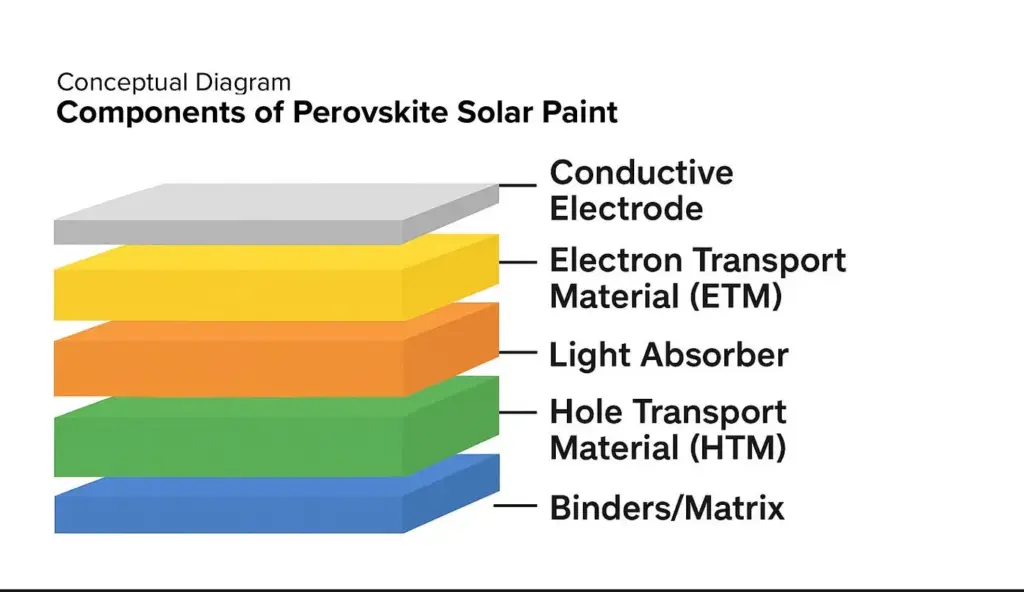
The resulting liquid can be sprayed or applied to surfaces like walls, roofs, windows, and even vehicles, converting them into energy-generating surfaces.
Why Is Solar Paint a Game-Changer for Solar Power?
Flexibility and Versatility
Unlike traditional solar panels that require a flat surface with direct sunlight exposure, solar paint can be applied to virtually any surface, even curved or irregular shapes. This opens up new possibilities for solar installations, particularly in urban areas with limited roof space.
Additionally, the paint can be applied to windows, allowing buildings to generate power without obstructing natural light. One of the major advantages is its ability to convert surfaces that were previously unused into energy-producing areas, such as:
- Residential buildings
- Public infrastructure like bridges or walls
- Vehicles, including cars, trains, and buses
This flexibility makes solar paint a versatile and cost-effective alternative to traditional panels, as it can be applied to a much broader range of structures.
Cost-Efficiency
Compared to conventional solar panels, solar paint promises to be significantly cheaper to produce. Traditional solar panel manufacturing involves expensive materials and energy-intensive processes, whereas solar paint is applied similarly to conventional paint, reducing production costs and installation expenses.
Furthermore, as the technology matures, the cost per watt generated could decrease, leading to more affordable solar energy for consumers globally.
Challenges in Commercializing Solar Paint
Efficiency Limitations
Although solar paint is promising, efficiency remains a significant challenge. Current lab tests show 20% efficiency for some solar paints, whereas traditional silicon panels typically range between 20-22%.
For solar paint to compete in the broader market, researchers will need to improve its efficiency while ensuring that the paint’s power output remains sustainable over time.
Durability and Environmental Factors
Another obstacle is durability. While traditional solar panels are highly durable and long-lasting, solar paint must be able to withstand exposure to UV rays, extreme weather conditions, and temperature fluctuations without degrading.
Researchers are working on improving the stability of the perovskite and quantum dot materials used in the paint to ensure that it can last for the typical 25-30 years expected from conventional solar panels.
Scalability of Manufacturing
Manufacturing solar paint on a commercial scale will require significant infrastructure and investment. The materials used in solar paint, particularly perovskite, need to be produced consistently at scale, and the application process must be both efficient and uniform.
Scaling up production without compromising quality remains one of the key hurdles in the transition from laboratory innovation to widespread use.
Government Support and Regulation: A Crucial Step
Policy and Funding for Innovation
Governments around the world are playing an essential role in driving the future of solar paint technology. Many countries already offer significant subsidies and tax incentives for traditional solar energy systems.
These policies are expected to extend to solar paint once it becomes commercially available. For example, countries with aggressive renewable energy targets, such as Germany, China, and the U.S., are likely to implement financial incentives to encourage the adoption of solar paint.
Additionally, international regulations for building-integrated photovoltaics (BIPV) and energy-efficient building materials may create a favorable environment for the introduction of solar paint in the coming years.
Governments that prioritize sustainability will likely push for solar coating solutions to be incorporated into building standards.
Environmental Impact of Solar Paint: A Green Solution
Reduced Environmental Footprint
One of the most significant environmental advantages of solar paint is its potential to reduce the carbon footprint associated with traditional solar panel production. Solar paint uses less material and can be applied to existing structures, which means there’s no need to manufacture bulky, resource-intensive panels.
This low-energy production process could make solar energy even more sustainable. Furthermore, solar paint could be applied to a much larger surface area, resulting in greater overall power generation without requiring additional land space.
By repurposing existing surfaces, solar paint reduces the environmental impact typically associated with large-scale solar farms and could prevent deforestation or land disruption.
Energy Harvesting in Urban Areas
Solar paint also makes it possible to harness energy in dense urban environments, where space is limited and solar panel installations are often impractical. Applying solar paint to buildings, cars, or infrastructure could allow cities to generate energy while utilizing already existing spaces.
Market Applications: Who Will Benefit from Solar Paint?
Residential Homes
Homeowners in urban areas with limited roof space will be among the first to benefit from solar paint. With the ability to apply the paint to walls, windows, and roofs, solar energy becomes a more feasible option for small, compact homes. Solar paint offers the possibility of clean, renewable energy without sacrificing space or aesthetics.

Commercial Buildings
Commercial buildings, particularly those in cities with high energy demands, stand to gain the most from solar paint. By coating exterior walls, facades, and even parking structures with solar paint, businesses can significantly reduce their reliance on traditional energy sources.
Transportation Industry
The automotive and aerospace industries are also exploring the use of solar paint. Applying it to electric vehicles (EVs), trains, and planes could allow them to harness solar energy, extending their range and reducing dependence on external charging stations.
Related Links
The Road to Commercialization in 2026
As 2026 approaches, solar paint technology is poised to enter the commercial phase. If efficiency and durability challenges can be overcome, solar paint could revolutionize the way we think about solar energy.
From urban buildings to transportation systems, solar paint promises to make energy harvesting more versatile, affordable, and sustainable.
The global demand for renewable energy, combined with government incentives, could lead to widespread adoption of solar paint within the next decade. This could make a significant impact on energy generation and sustainability efforts worldwide.
FAQs
Q: What is solar paint, and how does it work?
A: Solar paint is a liquid coating that converts sunlight into electricity. It uses light-absorbing materials, such as perovskite or quantum dots, to harness solar energy and generate power when applied to surfaces.
Q: When will solar paint be available for commercial use?
A: Solar paint is expected to be available for commercial use by late 2026, with initial applications in niche markets like buildings and infrastructure.
Q: What are the environmental benefits of solar paint?
A: Solar paint reduces the environmental footprint of traditional solar panels by using less material and providing greater energy generation without requiring additional land, offering a greener alternative for clean energy production.
Q: How efficient is solar paint compared to traditional panels?
A: Solar paint has reached efficiencies of up to 20% in lab tests. While still lower than the 20-22% efficiency of traditional panels, its ability to be applied to various surfaces gives it a unique edge.