
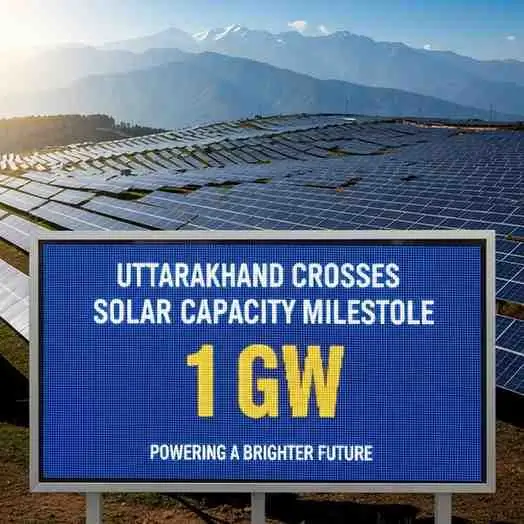
Uttarakhand has surpassed 1 gigawatt (GW) of installed solar capacity, marking a major Uttarakhand Hits 1 GW milestone for the Himalayan state. Official data released by the state government confirms that total installed solar capacity has crossed the 1,000 MW mark, reflecting steady growth across rooftop, ground-mounted, agricultural, and public infrastructure projects.
Crossing the 1 GW threshold is symbolically and strategically important. For a state historically dependent on hydropower and thermal imports, the milestone signals diversification of its energy mix.
Uttarakhand Hits 1 GW
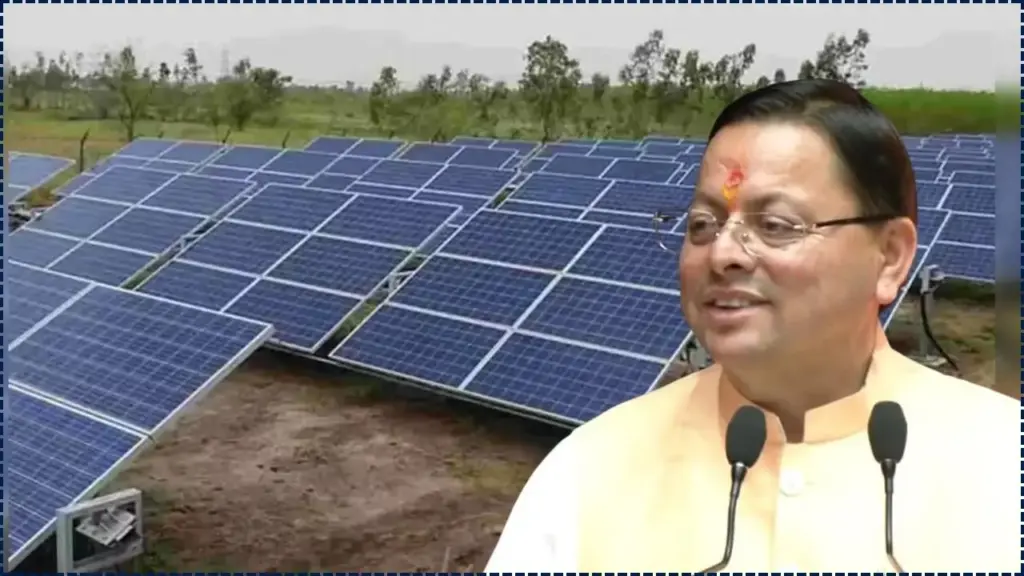
Officials from the Uttarakhand Renewable Energy Development Agency (UREDA) confirmed that the installed solar capacity has exceeded 1,000 MW. Chief Minister Pushkar Singh Dhami, in a government statement, said the achievement reflects “consistent policy support, public participation, and coordination with central renewable energy programmes.”
In practical terms, 1 GW of solar capacity can generate enough electricity annually to power hundreds of thousands of homes, depending on load patterns and seasonal output.
Energy economists note that for a relatively small state, this represents a meaningful share of total demand and strengthens long-term energy resilience.
How Uttarakhand Reached 1 GW
The milestone has been achieved through a combination of utility-scale installations and decentralised systems.
Ground-Mounted Solar Plants
Large solar parks in relatively flat districts such as Haridwar and Udham Singh Nagar account for a significant portion of capacity. These projects operate under long-term power purchase agreements with state distribution companies.
Given Uttarakhand’s terrain constraints, planners focused on optimising land use in accessible plains and foothill areas.
Rooftop Solar Growth
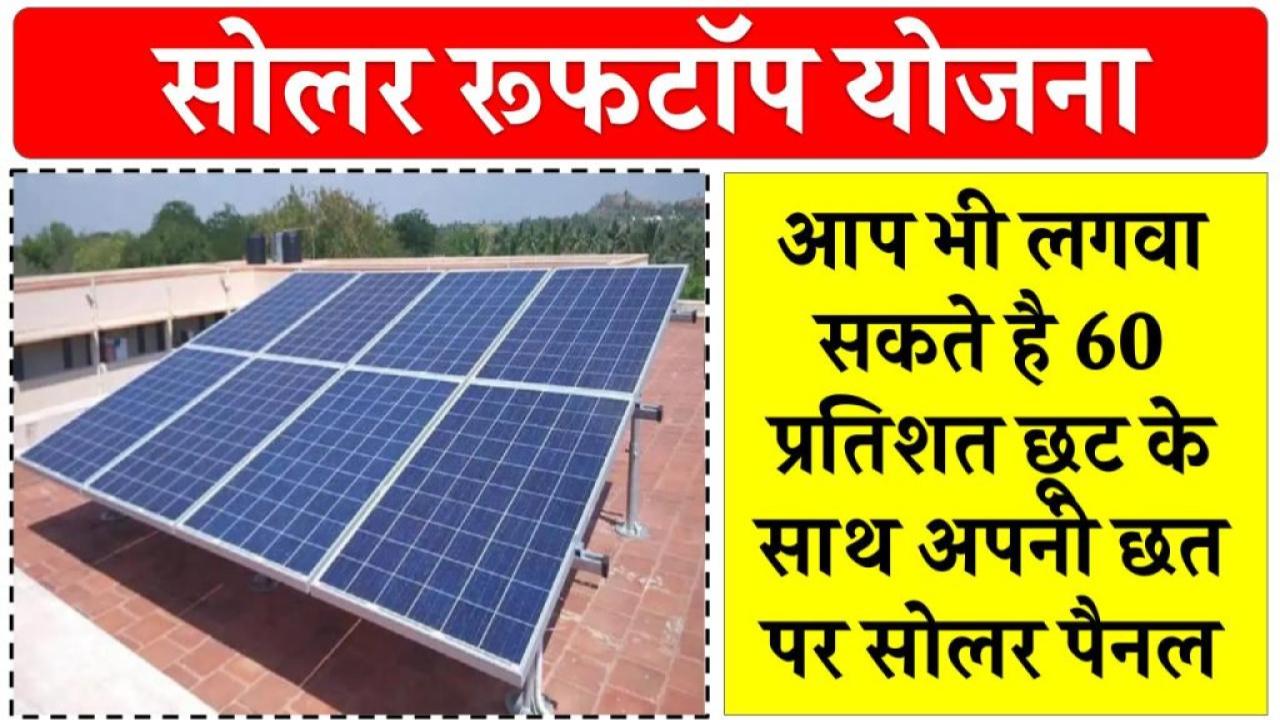
Residential, institutional, and commercial rooftop solar has expanded under central subsidy schemes. Programmes such as the PM Surya Ghar initiative have encouraged households to install panels with financial support and net-metering benefits. Rooftop installations reduce transmission losses and strengthen localised energy independence.
Canal-Top and Agricultural Projects
Canal-top solar installations represent innovative land-use strategies. Panels installed over irrigation canals reduce water evaporation while producing electricity. Solar-powered agricultural pumps have also reduced reliance on diesel in rural districts.
Policy Framework Driving Growth
Central Government Incentives
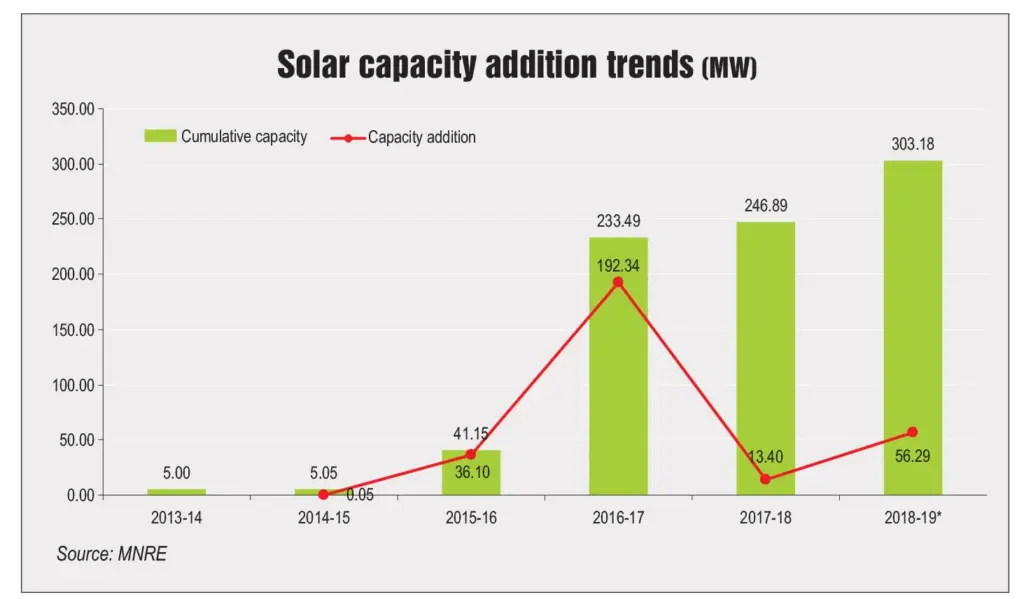
India’s renewable expansion is supported by the Ministry of New and Renewable Energy (MNRE). Financial incentives, capital subsidies, and grid integration support have accelerated deployment.
The Production-Linked Incentive (PLI) scheme for high-efficiency solar modules has strengthened domestic manufacturing capacity, ensuring equipment availability.
State-Level Programmes
The Chief Minister Solar Self-Employment Scheme has enabled local entrepreneurs to establish small solar plants. Officials say the scheme has generated employment while expanding capacity.
UREDA has simplified application processes, reduced approval timelines, and conducted awareness campaigns in rural areas. State policymakers emphasise that public participation has been central to the growth trajectory.
Economic and Employment Impact
Solar expansion has created direct and indirect employment in installation, maintenance, distribution, and technical services.Industry representatives report rising demand for skilled technicians, electricians, and engineers in renewable projects.
Local contractors and small businesses have benefitted from decentralised rooftop installations. Financial institutions have also expanded lending for residential solar adoption.
An energy policy expert at a leading Indian technical university noted that distributed solar can improve rural incomes by reducing electricity expenditure and creating service-sector jobs.
Energy Security and Reduced Import Dependence
Historically, Uttarakhand relied heavily on hydropower and purchased electricity from neighbouring states. Seasonal variations in river flow can affect hydroelectric output.
Solar generation provides diversification, particularly during dry months when hydro production may dip.
Grid operators say diversified renewable portfolios improve system stability. Hybrid management of hydro and solar allows flexible response to peak demand.
Environmental Considerations in a Fragile Region
Uttarakhand’s mountainous ecosystem requires careful infrastructure planning. Environmental experts stress that large installations must avoid forest land and ecologically sensitive zones.
Distributed rooftop solar has a comparatively smaller environmental footprint. Reduced diesel use in rural areas also cuts air pollution.
Climate researchers highlight that renewable diversification supports India’s commitment to expand non-fossil fuel capacity under international climate agreements. However, land-use conflicts and visual impact concerns remain part of policy discussions.
Grid Integration and Storage Needs
Solar output fluctuates with weather and seasonal sunlight variation. Grid operators must balance supply using hydro and thermal backup.
Energy planners are evaluating battery storage solutions and smart grid technologies to manage intermittency. Experts say the next stage of growth depends on improved storage capacity and digital monitoring systems.
Investment and Financing Landscape
Solar growth in Uttarakhand has attracted private developers and institutional investors. Competitive bidding processes have lowered tariffs in recent years.
Banking institutions have introduced green financing products to encourage rooftop solar adoption. Long-term power purchase agreements provide revenue certainty for utility-scale developers.
Financial analysts note that stable policy frameworks are essential for sustaining investor confidence.
Comparison with National Trends
Nationally, India has emerged as one of the world’s fastest-growing solar markets. States such as Rajasthan and Gujarat lead in absolute capacity due to abundant land availability.
Uttarakhand’s 1 GW capacity is smaller in scale but notable given terrain and land constraints. Renewable analysts view the state as a model for integrating decentralised solar in mountainous regions.
Role of Community Participation
Public acceptance has been crucial. Rooftop adoption depends on homeowner confidence and awareness. State outreach campaigns have educated citizens on financial benefits and environmental impact.
Village-level participation in small solar plants has fostered local ownership and accountability. Experts suggest that community engagement reduces resistance and enhances long-term maintenance.
Future Roadmap: Beyond the 1 GW Mark
State authorities have indicated plans to expand rooftop penetration further and promote solarisation of government buildings. Integration of electric vehicle charging infrastructure with renewable energy is under consideration.
Officials also aim to encourage solar-powered cold storage facilities and micro-grids in remote areas. Energy experts stress that continued policy stability and technological innovation will determine growth beyond the 1 GW milestone.
Broader Implications for Mountainous Regions
Uttarakhand’s experience may offer lessons for other Himalayan states. Challenging terrain and dispersed populations require tailored renewable strategies.
Distributed solar systems can complement hydropower and reduce grid vulnerability. Energy policy specialists argue that smaller states can contribute meaningfully to national renewable targets through decentralised approaches.
Related Links
Uttarakhand’s crossing of the 1 GW solar capacity mark marks a significant PRIMARY-KEYWORD milestone in the state’s energy transition. Through diversified deployment, supportive policy, and community engagement, the Himalayan state is steadily evolving into a green power hub.
While grid integration, storage, and environmental safeguards remain priorities, the milestone reflects measurable progress.
As India advances its clean energy ambitions, Uttarakhand’s approach illustrates how renewable growth can be adapted to mountainous geography while strengthening energy security and sustainability.