State-owned power major NTPC Limited, through its renewable arm NTPC Green Energy Limited (NGEL), has commissioned 158.4 megawatts (MW) of solar photovoltaic capacity in Andhra Pradesh.
The NTPC Green Milestone commissioning marks a significant milestone in the company’s clean energy expansion, pushing its total operational renewable portfolio beyond 9.15 gigawatts (GW) — the highest level in its history.
The newly operational solar capacity forms part of a larger 250 MW solar project in Kadapa district. With this addition, NTPC Green Energy strengthens its position among India’s leading renewable power producers at a time when the country is accelerating its transition away from fossil fuels.
NTPC Green Milestone Commissioning: Project Details and Timeline
The 158.4 MW capacity was declared commercially operational following receipt of required certifications and grid connectivity approvals. Company disclosures indicate that electricity generation began earlier in the month before formal commercial operation status was achieved.
The plant is part of NTPC’s strategy to deploy utility-scale solar projects in high-resource regions. Andhra Pradesh, known for strong solar irradiation and established transmission corridors, has emerged as one of India’s renewable hubs.
The remaining capacity from the 250 MW project is expected to be commissioned in subsequent phases, further increasing NTPC Green Energy’s total installed capacity.
NTPC’s Renewable Portfolio: A Record High
With this commissioning, NTPC Green Energy’s total operational renewable capacity has crossed 9 GW, marking a record peak for the group.
Historically, NTPC has been India’s largest thermal power generator, with coal-based plants forming the backbone of national electricity supply. However, in recent years, the company has accelerated diversification into solar, wind and hybrid renewable projects.
NTPC has publicly committed to reaching 60 GW of renewable capacity by 2032, which would represent a substantial shift in its generation mix.
An NTPC spokesperson stated, “The addition of 158.4 MW solar capacity reflects our sustained commitment to expanding clean energy assets while maintaining grid reliability and financial discipline.”
Why Andhra Pradesh Is Strategically Important
Andhra Pradesh offers favourable climatic conditions for solar generation, with high annual solar irradiation levels. The Kadapa region, in particular, has hosted multiple renewable installations over the past decade.
The state’s policy support and transmission readiness have attracted both public and private developers. Central government agencies have facilitated grid evacuation under the Inter-State Transmission System (ISTS) framework, enabling power to flow to demand centres across India.
Energy analysts note that concentration of solar assets in high-irradiation regions improves plant load factors and cost efficiency, although it also necessitates careful grid balancing.
Financial Structure and Power Purchase Agreements
Utility-scale solar projects typically operate under long-term Power Purchase Agreements (PPAs). These agreements guarantee electricity off-take at pre-determined tariffs, reducing revenue uncertainty.
While NTPC has not publicly disclosed the exact tariff for this specific project, most recent central solar auctions have produced tariffs in the range of ₹2.4 to ₹2.8 per kilowatt-hour, depending on project conditions.
Infrastructure lenders favour such projects due to predictable cash flows. NTPC’s sovereign backing further enhances creditworthiness and reduces financing costs.
A renewable infrastructure finance expert based in Mumbai said, “Projects backed by NTPC benefit from strong balance sheet support, making them attractive to both domestic and global lenders.”
Contribution to India’s Climate and Energy Goals
India has pledged to achieve 500 GW of non-fossil fuel power capacity by 2030 and reach net-zero emissions by 2070. Solar energy is expected to form the largest share of that expansion.
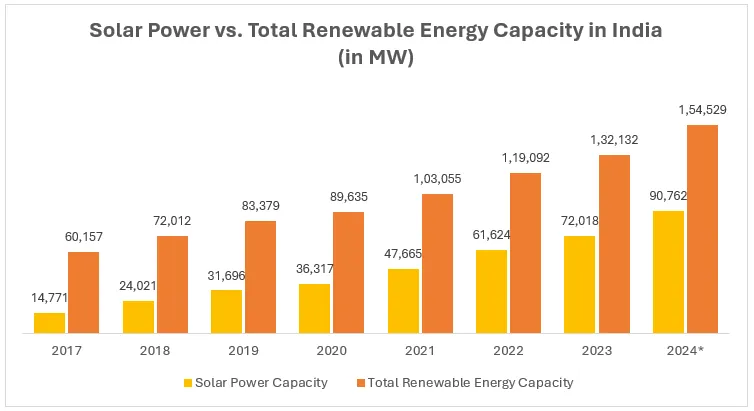
According to data from the Ministry of New and Renewable Energy (MNRE), India’s installed solar capacity has grown from under 10 GW in 2014 to over 140 GW today.
Large public sector players such as NTPC play a critical role in meeting these targets due to their execution capabilities and capital access. Energy policy researchers say sustained additions by NTPC enhance investor confidence in India’s long-term renewable roadmap.
Estimated Environmental Impact
A 158.4 MW solar plant can generate approximately 300 to 350 million units of electricity annually, depending on plant load factor and site conditions.
Based on average grid emission factors, this level of solar generation could offset roughly 250,000 to 300,000 tonnes of carbon dioxide annually compared to coal-based generation.
While exact figures depend on operational performance, renewable expansion contributes directly to lowering India’s carbon intensity. Environmental planners stress the importance of sustainable land management and biodiversity protection when developing large-scale solar parks.
Grid Integration and Operational Challenges
Solar generation peaks during daylight hours and declines sharply after sunset. This variability requires grid operators to maintain flexible balancing capacity.
India’s grid operator has been investing in advanced forecasting systems and real-time load management tools to integrate rising renewable capacity.
Experts suggest that future solar additions will increasingly be paired with:
- Battery energy storage systems
- Hybrid wind-solar configurations
- Pumped hydro storage
Such measures help manage evening demand spikes and improve grid stability.
Market Context: Competitive Renewable Landscape
India’s renewable energy market remains highly competitive. Major players include Adani Green Energy, Tata Power Renewable Energy and ReNew Power.
Competitive bidding has driven down solar tariffs significantly over the past decade. However, developers face pressures from rising module prices, interest rates and supply chain disruptions. Public sector participation by NTPC provides stability to the market and signals policy continuity.
An energy consultant in Delhi observed, “When NTPC commissions capacity, it reassures investors that India’s renewable policy framework remains robust.”
Investor and Shareholder Implications
For NTPC Limited, renewable capacity growth strengthens long-term sustainability credentials. Investors increasingly evaluate companies based on environmental, social and governance (ESG) metrics.

Renewable assets typically provide stable long-term returns under regulated frameworks. As global capital shifts toward green infrastructure, NTPC’s renewable expansion could support valuation resilience.
At the same time, the company continues to balance thermal generation with renewable investments to maintain grid reliability.
Future Outlook: Scaling Toward 2032
To meet its 60 GW renewable target by 2032, NTPC must sustain annual capacity additions at scale.
Future expansion areas include:
- Large solar parks in Rajasthan and Gujarat
- Wind projects in southern states
- Hybrid renewable plants combining storage
- Green hydrogen-linked solar installations
Energy experts expect renewable growth to accelerate further as storage costs decline and grid infrastructure strengthens.

Policy Implications and Energy Security
Expanding solar capacity reduces reliance on imported fossil fuels and enhances energy security. Renewable energy also protects consumers from global coal and gas price volatility.
Government policies, including production-linked incentives (PLI) for domestic solar manufacturing, aim to reduce import dependency on modules and cells.
Stable policy frameworks and transmission investments will remain critical to sustaining renewable growth.
Related Links
Electricity from Space? How Space-Based Solar Power tech is moving from sci-fi to reality in 2026.
The commissioning of 158.4 MW of solar capacity in Andhra Pradesh represents a meaningful milestone for NTPC Green Energy and underscores India’s accelerating renewable expansion. By pushing its operational renewable portfolio beyond 9 GW, NTPC reinforces its strategic shift toward cleaner power generation.
While grid integration, storage deployment and infrastructure investment remain essential, steady additions by major public sector entities provide confidence in India’s long-term clean energy transition.
As renewable capacity continues to scale, projects like this will help shape the future structure of the nation’s electricity system.