
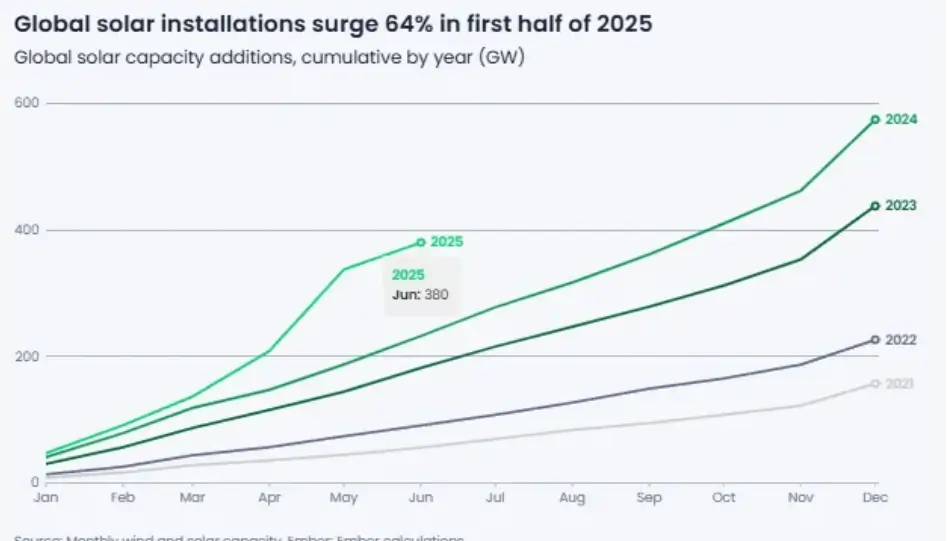
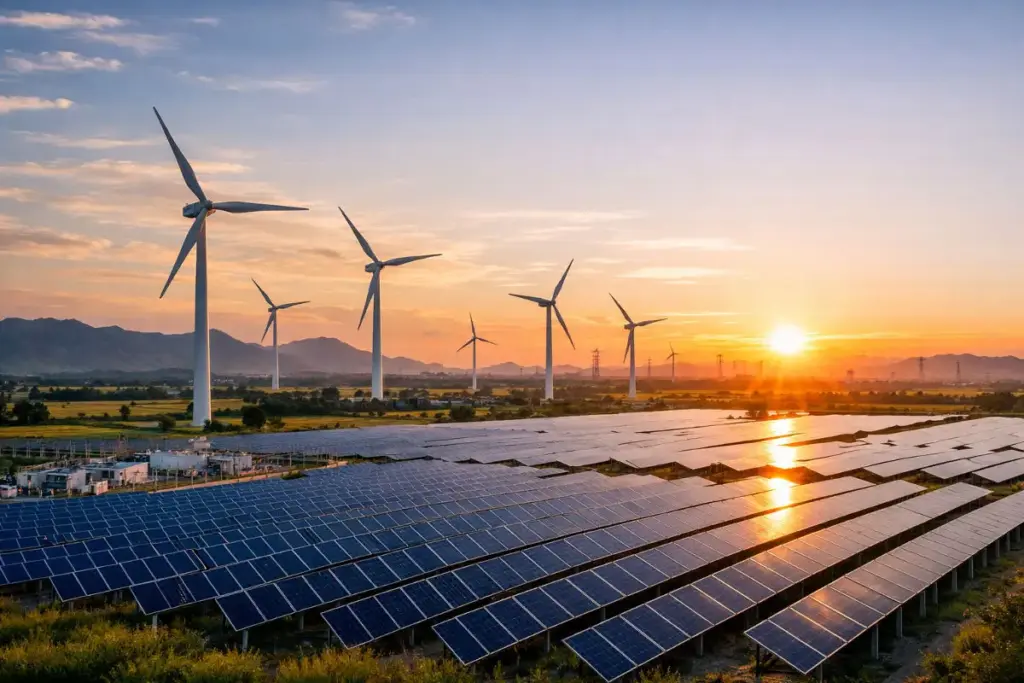
The ISA report on global solar capacity growth shows that the world added record levels of solar power in 2024, with installed capacity increasing by roughly 33% to more than 2,200 gigawatts.
However, the report warns that Africa and the world’s least developed countries (LDCs) received only a small share of solar investment, highlighting a persistent financing gap that could slow progress toward global clean-energy and climate targets.
Global Solar Capacity Surges
| Key Fact | Detail / Statistic |
|---|---|
| Global solar capacity | About 2,205 GW installed by 2024 |
| Annual growth | 33% increase compared with 2023 |
| Investment distribution | Africa and Latin America together received <7% of solar financing |
| Energy access gap | Around 600 million Africans lack electricity |
ISA Report on Global Solar Capacity Growth
The International Solar Alliance (ISA) says solar power experienced one of its strongest growth years on record. Global solar capacity expanded by roughly 548 gigawatts in 2024, bringing cumulative installations to about 2,205 gigawatts worldwide.
This growth reflects the accelerating transition toward renewable energy as governments attempt to reduce greenhouse-gas emissions and improve energy security.
Solar energy is now among the fastest-growing electricity sources globally. According to renewable-energy analysts, solar photovoltaic systems accounted for the majority of new renewable energy capacity added worldwide in recent years.
Why Solar Power Is Expanding So Rapidly
Several structural factors are driving the global solar boom.
Declining Technology Costs
Solar technology has become significantly cheaper over the past decade. Large-scale manufacturing, especially in Asia, has reduced the cost of photovoltaic modules, inverters, and installation equipment.
Industry studies indicate that solar electricity costs have fallen by up to 90% since 2010, making it competitive with fossil fuels in many regions.
Energy Security Concerns
Energy security concerns have intensified since the global energy crisis triggered by supply disruptions and geopolitical tensions.
Countries are increasingly investing in domestic renewable energy generation to reduce dependence on imported fuels. Solar power offers a scalable and relatively quick-to-deploy solution for expanding electricity supply.
Government Policy Support
Governments worldwide have introduced policies supporting renewable energy development.
These include:
- Renewable energy targets
- Solar auctions and feed-in tariffs
- Tax credits and subsidies
- Net-metering programs for rooftop systems
These policy measures have helped accelerate solar installations in both developed and emerging economies.
Regional Solar Growth Trends
Solar expansion has been uneven across different regions.
Asia Leads Global Solar Installations
Asia remains the largest solar market globally. China alone installed a substantial share of the world’s new solar capacity in 2024, supported by government incentives and large-scale solar farms. India has also accelerated solar deployment under national renewable energy targets.
Strong Growth in Europe and North America
European countries and the United States have also increased solar installations significantly. Rooftop solar adoption has expanded rapidly in these markets as households and businesses attempt to reduce electricity costs. Energy transition policies in the European Union have further supported solar investment.
Emerging Solar Markets in Latin America
Several Latin American countries, including Brazil and Chile, have seen strong solar growth in recent years. Favorable solar resources and competitive renewable energy auctions have attracted private investment to the region. However, overall financing remains uneven compared with developed markets.
Africa and LDCs Face a Major Solar Funding Gap
Despite favorable solar resources, Africa and the world’s least developed countries remain underrepresented in global solar investment.
The ISA report indicates that Africa and Latin America together received less than 7% of global solar financing, while LDCs accounted for less than 1% of total investment. This imbalance reflects several structural barriers affecting renewable energy development in these regions.
Africa’s Solar Potential
Africa is widely considered one of the most promising regions for solar energy development. The continent receives some of the highest solar radiation levels in the world. However, installed solar capacity remains relatively low compared with global totals.
Energy experts say Africa’s solar potential could transform electricity access across the region if investment barriers are addressed.
Energy Access Challenges
Electricity access remains a major challenge in many African countries. According to international energy estimates, around 600 million people across the continent still lack reliable electricity access.
Expanding renewable energy infrastructure could help address this gap. Solar mini-grids and decentralized solar systems are increasingly seen as solutions for providing electricity to remote communities.
Why Investment in Developing Countries Remains Limited
High Financing Costs
Solar projects in developing economies often face significantly higher financing costs than similar projects in advanced economies. Higher interest rates and currency risks increase project costs and reduce investor returns.
Weak Infrastructure
Renewable energy projects require reliable transmission networks and grid infrastructure. In many developing regions, electricity grids are outdated or insufficient for integrating large renewable energy projects.
Policy and Regulatory Barriers
Uncertain regulatory environments can discourage long-term investment. Complex permitting processes and inconsistent energy policies may delay renewable energy projects.
Limited Access to Capital
Many developing countries lack deep domestic financial markets capable of supporting large infrastructure investments. As a result, renewable energy projects rely heavily on international financing.
Role of Development Banks and Climate Finance
International financial institutions are playing an increasingly important role in bridging the solar investment gap.
Organizations such as the World Bank, African Development Bank, and Asian Development Bank provide financing and risk guarantees for renewable energy projects in developing countries. Climate finance initiatives are also supporting renewable energy development.
These programs aim to mobilize private investment by reducing risks associated with large infrastructure projects.
Technology and Supply Chain Developments
Technological improvements are continuing to drive solar expansion. Modern solar panels are more efficient and durable than earlier generations.
Battery storage systems are also becoming increasingly important for managing renewable electricity generation. These technologies allow electricity generated during the day to be stored and used during peak demand periods.
Supply chains for solar components are also expanding globally. However, analysts warn that reliance on a limited number of manufacturing hubs could create vulnerabilities in the renewable energy supply chain.
Investor Perspectives on Solar Expansion
Renewable energy investments are attracting increasing interest from institutional investors. Solar power projects offer stable long-term returns because electricity generation is predictable and operational costs are relatively low.
Investment funds, pension funds, and infrastructure investors are increasingly allocating capital to renewable energy projects. However, investors often prefer markets with stable policies and lower financing risks. This preference contributes to the concentration of solar investment in developed economies.
Global Climate Targets and Solar Energy
The rapid expansion of solar power is critical for achieving international climate goals. Energy experts say renewable energy capacity must increase significantly in the coming decade to limit global temperature rise.
According to international energy agencies, the world must triple renewable energy capacity by 2030 to remain on track for climate targets. Solar power is expected to provide a large share of this expansion.
Policy Solutions to Close the Funding Gap
Energy experts suggest several strategies to address the global solar investment imbalance.
These include:
- Increasing climate finance for renewable energy projects in developing countries
- Establishing public-private investment partnerships
- Improving policy stability to attract long-term capital
- Supporting grid modernization and infrastructure upgrades
- Encouraging regional cooperation for renewable energy markets
Such measures could help unlock solar development in regions with large renewable energy potential.
Related Links
The Solar “Subscription”: Why Gen-Z Homeowners are Leasing Panels Instead of Buying Them
West Asia Tensions and Solar Energy: Is India’s Energy Paradigm Shifting?
The ISA report on global solar capacity growth highlights both the remarkable expansion of solar power and the challenges that remain. While installations are rising at record levels worldwide, closing the financing gap for Africa and least developed countries will be essential to ensure a more balanced and inclusive global energy transition.
FAQs
What does the ISA report say about solar capacity growth?
The report states that global solar capacity increased by about 33% in 2024, reaching more than 2,200 gigawatts worldwide.
Why are Africa and LDCs receiving less solar investment?
Factors include higher financing costs, weaker infrastructure, and policy uncertainties that increase investment risk.
Why is solar energy important for climate goals?
Solar power generates electricity without emitting greenhouse gases and is considered essential for reducing global carbon emissions.
How can developing countries increase solar investment?
Improved financing mechanisms, stronger policy frameworks, and international cooperation can help attract renewable energy investment.