Across farms in the United States, Europe, and Asia, an agricultural innovation known as agrivoltaics is transforming how land is used. By installing solar panels above cropland, farmers are producing renewable electricity while continuing to grow crops underneath.
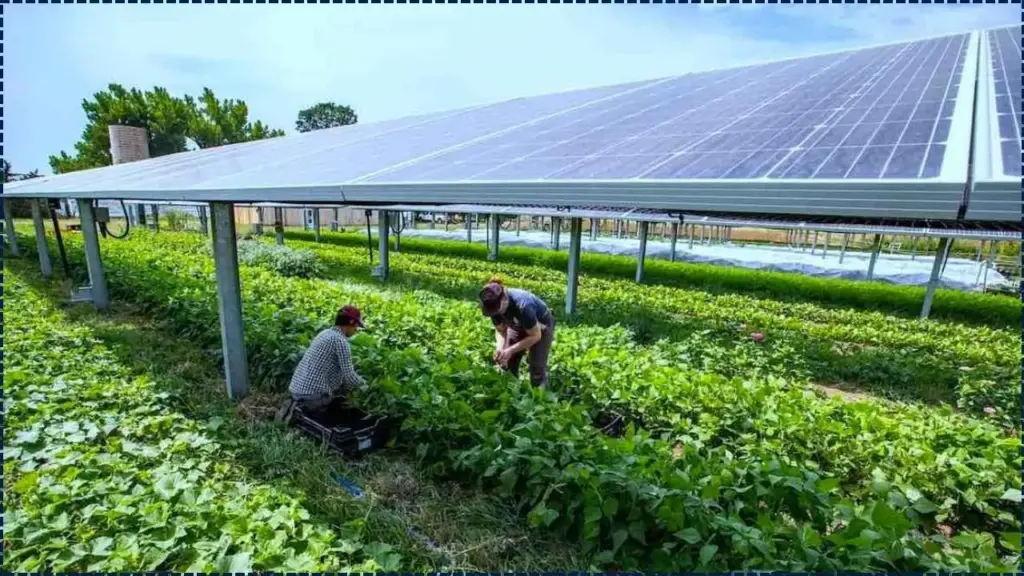
Researchers say the approach—sometimes called the Agri-Solar Miracle—can conserve water, stabilize yields, and significantly increase farm income by creating two sources of production from a single field.
The Agri-Solar Miracle
| Key Fact | Detail |
|---|---|
| Dual Land Use | Agrivoltaics allows land to produce crops and electricity simultaneously |
| Water Efficiency | Systems can increase water-use efficiency by 20–47% |
| Yield Benefits | Some crops show 20–60% yield increases under panels |
| Economic Gains | Farmers can generate revenue from both food production and solar electricity |
What Is Agrivoltaics?
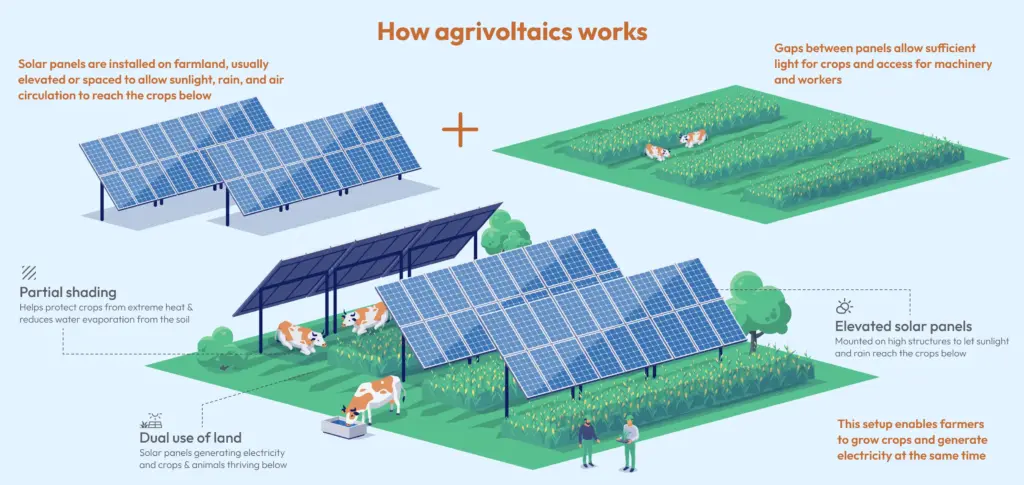
Agrivoltaics—also known as agri-solar—refers to systems where solar panels are installed above farmland so that crops or livestock can continue to occupy the land beneath them.
The approach attempts to address a growing tension between renewable energy expansion and farmland preservation. Large solar farms typically require substantial land areas, raising concerns that agricultural land could be lost to energy development.
Agrivoltaics offers a compromise by allowing both uses simultaneously. According to the U.S. National Renewable Energy Laboratory (NREL), these systems can support crop production, livestock grazing, or pollinator habitats while also generating electricity.
Researchers increasingly describe agrivoltaics as part of a broader “food-energy-water nexus,” where agriculture, renewable energy, and water conservation intersect.
Why Solar Panels Can Help Crops Grow
Although it may appear counterintuitive, growing crops under solar panels can create environmental conditions that benefit certain plants.
Microclimate Effects
Solar panels reduce direct sunlight and create partial shade, lowering soil and air temperatures beneath the arrays.
Studies have shown agrivoltaic installations can reduce local temperatures by 1 to 4 degrees Celsius, protecting crops from heat stress during extreme weather events. Greg Barron-Gafford, a professor at the University of Arizona who leads agrivoltaic research projects, has said that the panels create a beneficial microclimate.
“Plants beneath solar panels often experience less heat stress and improved water retention compared with crops grown in full sunlight,” Barron-Gafford explained in university research summaries.
Water Savings
Water conservation is one of the most significant advantages of agrivoltaics.Shade from the panels slows evaporation from the soil and reduces water loss through plant transpiration.
Research suggests agrivoltaic systems can improve water-use efficiency by 20–47 percent, meaning crops require less irrigation to produce the same yield. In regions facing increasing drought conditions, this improvement can translate into substantial cost savings for farmers and reduced pressure on water resources.
Protection from Extreme Weather
Solar arrays can also shield crops from harsh environmental conditions. Panels help buffer crops from intense sunlight, heavy rain, hail, and strong winds. These protective effects are especially valuable as climate change increases the frequency of extreme weather events.
Researchers say the shading effect can also reduce plant stress and stabilize growing conditions throughout the season.
Which Crops Grow Best Under Solar Panels?
Not all crops respond the same way to partial shade.
Shade-tolerant crops tend to perform best in agrivoltaic systems. Examples include:
- Leafy greens such as lettuce and spinach
- Tomatoes and peppers
- Certain herbs and vegetables
- Forage crops for livestock
Studies have found yield increases ranging from 20 percent to as much as 60 percent for some crops grown beneath solar arrays. Professor Joshua Pearce, an expert in sustainable energy systems at Western University, has noted that the improved microclimate can enhance plant productivity.
“The shading reduces heat stress and improves water retention, which can lead to better yields for certain crops,” Pearce said in research published on agrivoltaic systems.
However, crops that require intense sunlight—such as corn or wheat—may perform less well under heavily shaded arrays.
A New Revenue Model for Farmers
Agrivoltaics offers farmers something agriculture rarely provides: two revenue streams from the same land. Solar panels produce electricity that can be sold to utilities or used to power farm operations. At the same time, the fields continue to produce crops or livestock.
Researchers measure this productivity using the Land Equivalent Ratio (LER). When the LER exceeds 1.0, it means the combined solar-and-agriculture system produces more total value than separate land uses.
Many agrivoltaic farms report LER values above 1, meaning the dual-use system is more efficient than dedicating separate land areas to farming and solar energy.
Some economic analyses estimate agrivoltaic farms may increase land productivity by over 30 percent compared with traditional agricultural use alone.
Farmers Already Testing the System
United States
Agrivoltaic experiments in Arizona, Colorado, and Massachusetts have demonstrated promising results. In Arizona trials, researchers found crops grown beneath solar panels required less irrigation and maintained higher productivity during hot summer months.
Farmers participating in pilot programs reported that the systems also reduced soil evaporation and improved crop resilience during drought conditions.
Europe
Countries such as Germany, France, and Italy have launched agrivoltaic pilot projects supported by government policy.
Some European regulations require solar developers to maintain agricultural productivity when installing panels on farmland.
Asia
Japan has been a pioneer in agrivoltaics for more than a decade. Thousands of farms use elevated solar panels while continuing to grow vegetables or rice beneath them.
India and China are also expanding agrivoltaic programs as part of efforts to increase renewable energy production without sacrificing farmland.
Policy Support and Government Incentives
Government policies are increasingly encouraging agrivoltaic development. In the United States, federal renewable energy incentives and state programs support solar installations on farmland. Researchers say these policies could accelerate adoption of agrivoltaics.
In Europe, several countries have introduced regulatory frameworks that specifically promote agrivoltaic installations as part of climate and agricultural strategies.
Energy analysts say supportive policies are critical because agrivoltaic systems require specialized infrastructure and higher initial investment.
Environmental Benefits Beyond Water Savings
Agrivoltaics offers several environmental advantages.
Reduced Land-Use Conflict
Solar energy development often competes with agriculture for land. Agrivoltaics reduces that conflict by allowing both activities to occur simultaneously.
Improved Biodiversity
Some agrivoltaic farms support pollinator habitats beneath panels, encouraging bee populations and other beneficial insects.
Lower Carbon Emissions
By generating renewable electricity, agrivoltaic systems help reduce dependence on fossil fuels. Researchers say the combined environmental benefits make agrivoltaics a promising strategy for addressing climate change while protecting agricultural land.
Challenges Facing Agrivoltaic Expansion
Despite its potential, agrivoltaics is not without obstacles.
Higher Installation Costs
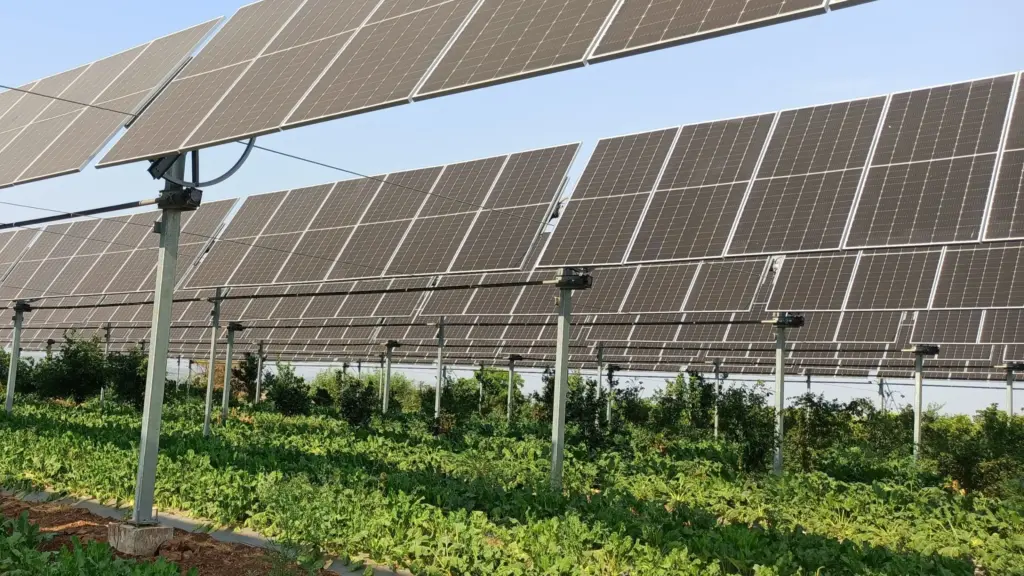
Agrivoltaic systems require taller structures and specialized designs so farm equipment can move beneath the panels. These engineering requirements make the systems more expensive than traditional solar farms.
Farming Logistics
Farmers must carefully plan irrigation systems, crop spacing, and equipment movement around solar infrastructure.
Limited Crop Compatibility
Some crops require full sunlight and may produce lower yields under shaded conditions. Researchers say continued experimentation will be necessary to identify the best crops and designs for different climates.
The Future of the Agri-Solar Miracle
Experts believe agrivoltaics could play a major role in future food and energy systems. Global demand for renewable electricity is rising rapidly, while farmland is increasingly under pressure from urban expansion and climate change.
By combining solar energy with agriculture, agrivoltaics offers a way to produce both food and power without expanding land use.
Energy policy researchers describe agrivoltaics as a potential “win-win solution” for food security, renewable energy development, and water conservation.
Related Links
Drive on Sunshine: The 2026 Guide to Bi-Directional Charging—Can Your EV Power Your Home for 3 Days?
The 10-Year Trap: Why Cheap “Tier-1” Solar Panels are Failing Homeowners in High-Heat Zones
Agrivoltaics is redefining the relationship between farming and energy production. By placing solar panels above crops, farmers can conserve water, protect plants from extreme heat, and generate renewable electricity.
If current research continues to confirm its benefits, the Agri-Solar Miracle may soon become a common sight across global farmland—delivering two harvests from the same land: food for people and power for the grid.
FAQs
What is agrivoltaics?
Agrivoltaics is a farming system where crops or livestock are grown beneath solar panels so land can produce both food and electricity.
Do crops grow well under solar panels?
Many crops perform well under partial shade, particularly leafy vegetables and forage crops.
How much water can agrivoltaics save?
Studies show agrivoltaic farms can improve water-use efficiency by 20–47 percent.
Why are farmers adopting agrivoltaics?
Farmers can earn income from both agricultural production and solar electricity generation while improving climate resilience.