

New federal grants for homeowners designed to encourage renewable energy adoption are making rooftop solar installations up to 40% cheaper in parts of the United States.
The incentives combine federal tax credits, state rebates, and financing programs created under recent climate legislation. Policymakers say the initiative aims to reduce household energy costs while accelerating the nation’s transition toward cleaner electricity sources.
New Federal Grants for Homeowners
| Key Fact | Detail |
|---|---|
| Federal Tax Credit | Up to 30% of solar installation cost eligible under the Residential Clean Energy Credit |
| Total Savings Potential | Combined incentives may reduce costs by roughly 40% |
| Climate Goal | Policy supports U.S. target of reducing emissions by 50–52% by 2030 |
| Average Installation Cost | $15,000–$25,000 before incentives |
Federal Incentives Drive a New Phase of Solar Adoption
The new federal grants for homeowners originate largely from policies included in the Inflation Reduction Act (IRA), a sweeping climate and economic law passed by Congress in 2022. A central element of the law is the Residential Clean Energy Credit, which allows homeowners to deduct 30% of the cost of installing solar panels and related technologies from their federal taxes.
According to the U.S. Department of Energy, the tax credit will remain at 30% until 2032, after which it is scheduled to gradually decrease unless Congress renews the program.
When combined with state rebates, local incentives, and utility programs, the overall cost reduction for some homeowners can approach 40% of the installation price. “Residential solar plays a critical role in the clean energy transition,” the Department of Energy said in official guidance on the incentive program.
Historical Context: Decades of U.S. Solar Incentives
Federal support for rooftop solar is not new. The first major national incentive, known as the Investment Tax Credit (ITC), was introduced in 2006. Initially set at 30%, the credit helped jump-start the U.S. solar industry by lowering installation costs and encouraging private investment.
According to the Solar Energy Industries Association (SEIA), U.S. solar capacity has grown more than 200-fold since the program began. Industry analysts say the extension of the credit under the Inflation Reduction Act provides long-term policy certainty, which is essential for large-scale energy investments.
“The stability of federal incentives has been one of the main drivers of solar growth in the United States,” said Abigail Ross Hopper, president of the Solar Energy Industries Association.
The Economics of Residential Solar
Solar power has become significantly more affordable over the past decade as manufacturing efficiencies improved and global demand increased. The National Renewable Energy Laboratory (NREL) reports that the average cost of residential solar systems has fallen by more than 60% since 2010.
Today, the typical home solar installation in the United States costs between $15,000 and $25,000 before incentives. With federal tax credits and additional incentives applied, homeowners may reduce that cost by several thousand dollars.
Energy economists say the long-term financial benefits can extend beyond installation savings. “Many households see substantial reductions in their electricity bills once solar panels are installed,” said Dr. Emily Carter, an energy policy expert at Princeton University.
In regions with high electricity prices, homeowners can recover the cost of their solar system within eight to twelve years, according to NREL estimates.
How the Incentives Work in Practice
Although often described as “federal grants,” most incentives are structured as tax credits. Homeowners who install eligible solar systems can claim the credit when filing their annual federal tax returns.
Eligible costs include:
- Solar photovoltaic panels
- Solar water heating equipment
- Battery storage systems
- Installation and labor costs
The credit has no maximum limit, allowing homeowners to claim the full percentage regardless of system size. Several states also provide additional support programs. For example:
- California offers incentives tied to battery storage adoption.
- New York provides rebates through the NY-Sun program.
- Massachusetts supports solar installations through the SMART program.
Case Study: A Homeowner’s Experience
For many households, federal incentives have made solar installations financially feasible for the first time. David Martinez, a homeowner in Phoenix, Arizona, installed rooftop solar panels in 2024.
The system cost approximately $20,000 before incentives. After claiming federal and state credits, the final cost dropped to about $13,000. “Our electricity bills were climbing every year,” Martinez said. “With the incentives available, installing solar finally made economic sense.”

Martinez estimates that his household electricity costs have declined by nearly 60% since installing the system.
Broader Economic Impact
The growth of residential solar is also influencing the U.S. labor market. The Solar Foundation, a nonprofit research organization, estimates that the solar industry employs more than 250,000 workers nationwide.
Many of those jobs involve installation, manufacturing, engineering, and system maintenance. Economists say federal incentives are helping expand this workforce while stimulating investment in domestic clean-energy manufacturing.
“The renewable energy transition is creating new employment opportunities across the country,” said Michelle Davis, a solar analyst at energy research firm Wood Mackenzie.
Environmental Benefits and Climate Goals
The expansion of residential solar energy is also linked to broader climate policy objectives. The United States has pledged to reduce greenhouse gas emissions by 50–52% below 2005 levels by 2030, according to the White House climate strategy.
Electricity generation remains one of the largest contributors to U.S. emissions. Increasing renewable energy production is considered essential for meeting climate targets.
The Environmental Protection Agency (EPA) estimates that a typical residential solar system can prevent three to four metric tons of carbon dioxide emissions each year. That reduction is roughly equivalent to the emissions produced by driving a gasoline car for more than 8,000 miles annually.
Concerns Over Cost and Accessibility
Despite widespread support for renewable energy incentives, critics argue that tax-based programs may benefit higher-income households more than low-income families.
“The upfront investment required for solar installations can still be a barrier,” said Mark Wolfe, executive director of the National Energy Assistance Directors Association. Some policy experts suggest expanding grant programs specifically targeted at low-income households to ensure equitable access to renewable energy.
Others question the long-term fiscal cost of subsidies.
The Congressional Budget Office has warned that federal energy tax credits could reduce government revenue by billions of dollars over the coming decade.
Grid Reliability and Infrastructure Challenges
As rooftop solar adoption increases, utilities must adapt the national electricity grid to accommodate decentralized power generation. Unlike traditional power plants, solar panels produce electricity intermittently depending on sunlight conditions.

Grid operators are investing in advanced forecasting tools, battery storage systems, and smart grid technologies to maintain reliability.
The Department of Energy estimates that rooftop solar could supply up to 40% of U.S. electricity demand by 2035 if adoption continues to accelerate.
Future Outlook for Residential Solar
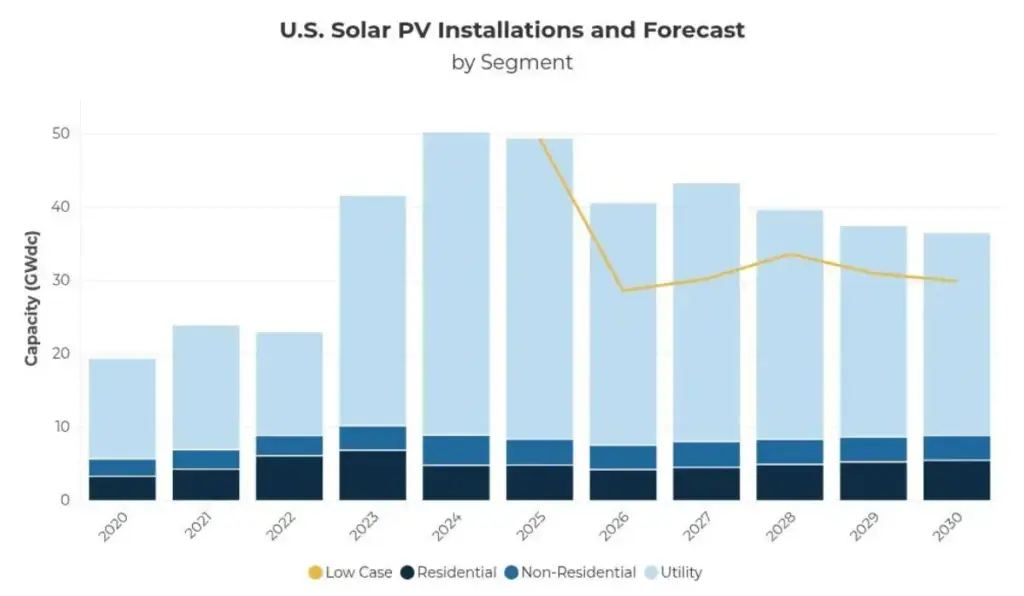
Energy analysts expect solar adoption to grow significantly during the next decade. The International Energy Agency (IEA) predicts global solar capacity will triple by 2030 as countries pursue clean energy strategies.
In the United States, rising electricity prices, improved technology, and stable policy incentives are expected to sustain strong demand for residential solar installations.
“Solar energy has moved from niche technology to mainstream energy infrastructure,” said Jenny Chase, a solar analyst at BloombergNEF.
Related Links
Elsewedy Electric Completes 348.6 MW El Saad Solar Plant in Riyadh
Zelestra Breaks Ground on 441 MW Solar Projects in Texas, Backed by Meta
Federal incentives are reshaping the economics of residential solar power in the United States. By lowering installation costs and encouraging private investment, policymakers hope to accelerate the transition to cleaner electricity. As solar technology improves and energy prices rise, analysts say rooftop solar may become an increasingly common feature of American homes.
FAQs
What are the new federal grants for homeowners?
They refer mainly to federal incentives such as the Residential Clean Energy Credit that reduce the cost of installing solar energy systems.
How much can homeowners save?
Federal incentives can cover about 30% of installation costs, with total savings reaching around 40% when combined with state programs.
Who qualifies?
Homeowners who install eligible solar systems on their primary or secondary residence in the United States may qualify.
How long will the incentives last?
The full 30% federal tax credit is currently scheduled to remain available through 2032.