India’s ALMM Mandate 2026 will require all eligible solar projects to use photovoltaic modules built entirely with domestically manufactured cells starting June 1, marking a major policy shift aimed at reducing import dependence, boosting local manufacturing, and strengthening energy security as the country rapidly expands its renewable capacity.

India’s ALMM Mandate 2026
| Key Fact | Detail |
|---|---|
| Implementation date | June 1, 2026 |
| Core rule | Modules must use domestic ALMM-listed cells |
| Strategic aim | Reduce imports, boost local industry |
| Long-term goal | Full solar supply chain localization |
ALMM Mandate 2026 Explained
From Modules to Cells: A Structural Policy Shift
India’s ALMM framework, introduced in 2019, initially ensured that only approved solar modules could be used in government-backed projects. The ALMM Mandate 2026 expands this requirement to include solar cells, effectively closing a major gap in domestic sourcing.
The Ministry of New and Renewable Energy said the expansion aims to “build a resilient and self-reliant solar manufacturing ecosystem.”
How the Compliance System Works
- List-I: Approved solar module manufacturers.
- List-II: Approved solar cell manufacturers.
Under the new mandate:
- Modules must come from List-I
- Cells inside those modules must come from List-II
This ensures complete domestic sourcing for critical components.
Historical Context: How India Reached This Point
A Decade of Solar Expansion
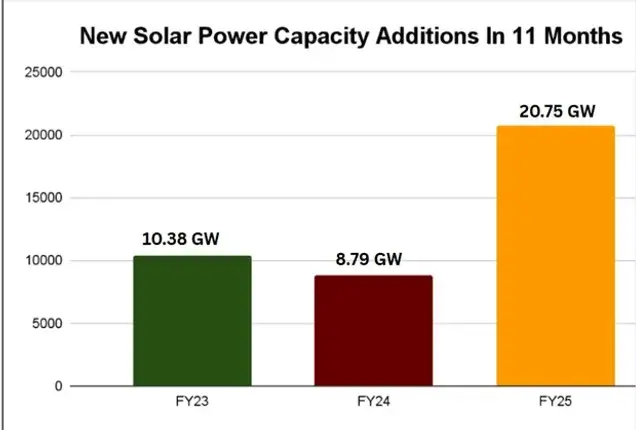
India’s solar policy evolution reflects rapid growth:
- 2014–2017: Solar capacity expansion begins under national missions
- 2018–2022: Heavy reliance on imported solar cells and modules
- 2019: ALMM introduced for modules
- 2021–2024: Production Linked Incentive (PLI) schemes launched
- 2026: Full domestic cell mandate enforced
This progression highlights a shift from deployment-first strategy to manufacturing-first strategy.
Why the ALMM Mandate 2026 Was Introduced
Import Dependence and Strategic Risks
India has historically depended on imports—especially from China—for over 70–80% of its solar cells. This created vulnerabilities in pricing, supply disruptions, and geopolitical risks. The mandate addresses these concerns by ensuring domestic production capacity.
Boosting Manufacturing Through Policy + Incentives
The ALMM mandate works alongside India’s Production Linked Incentive (PLI) scheme, which provides financial support to manufacturers building integrated solar facilities.
Together, these policies aim to:
- Increase domestic capacity.
- Improve technological capabilities.
- Reduce long-term costs.
Industry Impact: A Mixed Outlook
Winners: Domestic Manufacturers and MSMEs
Indian solar manufacturers are expected to benefit the most. The policy creates guaranteed demand for locally produced cells.
It also supports:
- Small and medium enterprises (MSMEs).
- Ancillary industries (glass, EVA sheets, frames).
- Job creation across manufacturing hubs.
Industry estimates suggest tens of thousands of jobs could be created over the next decade.
Case Study: A Solar Developer’s Perspective
A mid-sized solar developer operating in western India said the mandate would require “reworking procurement strategies entirely.”
The developer noted:
- Limited supplier options initially
- Higher upfront costs
- Need for long-term contracts with domestic manufacturers
However, the firm also acknowledged that “greater supply stability” could benefit projects in the long run.
Challenges: Supply Gap and Cost Pressure
India’s current solar cell production capacity still lags demand. Analysts warn that:
- Demand may exceed supply in early years.
- Project timelines could be delayed.
- Tariffs may increase temporarily.
Financial and Banking Implications
Impact on Project Financing
Banks and financial institutions are closely monitoring the transition. Higher capital costs may affect project viability in the short term. However, lenders may also view domestically sourced supply chains as:

- Less risky.
- More stable.
- Better aligned with government policy.
This could improve long-term financing conditions.
Global Context and Trade Implications
Part of a Broader Global Shift
India’s move reflects a wider global trend toward localized supply chains.
- The United States is incentivizing domestic manufacturing.
- The European Union is pushing for strategic autonomy.
- China continues to dominate global production.
The World Economic Forum has emphasized that supply chain resilience is becoming central to energy policy.
Trade and WTO Considerations
Localization policies can raise concerns under global trade rules. Some analysts suggest that strict domestic requirements could face scrutiny under international trade frameworks.
However, governments often justify such measures on national security and sustainability grounds.
Risks and Criticism
Risk of Overprotectionism
While the mandate supports domestic industry, critics warn that excessive protection could reduce competitiveness.
“If domestic manufacturers are not exposed to global competition, innovation could slow,” said a trade policy expert.
Execution Challenges
Key risks include:
- Delays in capacity expansion
- Quality control issues
- Policy uncertainty
Effective implementation will be critical to success.
Future Outlook: Toward Full Solar Supply Chain Independence
Beyond Cells: Wafers and Ingots
India is expected to extend localization requirements to upstream components such as wafers and ingots by the late 2020s. This would create a fully integrated domestic solar manufacturing ecosystem.
Long-Term Market Transformation
Experts believe the ALMM Mandate 2026 could:
- Strengthen India’s position as a global solar hub
- Reduce long-term costs through scale
- Improve resilience against global disruptions
Related Links
Electrolyzer Boom 2026: The Missing Link Between Solar Panels and Clean Heavy Transport
Second-Life Batteries: Giving Old EV Batteries a New Job in Home Solar Storage Systems
India’s ALMM Mandate 2026 marks a decisive shift from rapid solar deployment to strategic manufacturing self-reliance. While short-term challenges remain, the policy is expected to reshape the country’s renewable energy ecosystem and position India as a key player in the global solar supply chain.
FAQs
What is the ALMM Mandate 2026?
A policy requiring solar projects to use modules built with domestically manufactured cells.
Who must comply?
Government-backed, net-metering, and open-access solar projects.
Why is this important?
It reduces import dependence and strengthens domestic manufacturing.
Will it increase costs?
Short-term costs may rise, but long-term benefits are expected.